Fiona fallout: Losses being tallied as hundreds of soldiers arrive for cleanup duty

Advertisement

Advertise with us

STANLEY BRIDGE, P.E.I. - Phyllis Carr's voice broke with emotion as she surveyed damage to the historic town of Stanley Bridge, a small community on the north shore of Prince Edward Island.

Read this article for free:


By clicking the button above, an account will be created and you will begin to receive some of our recommended newsletters. You may opt out of any newsletter by visiting your Email and Communication Preferences page or by clicking "unsubscribe" at the bottom of any email.

or

Already have an account? Log in here »

To continue reading, please subscribe:

Digital Subscription

One year of digital access for only $1.44 a week*

  • Enjoy unlimited reading on winnipegfreepress.com
  • Read the E-Edition, our digital replica newspaper
  • Access News Break, our award-winning app
  • Play interactive puzzles

*Billed as $5.77 plus GST every four weeks. After 52 weeks, price increases to the regular rate of $19.95 plus GST every four weeks. Offer available to new and qualified returning subscribers only. Cancel any time.

To continue reading, please subscribe:

Add Free Press access to your Brandon Sun subscription for only an additional

$1 for the first 4 weeks*

  • Enjoy unlimited reading on winnipegfreepress.com
  • Read the E-Edition, our digital replica newspaper
  • Access News Break, our award-winning app
  • Play interactive puzzles
Start now

*Your next Brandon Sun subscription payment will increase by $1.00 and you will be charged $17.95 plus GST for four weeks. After four weeks, your payment will increase to $24.95 plus GST every four weeks.

Hey there, time traveller!
This article was published 26/09/2022 (1497 days ago), so information in it may no longer be current.

STANLEY BRIDGE, P.E.I. – Phyllis Carr’s voice broke with emotion as she surveyed damage to the historic town of Stanley Bridge, a small community on the north shore of Prince Edward Island.

“It’s very sad for those of us who lived here all of our lives and our parents lived here,” she said, taking in a scene that has become all too familiar in towns and villages across Atlantic Canada battered and drenched by post-tropical storm Fiona.

“Our life is going to change now around our harbour, and our marina and our fishing community and our fishermen.”

By the time Fiona left Stanley Bridge on Saturday, the main road was washed out, debris was strewn everywhere and the town’s prospects had suddenly dimmed, mainly because of damage to fishing boats that were picked up by a storm surge and dropped in the middle of the road.

Across the Maritimes, eastern Quebec and in southwestern Newfoundland, the economic impact of the storm’s wrath is still being tallied.

And electricity has yet to be restored to about 250,000 homes and businesses in Atlantic Canada. At the height of the storm on Saturday, more than 500,000 were in the dark, including 80 per cent of Nova Scotia Power’s customers and 90 per cent of P.E.I.

Even as crews worked around the clock to repair downed lines, some utility companies warned it could be several days before the power is back on for everyone.

“We’ve been able to start getting a better look at some of those hardest-hit areas with drones and helicopters and it is reinforcing how widespread the damage is,” Matt Drover, a spokesman for Nova Scotia Power, said in a statement Monday.

Drover said the utility is having to deal with thousands of trees on power lines, hundreds of broken or leaning poles and streets blocked by debris. He said the company has dispatched more than 1,000 technicians to the field, including crews from New Brunswick, Quebec, Ontario and New England.

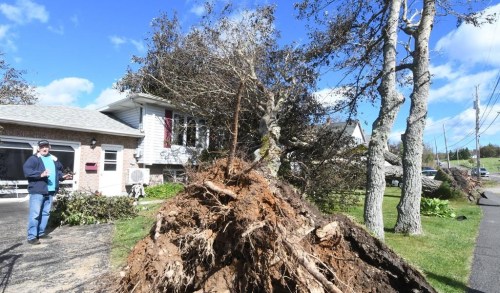
Homeowner George MacDonald describes the moment when several trees landed on his home in Glace Bay, Nova Scotia on Sunday September 25, 2022. A day after post-tropical storm Fiona left a trail of destruction through Atlantic Canada and eastern Quebec, residents of a coastal town in western Newfoundland continued to pick through wreckage strewn across their community, easily the most damaged area in the region. THE CANADIAN PRESS/Vaughan Merchant

Police in Nova Scotia said Monday that a man missing since Friday is believed to have been swept out to sea during the storm. Halifax district RCMP said 81-year-old Larry Smith of Lower Prospect, N.S., was last seen Friday evening, and an exhaustive search turned up no trace of him.

Search efforts were called off “based on the belief Mr. Smith entered the water,” the RCMP said in a statement.

On Sunday, RCMP in western Newfoundland confirmed that the body of a 73-year-old woman from Port aux Basques had been recovered after a record-breaking storm surge flooded her home and swept her out to sea. Her name was not released. The cause of death in another possible Fiona-related fatality in P.E.I. has yet to be determined, but the province’s acting director of public safety said Sunday preliminary findings pointed toward “generator use.”

Prime Minister Justin Trudeau expressed his condolences to the woman’s family during a media briefing in Ottawa. He said he plans to visit the region this week.

During the briefing, Newfoundland MP Gudie Hutchings told the prime minister that the gut-wrenching photos from Port aux Basques do not convey the level of devastation. She said at least 76 homes in the town of 4,000 had either been destroyed or structurally damaged.

“Newfoundlanders and Labradorians are resilient people, but I can tell you this has tested each and every one of us,” she said via video link from Port aux Basques. “(But) everyone is coming together to help these folks in need.”

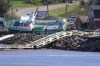
A lobster boat grounded on the rocks at the wharf in Stanley Bridge, P.E.I. on Sunday September 25, 2022. After hammering Atlantic Canada, post-tropical storm Fiona has moved inland in southeastern Quebec, with Environment Canada saying the storm will continue to weaken as it tracks across southeastern Labrador and over the Labrador Sea. THE CANADIAN PRESS/Brian McInnis

Rene Roy, editor of the town’s weekly newspaper, said the community remains in shock.

“There’s a lot of absolute uncertainty and shocked faces,” the editor of the Wreckhouse Press said in an interview Monday. “Normally when you walk around this town … people give you a nod, a smile or a wave. Today and yesterday, it’s just a shake of the head and click of the tongue.”

The southwestern corner of Newfoundland is used to major storms, Roy said, but Fiona’s lashing was unlike anything the community had ever seen.

“For the first time ever, everyone in town feared for their own life,” he said. “Now, we have 200 people without a place to stay.”

Earlier in the day, Defence Minister Anita Anand confirmed that HMCS Margaret Brooke, one of the military’s new Arctic patrol ships, will be conducting wellness checks in small communities along the southern shore of Newfoundland.

Meanwhile, members of the Canadian Armed Forces are being deployed to help with the cleanup. Anand confirmed Sunday that Newfoundland, Nova Scotia and P.E.I. would each be getting about 100 soldiers, with some already in place.

In this photo provided by Wreckhouse Press a home fights against high winds caused by post Tropical Storm Fiona in Port aux Basques, Newfoundland and Labrador, Saturday, Sept. 24, 2022. The home has since been lost at sea. (Rene Roy/Wreckhouse Press via AP)

Asked whether 100 soldiers per province was enough considering the scale of the devastation, Trudeau said: “If they need more, we will send more.”

The prime minister was also asked about past promises to improve the resilience of telecommunications infrastructure after cellphone service was severely affected by post-tropical storm Dorian in 2019. Trudeau said the government worked with providers before Fiona hit, but the storm exceeded even the direst predictions.

“We have learned lessons since Dorian and implemented them,” he said. “There will be more to learn on how we keep people protected, given that extreme weather events are going to get, unfortunately, more likely in the coming years.”

In Sydney, Cape Breton’s largest city, dozens of people — many of them international students or workers from Asia — have sought temporary shelter at the Membertou First Nation’s trade and convention centre.

Most of them were forced to flee an apartment building that started leaking when Fiona unleashed heavy downpours and tore at the building’s roof.

“Suddenly, emergency teams told us to evacuate the building,” said Deepchand Kumar Medalodan, a 30-year-old hospital worker who attended Cape Breton University. “We just grabbed essentials like passports and wallets.”

Some of the damage in Port aux Basques, Newfoundland and Labrador, caused by post tropical storm Fionais shown in this handout photo provided by Wreckhouse Press on Saturday, September 24, 2022. THE CANADIAN PRESS/HO-Wreckhouse Press-Rosalyn Roy

Medalodan said finding a new place to live will be tough. “There are a lot of students coming here and there aren’t apartments here.”

This report by The Canadian Press was first published Sept. 26, 2022.

— With files from Michael MacDonald and Lyndsay Armstrong in Halifax, Michael Tutton in Sydney, N.S., Lee Berthiaume in Ottawa and Morgan Lowrie in Montreal.

Report Error Submit a Tip

More Stories

Winnipeg novelist's latest offering a riveting fictional account of missionaries' plight

Reviewed by Julienne Isaacs 5 minute read Preview

Winnipeg novelist's latest offering a riveting fictional account of missionaries' plight

Reviewed by Julienne Isaacs 5 minute read Saturday, Sep. 7, 2019

In 1955, five American missionary couples set out to evangelize the Waorani, an Indigenous people group of the Ecuadorian rainforest that had never had contact with the outside world. They dubbed their mission “Operation Auca.”

After a few months of airdropping gifts, the five men — Jim Elliot, Peter Fleming, Nate Saint, Ed McCully and Roger Youderian — opted to set up camp on a beach near a Waorani settlement. Just a few days later, they were all speared to death. Thanks to the swift arrival of a Life magazine photographer, the brutal conclusion to Operation Auca became global news.

In her new novel, Five Wives, Winnipeg writer Joan Thomas tells this story again.

“In the missionaries’ memoirs, ‘God’s leading’ explains almost every impulse,” Thomas writes in a postscript. “I set out to peer behind that, to explore in human terms actions that astonished me.”

Read
Saturday, Sep. 7, 2019

SNC planned U.S. move if no deal: documents

Jordan Press and Christopher Reynolds, The Canadian Press 5 minute read Preview

SNC planned U.S. move if no deal: documents

Jordan Press and Christopher Reynolds, The Canadian Press 5 minute read Thursday, Mar. 28, 2019

OTTAWA - SNC-Lavalin warned federal prosecutors last fall about a possible plan to split the company in two, move its offices to the United States and eliminate its Canadian workforce if it didn't get a deal to avoid criminal prosecution, newly obtained documents show.

The documents, part of a PowerPoint presentation obtained by The Canadian Press, describe something called "Plan B" — what Montreal-based SNC might have to do if it can't convince the government to grant a so-called remediation agreement to avoid criminal proceedings in a fraud and corruption case related to projects in Libya.

Under that plan, SNC would move its Montreal headquarters and corporate offices in Ontario and Quebec to the U.S. within a year, cutting its workforce to just 3,500 from 8,717, before eventually winding up its Canadian operations.

“The government of Canada needs to weigh the public interest impact of the prosecution of SNC-Lavalin," the presentation reads.

Read
Thursday, Mar. 28, 2019

Fiona fallout: Losses being tallied as hundreds of soldiers arrive for cleanup duty

Hina Alam, The Canadian Press 7 minute read Preview

Fiona fallout: Losses being tallied as hundreds of soldiers arrive for cleanup duty

Hina Alam, The Canadian Press 7 minute read Monday, Sep. 26, 2022

STANLEY BRIDGE, P.E.I. - Phyllis Carr's voice broke with emotion as she surveyed damage to the historic town of Stanley Bridge, a small community on the north shore of Prince Edward Island.

"It's very sad for those of us who lived here all of our lives and our parents lived here," she said, taking in a scene that has become all too familiar in towns and villages across Atlantic Canada battered and drenched by post-tropical storm Fiona.

"Our life is going to change now around our harbour, and our marina and our fishing community and our fishermen."

By the time Fiona left Stanley Bridge on Saturday, the main road was washed out, debris was strewn everywhere and the town's prospects had suddenly dimmed, mainly because of damage to fishing boats that were picked up by a storm surge and dropped in the middle of the road.

Read
Monday, Sep. 26, 2022

Taxi and ride-hailing services receive 58 complaints since March

Jessica Botelho-Urbanski 5 minute read Preview

Taxi and ride-hailing services receive 58 complaints since March

Jessica Botelho-Urbanski 5 minute read Friday, Aug. 17, 2018

The City of Winnipeg has fielded 58 formal complaints about vehicle-for-hire operations since taking over industry oversight from the province in March.

According to freedom of information request results, the city mostly received complaints about taxi operations, and the two largest companies – Duffy’s Taxi and Unicity Taxi – were the main culprits.

From March 1, 2018 to July 13, 2018, the Winnipeg Parking Authority received 20 complaints about Duffy’s, mostly to do with driver road habits (five complaints), driver conduct (three), service refusal (three) or poor service (three), among other issues.

During the same period, Unicity had 19 complaints, five of them related to poor service and three about driver conduct, plus other misdeeds.

Read
Friday, Aug. 17, 2018

Brandon manufacturer says Canadian steel in demand, but high costs, long delivery times hit hard

Gabrielle Piché 6 minute read Preview

Brandon manufacturer says Canadian steel in demand, but high costs, long delivery times hit hard

Gabrielle Piché 6 minute read Yesterday at 2:01 AM CDT

Something’s different in a Brandon plant.

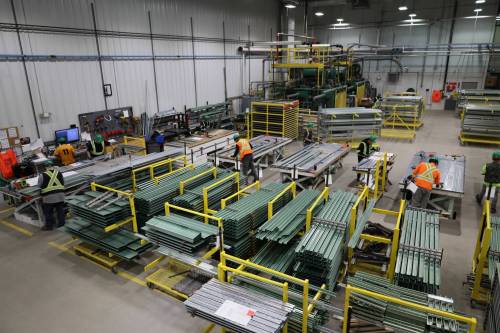
Building envelope panels — or shells for homes and commercial buildings — keep being produced at Greenstone Building Products.

But the galvanized steel used by workers has been arriving later and the price is constantly increasing, according to company leadership.

“It’s just a little bit nerve-wracking for us to hear the opposite narrative,” said Tilda Fortier, Greenstone Building Products’ business manager.

Read
Yesterday at 2:01 AM CDT

Imperialist crusades: 21st-century style

John R. Wiens 5 minute read Preview

Imperialist crusades: 21st-century style

John R. Wiens 5 minute read Wednesday, Jul. 8, 2026

In the 11th century and lasting into the 13th, the papacy launched a series of at least eight military campaigns we now refer to as the Crusades, or Holy Wars. They were an imperialistic call to arms for Christians to retake Jerusalem, which was at the time under Muslim rule.

Spiritual rewards for participation were implied, and other incentives offered, to dull the extra taxation demanded to fund the campaigns. Over time, the “crusades” morphed to become massacres of not only Muslims but also Jews and Christian dissidents — in other words, any enemies of the papacy. If today’s news sounds like déjà vu all over again, it probably should.

The stories keep repeating themselves in many forms. We now know that two 20th century world wars, global in scope, were caused by imperialistic ambitions, changes in the balance of international powers and corresponding arms races. The first was attributed to the assassination of the heir to the Austro-Hungarian throne by a Bosnian Serb, a kind of “regime change” initiative. The second resulted from rising tensions between Allied and Axis powers, triggered by the rise of European fascism and Japanese militarism. The human toll of both was unimaginable.

In the First World War, 15 to 22 million people, including soldiers and civilians, were killed and another 23 million were wounded. These numbers do not account for those otherwise affected — victims of chemical warfare whose compromised health shortened their lives; of the subsequent Spanish flu epidemic amplified by the displacement of peoples; others who died from other diseases caused by war conditions; and those who were malnourished or starved. Nor do they account for the ongoing trauma and resentments passed on intergenerationally to this day.

Read
Wednesday, Jul. 8, 2026