As gas prices spike, Montreal’s bike culture seen as model for rest of the country
Advertisement
Read this article for free:
or
Already have an account? Log in here »
To continue reading, please subscribe:
Digital Subscription
One year of digital access for only $1.44 a week*
- Enjoy unlimited reading on winnipegfreepress.com
- Read the E-Edition, our digital replica newspaper
- Access News Break, our award-winning app
- Play interactive puzzles
*Billed as $5.77 plus GST every four weeks. After 52 weeks, price increases to the regular rate of $19.95 plus GST every four weeks. Offer available to new and qualified returning subscribers only. Cancel any time.
To continue reading, please subscribe:
Add Free Press access to your Brandon Sun subscription for only an additional
$1 for the first 4 weeks*
- Enjoy unlimited reading on winnipegfreepress.com
- Read the E-Edition, our digital replica newspaper
- Access News Break, our award-winning app
- Play interactive puzzles
*Your next Brandon Sun subscription payment will increase by $1.00 and you will be charged $17.95 plus GST for four weeks. After four weeks, your payment will increase to $24.95 plus GST every four weeks.
Read unlimited articles for free today:
or
Already have an account? Log in here »
Hey there, time traveller!
This article was published 04/06/2022 (1611 days ago), so information in it may no longer be current.
Montrealer Olivia Collette sold her car in 2016 and hasn’t looked back.
Collette, a communications consultant living in central Montreal, said getting around using a bicycle, a car-sharing service or a transit pass has not only saved her money, it’s often more enjoyable.
“When it’s sunny and warm, it’s really pleasant,” Collette said of her bicycle commutes. “It’s a really pleasant way of going from A to B.”
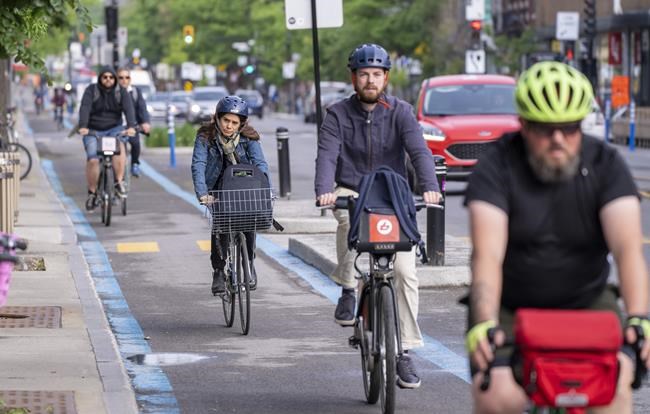
Collette said that while getting around Montreal isn’t difficult without a personal vehicle, she’s not sure doing so would be as easy in many other Canadian cities. And with the soaring cost of gasoline and new vehicles, urban transit experts say the rest of Canada should look to Montreal for lessons on how to boost cycling culture.
Stein van Oosteren, spokesperson for a Paris-based cycling association, says the time is right for Canadian cities to make big gains in changing the way people move around.
Van Oosteren, who grew up in the Netherlands before moving to France, said the rise of cycling in both countries was partially driven by high gas prices.
At the beginning of the 1970s, “the Netherlands was like Canada today: a car-centric country, where the car was the foundation of transport, and it was very unpleasant and dangerous to travel by bicycle,” said van Oosteren, who was in Montreal this week to speak at the Go vélo bicycle festival.
That began to change due to a campaign for safer streets, launched in response to the death of a six-year-old girl who was struck by a car and to gas shortages triggered by the 1973 oil crisis.
“The government, under pressure from both citizens who wanted livable cities and the real problem of gas shortages that we had in the Netherlands, decided to promote bikes,” he said.
In France, bicycles began to gain popularity in 2018, when a tax increase pushed the price of gas to nearly $3 a litre, he said. In Paris, meanwhile, that growth continued as the local government rapidly created temporary bike paths in 2020 to encourage people to enjoy the outdoors at the start of the COVID-19 pandemic, he said. Many of those paths have become permanent.
“This created a whole generation of cyclists who today travel by bike, and once this critical mass exists, it will attract others,” van Oosteren said.
Montreal, he said, is a cycling leader in North America — particularly due to the city’s focus on building a contiguous network of bike lanes that are protected from the rest of the street. The protected lanes attract a wide range of users because the infrastructure increases cyclists’ sense of safety.
In North America, the majority of bike trips are taken by men who are experienced cyclists, said Owen Waygood, a professor of transportation engineering at Polytechnique Montréal. Safer infrastructure, he said, will attract more women, older people and children.
“Montreal does have some great leadership in that respect,” he said.
Bike counters — automated sensors that detect and count passing cyclists — indicate an increase in users on new routes that are part of the city’s “express” bike lane network, the Réseau express vélo, Waygood said. The city began building the REV in 2020.
Around 2,000 cyclists a day, he said, use a recently constructed bike lane on St-Denis Street, a major artery in Montreal’s urban core. “There’s some days when it’s 8,000, which is impressive.”
But hard data can be difficult to come by. The provincial government conducts a travel survey every five years, but Waygood said that survey captures a limited snapshot and is usually done in the fall season — when there are fewer cyclists compared with the spring and summer.There’s no Canada-wide survey that would allow comparisons between different cities, he added.
Statistics Canada collects data about Canadians’ daily commutes, but the most recent public data from the federal statistics agency is from 2016. It indicates that Vancouver and Victoria have higher rates of cycling than Montreal does, which Waygood said makes sense given the milder year-round weather.
Ry Shissler, the communications manager for Cycle Toronto, a charity that promotes cycling culture, said the organization ranks Victoria, Vancouver and Montreal higher than Toronto at encouraging cycling. While Toronto is flatter than Montreal and has somewhat warmer weather, Shissler said Montreal has built better biking infrastructure.
“We just don’t have the same sort of network that makes people feel comfortable riding a bike,” Shissler said.
Toronto, however, keeps its bike-sharing system operational year-round, while Montreal packs up its bike system — called BIXI — for the winter.
Stephen Miller, spokesman with Transit, a trip-planning mobile application for public transit, said people are able to get around Montreal without a car in large part because of the city’s high-quality public transit network.
Transportation projects that have launched in Montreal have been exported internationally, he said, like car-sharing service Communauto, which can be found across Canada and in France. The technology used in the BIXI system, originally developed by a company owned by the City of Montreal, has since has been exported to cities around the world, including Toronto, New York City and London.

“Montreal benefits from having a culture that is focused on innovation in transit and public transportation,” Miller said.
Collette, who said she sometimes goes months without driving a car, said there’s now a rush hour on Montreal’s bike lanes, but she said it’s much less stressful than being stuck in traffic.
“If I had a car, I would have to pay for parking; I would have to move it all the time; I would still be paying to have the car even if I wasn’t using it,” she said.
This report by The Canadian Press was first published June 4, 2022.
Note to readers: This is a corrected story. A previous version misgendered Ry Shissler, whose pronouns are they/them.
Related Articles
Connecting bike lanes priority for political newbie
Advertisement Advertise With Us
Advertisement Advertise With Us