Budget 2022: Ottawa unveils $2.6B carbon capture tax credit for energy sector

Advertisement

Advertise with us

CALGARY - Ottawa is urging oil and gas companies to move quickly to take advantage of a major new tax credit for carbon capture and storage — a pricey technology that proponents say could play an important role in reducing this country's greenhouse gas emissions.

Read this article for free:


By clicking the button above, an account will be created and you will begin to receive some of our recommended newsletters. You may opt out of any newsletter by visiting your Email and Communication Preferences page or by clicking "unsubscribe" at the bottom of any email.

or

Already have an account? Log in here »

To continue reading, please subscribe:

Digital Subscription

One year of digital access for only $1.44 a week*

  • Enjoy unlimited reading on winnipegfreepress.com
  • Read the E-Edition, our digital replica newspaper
  • Access News Break, our award-winning app
  • Play interactive puzzles

*Billed as $5.77 plus GST every four weeks. After 52 weeks, price increases to the regular rate of $19.95 plus GST every four weeks. Offer available to new and qualified returning subscribers only. Cancel any time.

To continue reading, please subscribe:

Add Free Press access to your Brandon Sun subscription for only an additional

$1 for the first 4 weeks*

  • Enjoy unlimited reading on winnipegfreepress.com
  • Read the E-Edition, our digital replica newspaper
  • Access News Break, our award-winning app
  • Play interactive puzzles
Start now

*Your next Brandon Sun subscription payment will increase by $1.00 and you will be charged $17.95 plus GST for four weeks. After four weeks, your payment will increase to $24.95 plus GST every four weeks.

Hey there, time traveller!
This article was published 07/04/2022 (1667 days ago), so information in it may no longer be current.

CALGARY – Ottawa is urging oil and gas companies to move quickly to take advantage of a major new tax credit for carbon capture and storage — a pricey technology that proponents say could play an important role in reducing this country’s greenhouse gas emissions.

In the federal budget announced Thursday, the Liberal government said it will allocate $2.6 billion over five years to a tax credit for companies investing in projects that employ the technology, which traps greenhouse gas emissions from industrial sources and stores them deep in the ground to prevent them from being released into the atmosphere.

Starting in 2022, companies will be able to claim a tax credit of up to 60 per cent for direct air capture projects and 50 per cent for all other eligible carbon capture projects. A 37.5 per cent tax credit is available for investment in equipment for carbon transportation, storage and use. (Enhanced oil recovery, which involves injecting carbon underground to extract more oil from older wells, is excluded from the tax credit.)

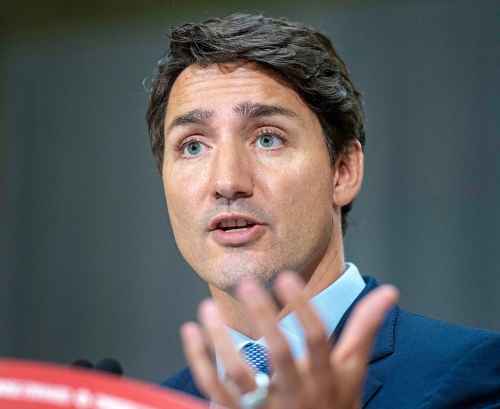
Finance Minister and Deputy Prime Minister Chrystia Freeland and Prime Minister Justin Trudeau speak with members of the media before the release of the federal budget, on Parliament Hill, in Ottawa, Thursday, April 7, 2022. Ottawa has unveiled a tax credit worth $2.6 billion over five years to help Canada’s energy sector invest in carbon capture and storage technology. THE CANADIAN PRESS/Sean Kilpatrick

The government will decrease the tax credit rates by 50 per cent in 2031 in an effort to get companies to build their carbon capture projects now, not later.

Kent Fellows, an assistant professor of economics with the University of Calgary’s School of Public Policy, said it’s clear that Ottawa wants the needle to move.

“It’s potentially a lot of money, and especially very quickly,” Fellows said of the tax credit. “They (the government) are looking for this to happen quickly. They’re looking for companies to get up off the couch, and actually get these proposals moving.”

Canadian oil and gas companies have reported record profits in recent months due to soaring commodity prices. But while many companies have proposed investing in carbon capture as a way to reach their emissions reduction goals, most projects are still in the development phase.

The industry has said the large-scale buildout of carbon capture and storage in Canada will be contingent on government help. Energy producers had lobbied for a carbon capture tax credit to cover up to 75 per cent of the capital costs of investing in the expensive technology.

Some of the companies that have proposed carbon capture and storage projects include Enbridge Inc., Atco Ltd., and Capital Power. In addition, the Oil Sands Pathways to Net Zero initiative — an alliance of Canadian Natural Resources Ltd., Cenovus Energy Inc., ConocoPhillips, Imperial Oil Ltd., MEG Energy Corp., and Suncor Energy Inc — has proposed a major carbon capture and storage transportation line that would capture CO2 from oilsands facilities and transport it to a storage facility near Cold Lake, Alta.

That project alone could deliver about 10 million tonnes of emissions reductions per year and could be up and running by the end of the decade, according to the oilsands group.

“With this announcement, the federal government has recognized the importance of developing new technologies to help Canada fight climate change, as well as the importance of the oilsands to our country’s energy security,” said Kendall Dilling, interim director of the Pathways to Net Zero Alliance, in a release Thursday.

“Because of the amount of long-term capital investment required to build carbon capture and storage infrastructure, and the speed we need to move at to meet 2030 targets, the countries that are doing this successfully are all using a collaborative model where governments are co-investing alongside industry,” Dilling added.

Proponents say Canada can’t meet its climate goals without vastly expanding the use of carbon capture and storage technology. The government’s recently released Emissions Reduction Plan envisions total emissions from the oil and gas sector — including production, refining and transportation via pipelines — falling to 110 million tonnes by 2030, down from 191 million tonnes in 2019.

“The International Energy Agency has determined that in order for the world to reach net zero, carbon capture and storage technologies are one of the tools in the tool box,” said Mark Zacharias, special adviser to the B.C.-based think tank Clean Energy Canada.

“This (carbon capture) could be transformational,” said Martha Hall Findlay, chief climate officer for Suncor. “Canada has had trouble meeting its emissions reductions targets … and this could take us from having trouble meeting our targets to being a global leader in emissions reduction.”

However, some environmentalists argue that offering a tax credit to oil and gas producers is akin to subsidizing fossil fuel production.

“Carbon capture is not a climate solution, it’s a greenwashing strategy,” said Julia Levin of Environmental Defence. “Instead of creating yet another fossil fuel subsidy, the government should have invested in proven climate solutions, including renewable energy, efficient affordable housing and electrification of transportation.”

In late March, the government of Alberta selected six proposals from companies interested in developing what would be Canada’s first carbon storage and sequestration hubs, in the Edmonton region. The proposals selected were put forward by Enbridge Inc., Shell Canada, Wolf Midstream, Bison Low Carbon Ventures, Enhance Energy and a joint-venture project from TC Energy and Pembina Pipeline Corp.

Also in Thursday’s budget, the federal government announced a new 30 per cent tax credit for exploration projects related to critical minerals such as lithium and cobalt, which are used in the production of electric cars and batteries.

This report by The Canadian Press was first published April 7, 2022.

Report Error Submit a Tip

More Stories

Letters, Oct. 30

7 minute read 2:00 AM CDT

Embarrassed by turnout

I am ashamed by the poor turnout of voters in the recent municipal election in Winnipeg. Just 38 per cent of eligible voters is a disgrace to the thousands of men and women who gave their lives in past wars, where they were defending democracy and the right to vote.

My grandfather was an infantry soldier in the First World War, and my father-in-law flew in Avro Lancasters in the Second World War. For both I am grateful.

Maybe the 62 per cent that had a flimsy excuse for not voting will keep this mind for the next election. People died for our right to vote.

Just say no (to deficits during good economic times)

Tom Brodbeck 5 minute read Preview

Just say no (to deficits during good economic times)

Tom Brodbeck 5 minute read Wednesday, Oct. 2, 2019

When a political party pledges to run small, “manageable” deficits if elected, it almost always means it will go deeper into the red if it wins government.

It’s human nature.

After all, as a government, if you get the blessing of the public to spend beyond your means, what’s a few billion more a year in overspending?

The problem is, it doesn’t usually end there. When those same politicians seek re-election, they often want permission to post even larger deficits. In some cases, they’ve abandoned the idea of balancing the books altogether, arguing perpetual deficit financing is acceptable, as long as the debt doesn’t exceed a certain percentage of the economy.

Read
Wednesday, Oct. 2, 2019

Meteorologist behind Rob’s Obs is moving weather station to Ontario

Ben Waldman 7 minute read Preview

Meteorologist behind Rob’s Obs is moving weather station to Ontario

Ben Waldman 7 minute read Monday, Jun. 13, 2022

In a Winnipeg winter, there are always at least two certainties: it will be cold, and it will snow. A third certainty: the people will talk endlessly about how frigid the temperature is, and argue about how much snow is cloaking their driveways. Is it colder than it ever has been? Is there more snow today than the same time last year?

Rob Paola likely knows the answers to those questions.

Paola possesses no super powers. He is but a man with a metre stick and 40 years of professional meteorological experience, in the midst of a lifelong love affair with Mother Nature, a most turbulent mistress who rarely, if ever, reciprocates.

Each year when snow begins to fall, Paola heads outside his Charleswood home to figure out how much. He sticks his ruler in the ground, grabs his clipboard, and clicks his pen. In neat script, he records the temperature, what time precipitation began, how deep the powder is stacked. Then, he shares his data and insights online with thousands of followers who want a clear answer to the eternal questions: Why is this happening? When will it stop? How much snow has fallen in the city of Winnipeg?

Read
Monday, Jun. 13, 2022

Wife’s witchy wonderment won’t spell trouble

Maureen Scurfield 6 minute read 2:00 AM CDT

DEAR MISS LONELYHEARTS: My wife believes in magic potions, which used to make me laugh. But since Halloween season started this year, she’s been acting in a way that frightens me. She seems to think she’s a modern-day “witch.” Give me a break!

Now she has three friends who think they are really casting spells when they get together! And this year on Halloween night she’s being formally accepted into their little witchy group meeting at one of their homes, and is getting a new sorceress name. It’s creepy! How do I cope? I’ve had enough of this.

— Seriously Upset, South St. Vital

Dear Upset: Don’t buy into the hocus pocus by being afraid of it and expressing any trepidation to your wife. She needs you to be strong, so she knows she has a solid anchor and can drop out of this witchy group if it becomes too scary or silly for her.

Science-art collaboration injects dose of emotion into cold, hard truths

Sarah Lawrynuik 5 minute read Preview

Science-art collaboration injects dose of emotion into cold, hard truths

Sarah Lawrynuik 5 minute read Wednesday, Apr. 28, 2021

Looking at spreadsheets and map plots of trees is far beyond Rhian Brynjolson’s typical day as a visual artist, but she became entranced and inspired by data collected by Canadian scientists for a new art project.

Her hope is to try and bring the numbers, map dots and statistics to life in a new way to help the public better connect to climate science.

Falcon Lake’s Brynjolson is one of 12 Canadian artists who participated in an art-science collaboration exhibit, co-ordinated by the Global Water Futures program out of the University of Saskatchewan. The project saw the artists paired with researchers and scientists across the country who then engaged in conversations to try to inspire a new angle to their art.

“The whole idea behind it is: water is life,” says Louise Arnal, the project lead, and a post-doctoral fellow at the Centre for Hydrology and Coldwater Laboratory.

Read
Wednesday, Apr. 28, 2021

City rec facilities crumbling

Ryan Thorpe 6 minute read Preview

City rec facilities crumbling

Ryan Thorpe 6 minute read Monday, Oct. 22, 2018

Throughout Winnipeg, decades-old community assets — pools, arenas and recreation and leisure centres — are deteriorating so quickly that service disruptions are inevitable.

Meanwhile, the city’s community services department, which is responsible for managing those assets, operates with an annual deficit of roughly $80 million, meaning there are scant resources to do little more than bail water on a sinking ship.

Soon, Winnipeggers will have a choice: fewer community services or higher costs.

“It poses a huge challenge because we have very limited dollars that we have to invest in our existing facilities. We also have growing demands for new amenities in new areas. We have to be very strategic,” said Ken McKim, manager of asset management for the department.

Read
Monday, Oct. 22, 2018