Only 8.5 million of the two billion trees promised by PM have been planted so far

Advertisement

Advertise with us

OTTAWA - The federal government has planted less than half a per cent of the two billion trees it pledged to put in the ground across Canada by 2030, The Canadian Press has learned.

Read this article for free:


or

Already have an account? Log in here »

To continue reading, please subscribe:

Subscribe and receive a limited-edition Free Press branded hat or tote.

Digital Subscription

One year of digital access for only $205*

  • Enjoy unlimited reading on winnipegfreepress.com
  • Read the E-Edition, our digital replica newspaper
  • Access News Break, our award-winning app
  • Play interactive puzzles

*First annual payment billed as $205.00 + GST for one year. This annual subscription will automatically renew at $233.00 + GST every 52 weeks (10% off the regular annual price of $259.35). Offer available to new and qualified returning subscribers only. Cancel any time.

To continue reading, please subscribe:

Add Free Press access to your Brandon Sun subscription for only an additional

$1 for the first 4 weeks*

  • Enjoy unlimited reading on winnipegfreepress.com
  • Read the E-Edition, our digital replica newspaper
  • Access News Break, our award-winning app
  • Play interactive puzzles
Start now

*Your next Brandon Sun subscription payment will increase by $1.00 and you will be charged $17.95 plus GST for four weeks. After four weeks, your payment will increase to $24.95 plus GST every four weeks.

Hey there, time traveller!
This article was published 13/12/2021 (1756 days ago), so information in it may no longer be current.

OTTAWA – The federal government has planted less than half a per cent of the two billion trees it pledged to put in the ground across Canada by 2030, The Canadian Press has learned.

Figures obtained through an access to information request show 8.5 million trees had been planted as of mid-November, representing just over 0.4 per cent of what the Liberals have repeatedly promised.

Prime Minister Justin Trudeau made the pledge during the 2019 election campaign, and the goal was repeated during the government’s 2020 throne speech setting out policy objectives.

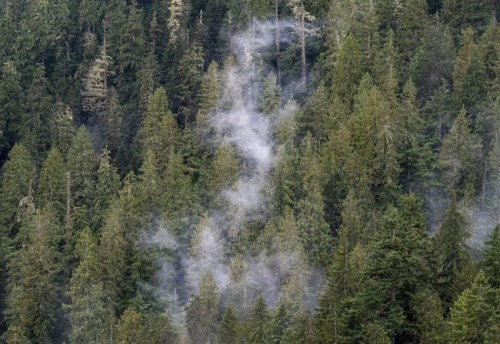
The clouds move among the old growth forest in the Fairy Creek logging area near Port Renfrew, B.C. Tuesday, Oct. 5, 2021. The government, which pledged in 2019 to plant 2 billion trees by 2030, has only planted 8.5 million trees so far, an access to information request by the Canadian Press shows. THE CANADIAN PRESS/Jonathan Hayward

It asserts the two billion trees would help Canada meet its climate-change targets while creating roughly 4,300 new jobs.

Despite the sluggish start to the tree-planting effort, the Natural Resources Department said the program isn’t falling behind.

“There will be about 30 million trees planted by the end of this year. Tree planting as part of this program will continue to ramp up,” said Joanna Sivasankaran of Natural Resources Canada.

Partners have pledged to grow those 30 million trees, according to the department, which has not yet received or validated all the figures.

Green MP Mike Morrice said the disclosure that only 8.5 million trees have so far been planted was “incredibly disappointing” but “not a complete surprise.”

“We’ve seen a pattern from this government of making grandiose promises around elections, but not following through, this being the most recent example,” Morrice said. “Planting trees is one of the cheapest forms of climate action, while regenerating forests can also reduce erosion.”

The government said it’s planning a big tree-planting push by the end of December, with a call to register new partners to plant an extra 250 to 350 million trees annually.

It blamed the slow start on sourcing seedlings, which can take between two and three years to grow. Tree planting is a seasonal activity that cannot take place all year round.

In its reply to the access to information request, Natural Resources said it had received 120 expressions of interest from organizations to plant trees in February 2021 and is “finalizing agreements to support the planting of over 30 million trees across the country, in both urban and rural areas.”

According to government data, 7.6 million of the 8.5 million trees planted since the prime minister made his pledge were in British Columbia. In Ontario, 89,000 extra trees have been planted, with 60,400 in Saskatchewan, 238,000 in Alberta, almost 350,000 in Quebec and 235,000 in New Brunswick.

A wide variety of trees have been planted including millions of conifers, according to the government’s data. In B.C., 2.8 million spruce and 3.9 million lodgepole pines have taken root. In Ontario, 18,500 oak trees, including white oak, have been planted alongside maple, hickory and black walnut trees.

Once planted, the young trees will be monitored annually to make sure they are surviving, until they are seven years old, Natural Resources Canada said.

Natural Resources said the figures obtained through the access to information request represent “the most recent compilation of 2021 planting data” up to mid-November. It said it would have final figures for trees planted this year by next spring and is expecting more to be added to the final tally from other planting sites.

The pledge to plant an extra two billion trees by 2030 means that an additional 200 million should be added every year, over and above the usual 500 million seedlings planted annually, including by the forestry industry.

The NDP’s natural resources spokesman, Charlie Angus, said Trudeau has “no credibility” on tackling climate change.

“Justin Trudeau’s failure to keep his promise to plant trees is an example of the utter ridiculousness of making promises without delivering on the climate crisis,” he said.

This report by The Canadian Press was first published Dec. 13, 2021.

Report Error Submit a Tip

More Stories

Wet weather heats up feed grain availability

Laura Rance-Unger 4 minute read Preview

Wet weather heats up feed grain availability

Laura Rance-Unger 4 minute read Yesterday at 2:01 AM CDT

Other than those in another rain cloud, it’s hard to find the silver linings attached to this year’s soggy harvest.

A showery September continued to cause delays and more deterioration in both quality and yield. Plus, the costs of mitigating post-harvest losses to spoilage are rising as the delays push further into fall. It takes more heat and time to artificially dry down grain as temperatures cool.

Crops harvested in August before the weather turned warm and damp came off with good quality and average yields. But farmers in some areas, such as southwest Manitoba, had only started when the rains came. Now they are plagued with standing water and sprouting swaths of grain that might not even make feed quality.

Suffice to say crop insurance adjusters are going to be busy this fall.

Read
Yesterday at 2:01 AM CDT

International flavour: Canadian investors may want to make like Ottawa, diversify beyond U.S.

Joel Schlesinger 6 minute read Preview

International flavour: Canadian investors may want to make like Ottawa, diversify beyond U.S.

Joel Schlesinger 6 minute read Yesterday at 2:01 AM CDT

Canada is learning the hard way about the dangers of putting too many eggs in its U.S. economic basket.

Much has been made about the need to diversify our economy away from the United States.

Diversification is understandably beneficial. The more varied streams of revenue a nation has, the less affected the economy will be when one of those sources is interrupted.

The same can be said about investment portfolios.

Read
Yesterday at 2:01 AM CDT

The idea of Alberta separation viewed through a faith lens shows further fracture lines

Josiah Neufeld 10 minute read Preview

The idea of Alberta separation viewed through a faith lens shows further fracture lines

Josiah Neufeld 10 minute read Yesterday at 2:01 AM CDT

CALGARY — One morning in May, John Pentland, a minister at Hillhurst United Church in Calgary, opened his newspaper and read about a group of Albertans who were trying to divide his country.

Something inside of him felt like it cracked open. He started to weep.

“I couldn’t stop, I couldn’t breathe,” he said. He called a friend and told him: “I think I’m losing my mind.”

Pentland has always believed in Canada — flawed as it might be — as a nation gifted with diversity and welcoming of asylum seekers, refugees and immigrants. But recently that belief has been shaken as he’s witnessed right-wing ideologies charged with anti-immigrant sentiment take root in his province. It makes him angry and embarrassed for the country he loves.

Read
Yesterday at 2:01 AM CDT

Free Press staff 2 minute read Yesterday at 2:01 AM CDT

Advance voting for civic and school board elections begins next week.

Voters can cast early ballots for the Oct. 28 election in certain locations from Monday through Oct. 23.

Eligible voters can use their address to search for a convenient location.

Early votes can be cast at the council building at city hall (510 Main St.) every day, except weekends and Thanksgiving, from Monday to Oct. 23.

Manitoba marks end of sending simple workplace problems to doctor’s office

Tory McNally 7 minute read Preview

Manitoba marks end of sending simple workplace problems to doctor’s office

Tory McNally 7 minute read Yesterday at 2:01 AM CDT

There are some changes in the workplace that make you think: “Well, it’s about time.”

This is one of them.

Starting Oct. 1, Manitoba changed the rules around sick notes. I think it is going to be a wonderful change — not just for doctors and patients, but for employers, employees and the way we think about accountability at work.

The change comes from Bill 11, the Employment Standards Code Amendment Act (Sick Notes for Employee Absences), which received royal assent on June 1 and came into force Thursday. Under the new rules, employers generally cannot require a sick note for an illness or injury unless the employee is away for more than one week or has been absent because of illness or injury for more than 10 scheduled workdays in the calendar year.

Read
Yesterday at 2:01 AM CDT

Brandonmeat packer thriving on its own

Abiola Odutola 3 minute read Preview

Brandonmeat packer thriving on its own

Abiola Odutola 3 minute read Yesterday at 2:01 AM CDT

BRANDON — Canada Packers has strengthened its business and laid the foundation for future growth during its first year as an independent company, its president says.

The Brandon-based pork producer, separated from Maple Leaf Foods in October 2025, established its own leadership, strategy, systems, culture and identity while continuing operations across its hog production farms and regional hog barns in southern and eastern Manitoba.

The company’s first year was focused on building a successful standalone business while continuing to serve customers, communities and shareholders, president Dennis Organ said.

“Market conditions over the past year have been more challenging than we anticipated when we became a separate entity,” he said in an email. “Despite that, we continued to execute against our priorities, including increasing processing volumes, maintaining disciplined operations and strengthening the business.”

Read
Yesterday at 2:01 AM CDT