New minister says natural resources must evolve to include renewables, biofuels

Advertisement

Advertise with us

OTTAWA - In a country intent on helping to slow global warming without destroying its economy, Canada's latest natural resources minister says his department can no longer be thought of mainly as the ministry for fossil fuels.

Read this article for free:


or

Already have an account? Log in here »

To continue reading, please subscribe:

Subscribe and receive a limited-edition Free Press branded hat or tote.

Digital Subscription

One year of digital access for only $205*

  • Enjoy unlimited reading on winnipegfreepress.com
  • Read the E-Edition, our digital replica newspaper
  • Access News Break, our award-winning app
  • Play interactive puzzles

*First annual payment billed as $205.00 + GST for one year. This annual subscription will automatically renew at $233.00 + GST every 52 weeks (10% off the regular annual price of $259.35). Offer available to new and qualified returning subscribers only. Cancel any time.

To continue reading, please subscribe:

Add Free Press access to your Brandon Sun subscription for only an additional

$1 for the first 4 weeks*

  • Enjoy unlimited reading on winnipegfreepress.com
  • Read the E-Edition, our digital replica newspaper
  • Access News Break, our award-winning app
  • Play interactive puzzles
Start now

*Your next Brandon Sun subscription payment will increase by $1.00 and you will be charged $17.95 plus GST for four weeks. After four weeks, your payment will increase to $24.95 plus GST every four weeks.

Hey there, time traveller!
This article was published 16/11/2021 (1763 days ago), so information in it may no longer be current.

OTTAWA – In a country intent on helping to slow global warming without destroying its economy, Canada’s latest natural resources minister says his department can no longer be thought of mainly as the ministry for fossil fuels.

But Jonathan Wilkinson also says the Liberals are not singling out the oil and gas sector to do an unfair amount of heavy lifting in the fight against climate change because all industries that contribute to the problem have to be part of the solution.

Wilkinson is three weeks removed from the cabinet shuffle that made him the fourth natural resources minister in the last six years. Now after helming the environment department tasked with combating climate change, he’s in charge of the department that regulates and promotes many of the products that cause it.
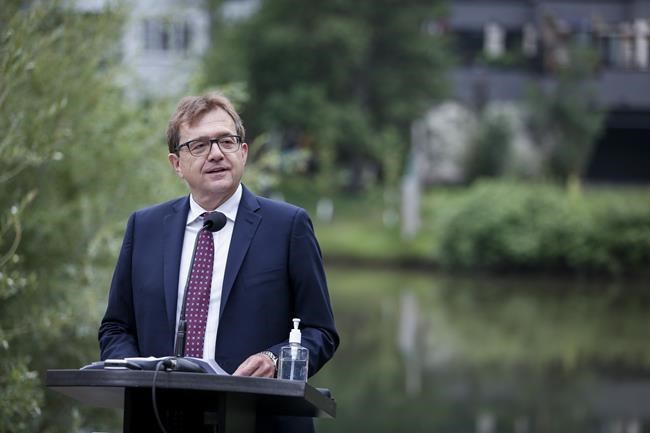
Jonathan Wilkinson makes an announcement in Calgary, Alta., Tuesday, July 20, 2021. Canada's latest natural resources minister says in a country intent on helping to slow global warming without destroying the economy, his department can no longer be thought of mainly as the ministry for fossil fuels. THE CANADIAN PRESS/Jeff McIntosh

But when the 56-year-old former clean tech CEO took over Natural Resources Canada, some saw it as a signal the department is going to evolve to prioritize clean technology in a way it hasn’t yet done.

“I would agree with that,” Wilkinson said, in an interview with The Canadian Press, about his priorities for the new job.

“I do think that the way in which we define natural resources going forward actually has to include renewable energy, it has to include hydrogen, it has to include biofuels. I absolutely think that the old sort of way of conceptualizing the department, which is just about oil and gas and mining, is not the way that we think about it going forward.”

The push-pull between the fossil fuel sectors that the world, and Canada, have relied on for decades, and the science that blames the burning of fossil fuels for the increasingly warmer planet and associated climate destruction, was on full display in the last two weeks at the United Nations COP26 climate talks in Scotland.

Environment advocates argued hard that the only way to keep global warming from becoming catastrophic is a full-scale phase out of the use of fossil fuels. The creation of a Beyond Oil and Gas Alliance, an initiative to phase out fossil fuels entirely, was among the most talked-about initiatives to come out of COP26.

The Quebec government signed on as an associate member but Canada did not.

Wilkinson, who spent several days at COP26 pushing Canada’s position on phasing out fossil fuel subsidies, but promoting the development of hydrogen, said the all-or-nothing polarized positions on oil and gas production are difficult. He said he still sees a role in Canada for some fossil fuels as long as they are not contributing to greenhouse gas emissions.

That includes, he said, using bitumen for non combustible uses like asphalt or carbon graphite, and extracting hydrogen molecules from natural gas, as long as that is done with technology that first reduces and then eventually eliminates the greenhouse gas emissions that come from that process.

“Those are things we should be looking at because at the end of the day, we’re interested in good economic outcomes and no carbon emissions,” he said. “So I think that’s the way people need to think about it, rather than taking the polar position, which is no fossil fuels or fossil fuels are going to continue forever.”

Wilkinson is less bullish on the future for most oil and sees no pathway in Canada to keep using coal because the technology and geological formations needed to capture and store its emissions will not be both affordable and prepared for the 2030 deadline to phase out all “unabated” coal-fired power plants.

“On the oil side. I mean, look, it is primarily a transportation fuel and we’re all committing to actually go to net zero vehicles,” he said. “And so over time, you are going to see a reduction in the amount of oil being used, being combusted for the purposes of transportation That’s just logic.”

Carbon capture technology overall is also not a massive, long-term solution to allow the continued burning of fossil fuels for energy, said Wilkinson, because the geological formations needed to store the gases don’t exist everywhere.

His priorities for the first months of his new job are to work with oil and gas provinces to develop the cap on oil and gas production emissions the Liberals promised in the recent election.

Former prime minister Stephen Harper recently accused the Liberals of targeting oil producing regions to fulfil their climate change goals, because those regions don’t vote for the Liberals. Wilkinson didn’t reference Harper directly, but rejected the sentiment.

“Some people say that we’ve singled out the oil and gas space and to that I actually say that’s just not true,” he said. “If you read the rest of the climate plan, for example, in the in transportation space, we said hard stop of the sale of internal combustion engine vehicles after 2035 for the same reasons.”

He said one of his priorities is working with those regions affected to ensure the transition away from fossil fuels is a positive one.

This report by The Canadian Press was first published Nov. 16, 2021.

Report Error Submit a Tip

More Stories

Convicted sex offender awaits latest sentence

Dean Pritchard 5 minute read Preview

Convicted sex offender awaits latest sentence

Dean Pritchard 5 minute read Saturday, Jul. 25, 2026

Prosecutors are seeking a 15-year prison sentence for a Red Lake, Ont., man who groomed two Indigenous girls online and drove nearly 500 kilometres to Winnipeg to sexually abuse one of them.

Scott Christopher Alcorn, 50, has pleaded guilty to one count each of child luring, sexual interference and possession of child sexual abuse material.

Alcorn was still on parole for child sex offences at the time of his April 2025 arrest, having been convicted four years earlier of providing a 16-year-old girl a bottle of alcohol in exchange for sex.

“Despite this (prior conviction)… Mr. Alcorn egregiously reoffended, this time to lure two children online and successfully groomed, manipulated and commodified one of (the victims),” Crown attorney Dayna Queau-Guzzi told provincial court Judge Robert Heinrichs at a sentencing hearing Thursday.

Read
Saturday, Jul. 25, 2026

Convicted mail bomber loses parole-denial appeal

Tyler Searle 4 minute read Preview

Convicted mail bomber loses parole-denial appeal

Tyler Searle 4 minute read Thursday, Apr. 2, 2026

Convicted mail bomber Guido Amsel has lost his fight for full parole, after his appeal for release was shot down by the Parole Board of Canada.

In 2018, Amsel received a life sentence with no chance of parole for 10 years for the attempted murders of his ex-wife Iris Amsel and lawyers Maria Mitousis and George Orle in 2015 by mailing explosives to them. One of the bombs, placed inside a hand-held tape recorder with instructions to press the “play” button, exploded in Mitousis’s office, resulting in the loss of her right hand.

He was also sentenced to 12 years minus time served for an earlier attempt to murder his ex-wife in 2013.

He was 59 years old in August, when he appeared before the board to argue for full parole. Had it been granted, he would have been released from federal custody and deported to Germany, where he was born and lived for decades.

Read
Thursday, Apr. 2, 2026

The port of Churchill — but done right

Editorial 4 minute read Preview

The port of Churchill — but done right

Editorial 4 minute read Saturday, Sep. 12, 2026

The seagoing grain carrier wasn’t christened with a champagne bottle. There was no confetti or streamers. Nevertheless, the Aug. 31 event marking the first shipment of grain to be loaded at the Port of Churchill since 2020 was celebrated like the launch of a brand new vessel.

The presence of the federal minister of northern and arctic affairs, provincial cabinet ministers and leaders and elders from several northern First Nations signalled that the fast-tracked process of refurbishing and buffing up Manitoba’s deep-water seaport gem is gaining momentum.

For OneNorth, the partnership of 29 First Nations and 12 northern communities which owns the Port of Churchill and the Hudson Bay Railway (both operated by the Arctic Gateway Group) the event heralded a new beginning. It’s been eight years since OneNorth purchased the port and railroad, and six years since grain was moved by rail through Manitoba and then by ship to European markets. Two more grain shipments, plus shipments of potash and critical minerals, will continue through the fall.

When Prime Minister Mark Carney solicited the premiers to suggest “nation-building” projects following his election in 2025, Premier Wab Kinew pitched a Manitoba trade corridor that would move wheat, critical minerals, potash and energy (oil or liquid natural gas) through the Port of Churchill.

Read
Saturday, Sep. 12, 2026

Nifty neighbours also jonesing for geniality

Maureen Scurfield 4 minute read Saturday, Sep. 12, 2026

DEAR MISS LONELYHEARTS: Recently, a new couple with no children moved onto our cul de sac, and everybody is taking notice! This attractive pair with no kids both drive amazing cars, work from home and leave their garage doors up a lot. Everybody on the street walks by to sneak a peek into the big garage at just about any time of day.

Lately, the man’s been out on his front lawn in a muscle shirt in the late afternoon, planting shrubs and putting up stylish fall-themed ornaments. At night they often leave the living-room curtains open. That makes for convenient viewing for curious neighbours like us!

A few days ago, my wife invited the new couple over for a barbecue and swim in our pool. They are really nice people, but mentioned that other people nearby have been pretty stand-offish. They wonder why. Should I tell them it’s probably just jealousy over their beautiful vehicles and enviable lifestyle, or should I just shut up?

—Wanting to Help, Sage Creek

A father and son arrested last month are accused of travelling across Canada — and using courier services and Canada Post — to supply their Winnipeg drug-trafficking operation, a recent court filing shows.

Devinder Singh, 57, and his 32-year-old son Tarundev Singh, charged by Winnipeg Police Service organized crime investigators last month, are each accused of several counts of conspiracy to commit an indictable offence and related drug-trafficking offences, court records show.

Tarundev is also charged with several firearms offences.

Details of the pair’s alleged trafficking operation and the ongoing police investigation — dubbed Project Pink Panther — are contained in a lawsuit filed in the Court of King’s Bench by the provincial civil forfeiture office this week.

250 years ago Thomas Jefferson and the American Declaration of Independence

Allan Levine 5 minute read Preview

250 years ago Thomas Jefferson and the American Declaration of Independence

Allan Levine 5 minute read Saturday, Jul. 4, 2026

In the 16th and 17th centuries, countries and territories such as the Netherlands and Portugal boldly declared their independence from Spain. But 250 years ago, on July 4, 1776, the American Declaration of Independence — marked in the U.S. by the semiquincentennial celebrations — was the first time an overseas colony (the 13 colonies, in this case) had set out in an official document its reasons for breaking away from its mother country.

Because the Declaration ultimately gave birth to the United States, it is considered one of the greatest of historical treatises. Thomas Jefferson, its primary author, later explained that his main aim was “not to find out new principles, or new arguments, never before thought of … but to place before mankind the common sense of the subject; in terms so plain and firm as to command their assent.”

He did so brilliantly, creating, in theory at least, an enlightened argument for American independence based on the political, economic, social and philosophical thinking of the era.

Influenced by such philosophers as John Locke and Montesquieu, Jefferson, then 33 years old, a lawyer, landowner, Virginia politician and a delegate to the Second Continental Congress which met in Philadelphia, passionately believed in natural law — that all human beings were born free and equal and that no king or ruler could abolish these rights. It was a key point he made in the Declaration’s well-known preamble.

Read
Saturday, Jul. 4, 2026