Green groups greet climate deal with hope, frustration after last-minute compromise

Advertisement

Advertise with us

A last-minute deal reached at the United Nations climate talks Saturday drew a mix of discouragement and determination from environmental groups and politicians in Canada.

Read this article for free:


By clicking the button above, an account will be created and you will begin to receive some of our recommended newsletters. You may opt out of any newsletter by visiting your Email and Communication Preferences page or by clicking "unsubscribe" at the bottom of any email.

or

Already have an account? Log in here »

To continue reading, please subscribe:

Digital Subscription

One year of digital access for only $1.44 a week*

  • Enjoy unlimited reading on winnipegfreepress.com
  • Read the E-Edition, our digital replica newspaper
  • Access News Break, our award-winning app
  • Play interactive puzzles

*Billed as $5.77 plus GST every four weeks. After 52 weeks, price increases to the regular rate of $19.95 plus GST every four weeks. Offer available to new and qualified returning subscribers only. Cancel any time.

To continue reading, please subscribe:

Add Free Press access to your Brandon Sun subscription for only an additional

$1 for the first 4 weeks*

  • Enjoy unlimited reading on winnipegfreepress.com
  • Read the E-Edition, our digital replica newspaper
  • Access News Break, our award-winning app
  • Play interactive puzzles
Start now

*Your next Brandon Sun subscription payment will increase by $1.00 and you will be charged $17.95 plus GST for four weeks. After four weeks, your payment will increase to $24.95 plus GST every four weeks.

Hey there, time traveller!
This article was published 13/11/2021 (1797 days ago), so information in it may no longer be current.

A last-minute deal reached at the United Nations climate talks Saturday drew a mix of discouragement and determination from environmental groups and politicians in Canada.

Almost 200 countries accepted the contentious climate compromise aimed at preserving a key target in the fight against global warming, which contained a final change that watered down crucial language about coal.

Several countries, including small island states, said Saturday they were deeply disappointed by the edit promoted by India to “phase down” rather than “phase out” coal power, the single biggest source of greenhouse gas emissions.
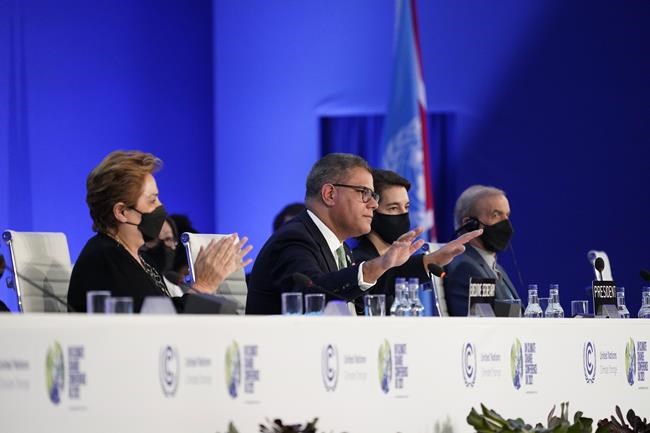
Britain's Alok Sharma, President of the COP26, second left, gestures as delegates applaud, flanked by Patricia Espinosa, left, UNFCCC Executive-Secretary, during the closing plenary session at the COP26 U.N. Climate Summit, in Glasgow, Scotland, Saturday, Nov. 13, 2021. Environmental groups and politicians in Canada are reacting with a mix of hope, discouragement and determination to news that a last-minute deal had been reached at the United Nations climate change conference. THE CANADIAN PRESS/AP-Alberto Pezzali

Environment Minister Steven Guilbeault said Canada was able to set an example for other large, oil-producing nations at the conference, but that “we haven’t and won’t be able to win every single battle in the fight against climate change.”

“We know we need to do more and the world needs to do more. Canadians gave us a mandate to go further and faster in our fight against climate change and there’s no doubt we have our work cut out for us,” he said in a statement posted to Twitter.

The Sierra Club’s Canadian chapter, meanwhile, said the deal marks a “disappointing end” to the two-week conference in Glasgow, Scotland, known as COP26.

“This final agreement is a small step but not the leap we need,” representatives said in a statement, calling the compromise “on trend with the divisive summit.”

“In the words of David Attenborough … ‘our motivation should not be fear but hope.'”

They and others cited the international goal to limit global warming to 1.5 C above pre-industrial times.

Climate Action Network Canada, which was also in attendance, warned Canadian politicians they will be held to the deal’s pledges.

“We leave Glasgow with renewed conviction that we must fight back against every fraction of a degree of warming, to protect the people and the places we love,” the network said in a Twitter post.

Green Party MP Elizabeth May said in tweet from Scotland that the diluted language on coal marks a move to appease India, China and others.

“The hope of holding to 1.5 degrees is barely alive. But hope is not lost,” she wrote.

The advocates’ views reflected those of many states, as nation after nation complained on the final day of the U.N. talks the agreement did not go far or fast enough. They said, however, that it was better than nothing and provided incremental progress, if not success.

Kathryn Harrison, a political science professor the University of British Columbia specializing in environmental and climate change policy, said the commitments show progress but that the globe remains on track for 2.4 C of warming this century.

Nonetheless, the call for more ambitious near-term targets at next year’s conference is “encouraging,” she said.

“It’s also increasingly clear that greater climate finance for developing countries from wealthy, developed countries like Canada will be essential in achieving needed progress,” she said in an email.

The meeting has also sent a strong signal to Canada’s fossil-fuel industry, whose exports Harrison warned are bound to decline after 2030 if countries keep their word on temperature goals.

“COP26 finally called out the elephant in the room with more focus than at any previous COP on fossil fuels as the main cause of climate change,” she said, pointing to oil and gas as well as coal.

Canada has joined more than 20 countries in promising to end subsidies for fossil fuels projects overseas. And the deal itself calls for an eventual end of some coal power and of fossil fuel subsidies.

Negotiators from Switzerland and Mexico deemed the coal language change against the rules because it came so late. However, they said they had no choice but to hold their noses and go along with it.

“Our fragile planet is hanging by a thread,” United Nations Secretary-General Antonio Guterres said in a statement. “We are still knocking on the door of climate catastrophe.”

Many other nations and climate campaigners pointed at India for making demands that weakened the final agreement.

“India’s last-minute change to the language to phase down but not phase out coal Is quite shocking,” said Australian climate scientist Bill Hare, who tracks world emission pledges for the science-based Climate Action Tracker. “India has long been a blocker on climate action, but I have never seen it done so publicly.”

Others approached the deal from a more positive perspective. In addition to the revised coal language, the Glasgow Climate Pact included enough financial incentives to almost satisfy poorer nations and solved a long-standing problem to pave the way for carbon trading.

The agreement also says big carbon polluting nations have to come back and submit stronger emission cutting pledges by the end of 2022.

“It’s a good deal for the world,” U.S. climate envoy John Kerry told The Associated Press. “It’s got a few problems, but it’s all in all a very good deal.”

This report by The Canadian Press was first published Nov. 13, 2021.

—With files from The Associated Press

Report Error Submit a Tip

More Stories

Former Zelenskyy aide Iuliia Mendel has book out this fall

The Associated Press 2 minute read Wednesday, Apr. 6, 2022

NEW YORK (AP) — A journalist and former aide to Ukrainian President Volodymyr Zelenskyy has a book coming out this fall, one of the first announced releases about Zelenskyy and Russia's invasion of Ukraine.

One Signal Publishers announced Wednesday that it had acquired Iuliia Mendel's “The Fight of Our Lives.” Mendel served as Zelenskyy's press secretary and spokesperson from 2019-2021 and has been sending dispatches about the war to the Washington Post. According to One Signal, a Simon & Schuster imprint, Mendel will write about everything from Zelenskyy's meetings with Soviet leader Vladimir Putin to the phone calls with then-President Donald Trump that led to his impeachment for trying to pressure Zelenskyy into investigating Joe Biden.

Mendel also will write on the “massive economic problems facing Ukraine, entrenched corrupt oligarchs in league with Russia, and — in shades of the United States’ recent federal election — the Kremlin’s repeated attacks to discredit Zelenskyy through disinformation and an army of bots and trolls,” One Signal's announcement reads in part.

Mendel, 35, has written for the Post and The New York Times among others.

Women’s hockey pioneers face offon PTE stage

Ben Waldman 5 minute read Preview

Women’s hockey pioneers face offon PTE stage

Ben Waldman 5 minute read 2:00 AM CDT

You probably haven’t heard of the Preston Rivulettes, but nearly a century ago, they were considered by many to be the best hockey team in Canada.

Not the best women’s hockey team but the best hockey team, period.

Throughout the 1930s, the team was revered for its on-ice dominance, “a smooth-working hockey machine” and the “perennial rulers” of the Dominion Women’s Amateur Hockey Association, per The Canadian Press.

Of the estimated 350 games the club played, historical records show it lost fewer than 10 times.

Read
2:00 AM CDT

Law will curb e-scooter enthusiasts

Editorial 4 minute read Preview

Law will curb e-scooter enthusiasts

Editorial 4 minute read 2:00 AM CDT

For people concerned about safety on Manitoba’s sidewalks and roadways, the province’s announcement that new rules will be introduced next year regarding the use of e-scooters and other personal electric vehicles (PEVs) was no doubt met with an enthusiastic “It’s about time.”

As their popularity and their presence among pedestrians on sidewalks and/or motor vehicles on the road has increased steadily, so have reports of close calls or, even worse, collisions involving e-scooters or other PEVs — including electric skateboards, hoverboards and unicycles — being operated imprudently and at unsafe speeds.

Traffic laws urgently need to be updated to govern the use of these conveyances, which up until now have remained in a regulatory grey area that has allowed PEVs to operate largely without guidelines and outside conventional avenues of traffic-safety enforcement. Accordingly, updates regarding PEV use will be included in the Highway Traffic Act in 2027.

The new legislation will govern such areas as mandatory helmet use, age restrictions, where PEVs can lawfully operate and the maximum speed at which they can travel (25 km/h). The aim of the new law, according to the province’s website, is “to help keep Manitobans safe when sharing roads, paths, and other public spaces.”

Read
2:00 AM CDT

The currency of trust

Stephen Borys 6 minute read Preview

The currency of trust

Stephen Borys 6 minute read 2:00 AM CDT

Over the course of three weeks last month, I saw three very different sides of Dr. Ernest Cholakis — philanthropist, distinguished alumnus and dental surgeon.

The last of these was the most personal. And painful.

A week after watching Ernest receive the University of Manitoba’s distinguished alumni award for lifetime achievement — an honour for which I was one of his nominators — I arrived at his clinic with a tooth that had cracked in half. The pain had become considerable and, although his schedule was full, he found a way to fit me in.

Ernest has been my dentist for more than a decade, although our relationship has extended well beyond dentistry into friendship and a shared involvement in the cultural and community life of Winnipeg. I thought I knew him reasonably well. But helping to prepare his nomination introduced me to aspects of his professional life I had never fully appreciated.

Read
2:00 AM CDT

Moderation, boundaries can mend things with mom

Maureen Scurfield 5 minute read Friday, May. 12, 2023

DEAR MISS LONELYHEARTS: My recently widowed mother, who’s a former advertising exec from Toronto, invited herself to visit me for a whole month recently — a 28-day sentence. I left Toronto to get away from her, because she befriended all my friends in high school and college.

Anyway, I gamely staged a little party for her at a restaurant, so she’d meet a few people. My friends loved her! She got them playing a mixer game, and everybody had fun.

But then, she went too far. She actually took down some of my girlfriends’ phone numbers on a little list and jotted a couple words on what they liked to do — like the super saleswoman she is. The next day she made lunch and touristy dates, for when I was at work.

A few days later one of them called me and finally spoke the words I didn’t want to hear: “Your mother is more fun than you are!” I blew up! I said back to her, “Well then, how come she had to leave Toronto and come way out here to Winnipeg to steal my friends?”

The wisdom of the double down

Allan Levine 5 minute read Saturday, Dec. 10, 2022

My late grandmother, Sarah Kliman, enjoyed gambling. She was never a big bettor, but she did visit Las Vegas from time to time.