A timeline on rail disruptions by anti-pipeline protesters across Canada

Advertisement

Advertise with us

RCMP began enforcing an injunction earlier this month that prevents interference with construction of a $6.6-billion natural gas pipeline in northern British Columbia.

Read this article for free:


or

Already have an account? Log in here »

To continue reading, please subscribe:

Subscribe and receive a limited-edition Free Press branded hat or tote.

Digital Subscription

One year of digital access for only $205*

  • Enjoy unlimited reading on winnipegfreepress.com
  • Read the E-Edition, our digital replica newspaper
  • Access News Break, our award-winning app
  • Play interactive puzzles

*First annual payment billed as $205.00 + GST for one year. This annual subscription will automatically renew at $233.00 + GST every 52 weeks (10% off the regular annual price of $259.35). Offer available to new and qualified returning subscribers only. Cancel any time.

To continue reading, please subscribe:

Add Free Press access to your Brandon Sun subscription for only an additional

$1 for the first 4 weeks*

  • Enjoy unlimited reading on winnipegfreepress.com
  • Read the E-Edition, our digital replica newspaper
  • Access News Break, our award-winning app
  • Play interactive puzzles
Start now

*Your next Brandon Sun subscription payment will increase by $1.00 and you will be charged $17.95 plus GST for four weeks. After four weeks, your payment will increase to $24.95 plus GST every four weeks.

Hey there, time traveller!
This article was published 17/02/2020 (2419 days ago), so information in it may no longer be current.

RCMP began enforcing an injunction earlier this month that prevents interference with construction of a $6.6-billion natural gas pipeline in northern British Columbia.

Here is a timeline of the dispute, along with rail disruptions by people showing solidarity with the hereditary Wet’suwet’en chiefs opposing the Coastal GasLink project:

Dec. 31, 2019 — The B.C. Supreme Court grants Coastal GasLink an injunction calling for the removal of any obstructions including cabins and gates on any roads, bridges or work sites the company has been authorized to use.
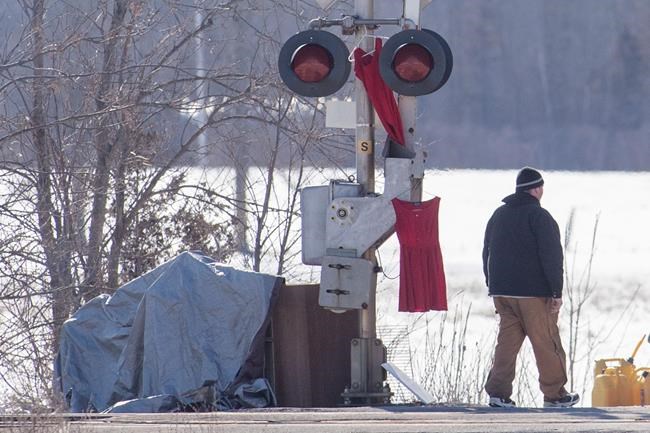
A protester walks past a train signal with red dresses during the twelfth day of protest in Tyendinaga, near Belleville, Ontario, on Monday Feb.17, 2020, as they protest in solidarity with the Wet'suwet'en hereditary chiefs opposed to the LNG pipeline in northern British Columbia. THE CANADIAN PRESS/Lars Hagberg

Jan. 1, 2020 — The Wet’suwet’en First Nation serves Coastal GasLink with an eviction notice, telling the company workers are “currently trespassing” on their unceded territory.

Jan. 27 — The British Columbia government appoints former New Democrat MP Nathan Cullen as a provincial liaison with Wet’suwet’en hereditary chiefs in the LNG pipeline dispute.

Jan. 30 — The hereditary chiefs of the Wet’suwet’en agree to seven days of meetings with the province.

Feb. 5 — The talks that were intended to de-escalate the dispute fail after just two days.

Feb. 6 — Protesters outside of Belleville, Ont., east of Toronto, start holding up railway traffic.

Feb. 7 — Via Rail halts service along one of its busiest routes because of the Belleville-area blockade. All travel between Toronto, Ottawa and Montreal is cancelled. Canadian National Railway obtains a court injunction to end a demonstration by members of the Tyendinaga Mohawk Territory near Belleville. Protesters also begin disruptions at ports in Vancouver and Delta, B.C.

Feb. 8 — Protesters in Toronto disrupt Canadian Pacific Railway traffic moving through the downtown.

Feb. 9 — Kahnawake Mohawk community members south of Montreal erect a blockade on a CP rail line.

Feb. 10 — Demonstrators in the Montreal area disrupt commuter train service on the Exo Candiac line. A shuttle bus service is in effect for affected rail stations.

Feb. 11 — CN stops transport between Prince George, B.C., and Prince Rupert, B.C., because of a blockade near Hazelton, B.C. The company says it has halted more than 150 freight trains since blockades started on Feb. 6.

Feb. 12 — The Manitoba government says it may seek a court injunction to end a blockade on a rail line west of Winnipeg, but CN obtains its own court order. The RCMP also formally end enforcement operations in a region of northern B.C. that’s at the centre of the pipeline dispute. Two hereditary Wet’suwet’en chiefs start a constitutional challenge of fossil fuel projects, as Prime Minister Justin Trudeau calls for demonstrators across the country to observe the rule of law.

Feb. 13 — CN shuts down its operations in Eastern Canada. The railway says blockades have ended in Manitoba and may come down soon in British Columbia, but the orders of a court in Ontario have yet to be enforced and continue to be ignored.

Feb. 14 — A rail blockade that halted train traffic to and from the Port of Prince Rupert is lifted as First Nations leaders agree to meet with federal and provincial politicians. A date for that sit-down is to be arranged. CN spokesman Jonathan Abecassis says the blockade was removed overnight.

Feb. 15 — Indigenous Services Minister Marc Miller says “modest progress” was made in talks with the Mohawk First Nation over a rail blockade that’s shut down train service across much of Eastern Canada. But Miller declined to say what progress was made after nine hours of meetings on Tyendinaga Mohawk territory near Belleville, Ont., saying he would deliver that message to Trudeau directly.

Feb. 16 — Trudeau cancels his planned trip to Barbados, less than 24 hours before his scheduled departure, so he can handle the protests in Canada. Meanwhile, protesters briefly shut down a busy Ontario border crossing.

Feb. 17 — Trudeau convenes the Incident Response Group, an emeregency committee that meets in the event of a national crisis.

This report by The Canadian Press was first published Feb. 17, 2020.

Report Error Submit a Tip

More Stories

Churchill draws scientists from around the world researching impacts of climate change

Sarah Lawrynuik 13 minute read Preview

Churchill draws scientists from around the world researching impacts of climate change

Sarah Lawrynuik 13 minute read Friday, Oct. 23, 2020

CHURCHILL — There is something special about this town.

People who have been here know, though it is challenging to describe. Those who haven’t are told tales of a nearly mystical small community, the unique geography and the magnificent wildlife.

Exactly what makes it such a special place is hard to define, but whatever that intrinsic character is, it acts as a magnetic force for humans and animals alike.

Every summer — as if on cue — the sleek white backs of more than 50,000 beluga whales begin peeking out of the waters of southwestern Hudson Bay as they return to the estuaries of northern Manitoba. Their fidelity to this summer habitat is centuries old, passed on from one generation to the next. This loyalty to the region ensures for as long as this site is safe, these alien-like, curious whales will continue to return.

Read
Friday, Oct. 23, 2020

Suspension upheld for teen hockey player involved in hazing

Free Press staff 3 minute read Preview

Suspension upheld for teen hockey player involved in hazing

Free Press staff 3 minute read Sunday, Aug. 9, 2026

A high school hockey player who was found to have been involved in sexualized hazing of rookie teammates lost his suspension appeal.

The youth player was barred from Hockey Canada-sanctioned activities. He was handed the four-year and nine-month suspension from sanctioned hockey after an interim ban issued in March 2024.

He appealed his suspension late last year to the Sport Dispute Resolution Centre of Canada, an independent conflict tribunal, but the centre upheld the youth’s suspension, according to a written decision issued earlier this year.

An independent investigator who probed the hockey player’s actions described the youth as a veteran player who both participated in and co-ordinated the “assigning” of rookie team members to veteran players to perform tasks for them. He himself was “assigned” a rookie, the decision said.

Read
Sunday, Aug. 9, 2026

Who protects collegiate athletes?

Brian Ramsay 4 minute read 2:00 AM CDT

College athletes need advocacy, before another life is lost.

They need an independent voice because, as the system stands, athletes speaking out for personal safety would end their positions on their teams. They need an advocate when their voices cannot be heard — and, more importantly, when they are being ignored or silenced.

What happened on Aug. 20 — when Arizona State University hockey player Matthew Mayich collapsed during a high-intensity outdoor workout — was not an accident. Mayich is still in hospital in critical condition.

When established processes and safeguards are alleged not to have been followed, the response cannot begin and end with the institution investigating itself and declaring nothing went wrong. Serious incidents demand transparency, accountability and independent scrutiny.

Gillingham talks trash, pledges big bin boost

Joyanne Pursaga 4 minute read Preview

Gillingham talks trash, pledges big bin boost

Joyanne Pursaga 4 minute read 2:01 AM CDT

Scott Gillingham says he would add hundreds of locked garbage bins downtown to prevent unsightly trash piles if re-elected as mayor.

Gillingham led a program that added about 120 locked garbage bins along Portage Avenue and Main Street last fall, after trash was repeatedly strewn around the area. If he wins a second term, he plans to add at least 200 more of the receptacles.

A look at how one locked Main Street recycle/garbage bin in front of city hall fared offers an example of the bins’ success so far, he said.

“Every day, you would see the lids up, and people had been rifling through it, or someone left the lid up and the wind picked up the garbage and (spread) it everywhere. It’s much more difficult now. Once the garbage is in, the garbage stays in,” said Gillingham.

Read
2:01 AM CDT

Transit, roads and city council’s priorities

Erna Buffie 5 minute read Preview

Transit, roads and city council’s priorities

Erna Buffie 5 minute read 2:00 AM CDT

Did any of you happen to notice that the week of Sept. 14 marked an interesting confluence of events in Winnipeg? First up was the mayoral debate on public transit. Second was an announcement that the city would be undertaking a survey to determine whether their citizens’ “transportation needs” are being met.

The debate on our public bus system, from which our current Mayor Scott Gillingham was tellingly absent, focused primarily on safety rather than the efficiency of the system.

Which, on one level, is no great surprise.

After all unlawful incidents on buses and at transit stops have increased by 280 per cent compared to levels recorded around 2016. Moreover, the candidates were primarily speaking to the bus drivers’ union that organized the event, and bus drivers are often the victims of violent episodes.

Read
2:00 AM CDT

Today’s horoscope

Georgia Nicols 4 minute read Preview

Today’s horoscope

Georgia Nicols 4 minute read 2:00 AM CDT

MOON ALERT: Caution! Avoid shopping (except food and gas) and important decisions until after 3:30 p.m. today. After that, the moon moves from Gemini into Cancer.

ARIES (March 21-April 19)

This is a creative day for you. Because you’re the artisan of the zodiac, tap into your talents and make some art or explore one of your many hobbies. However, avoid intense discussions with partners, spouses and friends. Keep things light.

TAURUS (April 20-May 20)

Read
2:00 AM CDT