Protesters to take cues from B.C. as Quebec premier urges end to rail blockade

Advertisement

Advertise with us

KAHNAWAKE, Que. - Mohawks manning a barricade that has disrupted rail traffic near Montreal said Wednesday they'll remain in place as long as the RCMP is present on territory of the Wet'suwet'en First Nation in northern British Columbia.

Read this article for free:


or

Already have an account? Log in here »

To continue reading, please subscribe:

Subscribe and receive a limited-edition Free Press branded hat or tote.

Digital Subscription

One year of digital access for only $205*

  • Enjoy unlimited reading on winnipegfreepress.com
  • Read the E-Edition, our digital replica newspaper
  • Access News Break, our award-winning app
  • Play interactive puzzles

*First annual payment billed as $205.00 + GST for one year. This annual subscription will automatically renew at $233.00 + GST every 52 weeks (10% off the regular annual price of $259.35). Offer available to new and qualified returning subscribers only. Cancel any time.

To continue reading, please subscribe:

Add Free Press access to your Brandon Sun subscription for only an additional

$1 for the first 4 weeks*

  • Enjoy unlimited reading on winnipegfreepress.com
  • Read the E-Edition, our digital replica newspaper
  • Access News Break, our award-winning app
  • Play interactive puzzles
Start now

*Your next Brandon Sun subscription payment will increase by $1.00 and you will be charged $17.95 plus GST for four weeks. After four weeks, your payment will increase to $24.95 plus GST every four weeks.

Hey there, time traveller!
This article was published 12/02/2020 (2421 days ago), so information in it may no longer be current.

KAHNAWAKE, Que. – Mohawks manning a barricade that has disrupted rail traffic near Montreal said Wednesday they’ll remain in place as long as the RCMP is present on territory of the Wet’suwet’en First Nation in northern British Columbia.

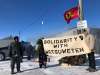
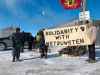
About a dozen people milled about the site, which featured Mohawk flags, a sign expressing solidarity with the Wet’suwet’en and a mound of snow pushed onto the railway tracks. Children played in the snow, and other supporters came by to sit by a fire or replenish the store of coffee and donuts.

Some protesters said they could stay put for weeks or months if need be — but they said they’ll take their cue from Wet’suwet’en hereditary chiefs in B.C. opposing construction of the Coastal GasLink pipeline.
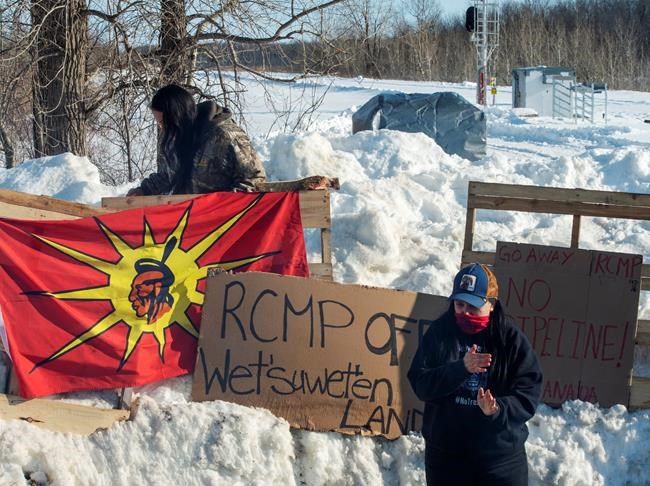
Members of the Mohawk community man a blockade of the commuter rail line Wednesday, February 12, 2020 in Kahnawake, Que..THE CANADIAN PRESS/Ryan Remiorz

Tekarontake, a Kahnawake Mohawk, said the conflict, which has triggered Indigenous actions across the country, is the result of a failure by governments and others to accept that the land belongs to the people who continue to adhere to the ways of their ancestors.

“That’s whose land this is, we have never disconnected ourselves from our mother. This land is our mother,” he said. “We haven’t abandoned her, we still love her, we care for her and we will defend her to the best of our ability.” He said for the blockade to end, Canada will have to “come to its senses.”

The blockade in southern Quebec began Saturday as RCMP officers in B.C. enforced an injunction requiring pipeline opponents to clear the way for construction. Commuter train service on the line has been halted since Monday morning.

On Wednesday, Quebec Premier Francois Legault called on the federal government to do more to help resolve the anti-pipeline protests that are disrupting rail service across the country.

“I would hope that the federal government would work more with us on this problem, which is a Canadian problem,” Legault told reporters. “What’s more, it is a problem related to transportation, which is a federal jurisdiction, it’s an issue related to aboriginals, which is a shared jurisdiction, so I do not understand why (Transport Minister Marc) Garneau and the federal government do not want to get involved with us in the matter.”

Tekarontake shrugged off the inconvenience faced by those who use the rail line. “Everything inconveniences them anyways,” he said. “But they still get to work. There are still buses, cars.”

One Kahnawake community member, a father and grandfather who didn’t want his name used, said he’s been coming by periodically with wood to keep the fire going.

“It’s a symbol — they know that we’re standing with them in northern B.C.,” he said. He added that no one at the barricade wishes to see tensions escalate.

Dwayne Zacharie, chief of Kahnawake’s Peacekeepers police force, said his members are ensuring community members are safe.

The tracks in question running between Montreal and Albany, N.Y., belong to CP Rail, which has halted freight shipments on the line.

“CP has been impacted by the blockades and continues to monitor the situation closely,” the Calgary-based company said in an email.

Exo, which runs the commuter trains on the affected line, said it is making decisions daily on whether service can resume. Since Monday, it has been hiring buses to provide shuttle service to the roughly 3,000 daily passengers who have seen train service halted between Montreal and several suburban towns southwest of the city.

Louis-Andre Bertrand, a spokesman for the transit authority, said a shortage of drivers and buses in the Montreal area could force it to resort to school buses if the closure of the line continues.

This report by The Canadian Press was first published Feb. 12, 2020.

Report Error Submit a Tip

More Stories

COVID-19 vaccine Q-and-A: What you need to know

Melissa Couto Zuber, The Canadian Press 5 minute read Preview

COVID-19 vaccine Q-and-A: What you need to know

Melissa Couto Zuber, The Canadian Press 5 minute read Wednesday, Jan. 13, 2021

Canada's COVID-19 vaccine rollout hits its one-month mark on Thursday, but questions remain about the inoculations themselves, how they're being distributed and what happens next.

The Canadian Press recently spoke with experts in infectious disease, immunology and public health to help get some clarity on popular queries.

WHO'S NEXT IN LINE TO GET THE VACCINE?

Canada's provinces seem to mostly be adhering to recommendations put forward by the National Advisory Committee on Immunization (NACI), which suggests first vaccinating those most vulnerable to severe COVID outcomes, as well as those who care for them.

Read
Wednesday, Jan. 13, 2021

Letters, Sept. 28

7 minute read Yesterday at 2:00 AM CDT

Other options are closer

Every Winnipeg driver learns this lesson eventually: keep your eyes on the horizon too long and the pothole gets you. Manitoba’s energy debate has the same problem. We keep looking far down the road for the next big project and missing what’s close at hand.

Scott Forbes (Time for 21st-century leadership at MB Hydro, Think Tank, Sept. 24) makes a strong case for more wind and storage. But much of this debate is still measured in thousands of megawatts, generated far from where the power is used.

The more immediate opportunity is close to home.

Use it twice: a data centre we could support

Hersh Seth 5 minute read Preview

Use it twice: a data centre we could support

Hersh Seth 5 minute read Thursday, Jul. 30, 2026

In June, Premier Wab Kinew rejected a massive AI data centre planned near Île-des-Chênes. The project would have used 500 megawatts of power, which is about the same as the Grand Rapids generating station, and would have run on six natural gas turbines. Kinew said the environmental cost was too high and the long-term benefit for Manitobans was too low.

He made the right call. But simply saying no to data centres is not enough.

Winnipeg is a cold city. Data centres are basically huge electric heaters with computers inside. Almost every watt they use turns into heat, and most facilities pay to release it into the air. In a city that spends half the year paying to stay warm, that’s not just waste; it’s an opportunity. The idea is simple: use the energy twice. First for computing, then for heating our buildings.

The stakes are real. Manitoba Hydro’s new resource plan says peak demand will exceed our capacity as early as 2029 or 2030, and that the province will need about 1,760 additional megawatts of dependable capacity by 2035.

Read
Thursday, Jul. 30, 2026

Kinew adds cabinet portfolio to focus on first responders

Carol Sanders and Nicole Buffie 5 minute read Preview

Kinew adds cabinet portfolio to focus on first responders

Carol Sanders and Nicole Buffie 5 minute read Yesterday at 3:47 PM CDT

Premier Wab Kinew shuffled his cabinet Monday and created a new ministerial position that will oversee first responders in the province.

Kinew appointed David Pankratz, the MLA for Waverley, as minister responsible for first responder initiatives.

Tuxedo MLA Carla Compton was appointed minister responsible for accessibility, taking over the role from Families Minister Nahanni Fontaine.

The new ministers were sworn in at a ceremony at the legislature Monday afternoon.

Read
Yesterday at 3:47 PM CDT

Quebec seeks resolution to rail line blockade

Sidhartha Banerjee, The Canadian Press 4 minute read Preview

Quebec seeks resolution to rail line blockade

Sidhartha Banerjee, The Canadian Press 4 minute read Wednesday, Feb. 12, 2020

KAHNAWAKE, Que. - Mohawks manning a barricade that has disrupted rail traffic near Montreal said Wednesday they'll remain in place as long as the RCMP is present on territory of the Wet'suwet'en First Nation in northern British Columbia.

About a dozen people milled about the site, which featured Mohawk flags, a sign expressing solidarity with the Wet'suwet'en and a mound of snow pushed onto the railway tracks. Children played in the snow, and other supporters came by to sit by a fire or replenish the store of coffee and donuts.

Some protesters said they could stay put for weeks or months if need be — but they said they'll take their cue from Wet'suwet'en hereditary chiefs in B.C. opposing construction of the Coastal GasLink pipeline.

Tekarontake, a Kahnawake Mohawk, said the conflict, which has triggered Indigenous actions across the country, is the result of a failure by governments and others to accept that the land belongs to the people who continue to adhere to the ways of their ancestors.

Read
Wednesday, Feb. 12, 2020

Pallister’s ego behind carbon tax flip-flop

Dan Lett 6 minute read Preview

Pallister’s ego behind carbon tax flip-flop

Dan Lett 6 minute read Thursday, Oct. 4, 2018

It doesn't make any sense.

Earlier this week, Manitoba Premier Brian Pallister stunned onlookers inside and outside the province with a decision to abandon his own $25-per-tonne carbon tax — the core lever in a complex, provincewide plan to curb carbon emissions.

The premier told reporters Wednesday he was throwing out nearly two years of work on a homegrown climate change plan because Ottawa did not "respect" Manitoba's desire to hold carbon taxes at about half the level demanded by the federal government.

It was not clear what Pallister meant by respect; the two levels of government disagree about the level at which carbon taxes should be set. Up until this week, the two levels of government disagreed over policy and methodology.

Read
Thursday, Oct. 4, 2018