Chiefs head to court over pipeline as supporters take to streets in protest

Advertisement

Advertise with us

Two hereditary chiefs from a British Columbia First Nation at the heart of a wave of national protests launched a constitutional challenge of fossil fuel projects on Wednesday as Prime Minister Justin Trudeau called for demonstrators to observe the rule of law.

Read this article for free:


or

Already have an account? Log in here »

To continue reading, please subscribe:

Subscribe and receive a limited-edition Free Press branded hat or tote.

Digital Subscription

One year of digital access for only $205*

  • Enjoy unlimited reading on winnipegfreepress.com
  • Read the E-Edition, our digital replica newspaper
  • Access News Break, our award-winning app
  • Play interactive puzzles

*First annual payment billed as $205.00 + GST for one year. This annual subscription will automatically renew at $233.00 + GST every 52 weeks (10% off the regular annual price of $259.35). Offer available to new and qualified returning subscribers only. Cancel any time.

To continue reading, please subscribe:

Add Free Press access to your Brandon Sun subscription for only an additional

$1 for the first 4 weeks*

  • Enjoy unlimited reading on winnipegfreepress.com
  • Read the E-Edition, our digital replica newspaper
  • Access News Break, our award-winning app
  • Play interactive puzzles
Start now

*Your next Brandon Sun subscription payment will increase by $1.00 and you will be charged $17.95 plus GST for four weeks. After four weeks, your payment will increase to $24.95 plus GST every four weeks.

Hey there, time traveller!
This article was published 12/02/2020 (2423 days ago), so information in it may no longer be current.

Two hereditary chiefs from a British Columbia First Nation at the heart of a wave of national protests launched a constitutional challenge of fossil fuel projects on Wednesday as Prime Minister Justin Trudeau called for demonstrators to observe the rule of law.

The challenge calls on the Federal Court to declare that Canada is constitutionally obliged to meet international climate change targets, which the chiefs contend would cancel approvals for a natural gas pipeline that runs through traditional Wet’suwet’en territory in northern B.C.

“If Canada is allowed to continue approving infrastructure for fracked gas projects on a 40-year timeline, our territories will become a wasteland before the project licenses expire,” Chief Lho’imggin, who also goes by Alphonse Gagnon, said in a statement.

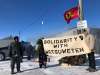
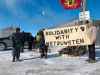
People arrive at the train track blockade in Tyendinaga Mohawk Territory near Belleville, Ontario, on Tuesday Feb. 11, 2020, in support of Wet'suwet'en's blockade of a natural gas pipeline in northern B.C. THE CANADIAN PRESS/Lars Hagberg

“As house chief it is my responsibility to protect our house territory. We’re asking the court to get Canada to act before it is too late.”

The challenge came as protesters continued to blockade major ports and rail lines in Ontario, Quebec and British Columbia, scuttling freight and passenger service and prompting growing calls for federal government intervention.

Speaking in Senegal on Wednesday, Trudeau called on all sides to resolve their differences but insisted that protesters must honour Canadian law.

“We recognize the important democratic right — and will always defend it — of peaceful protest,” Trudeau said during a news conference with Senegal President Macky Sall. “But we are also a country of the rule of law, and we need to make sure those laws are respected.”

Trudeau’s remarks, echoed by Canada’s transportation and finance ministers throughout the day, drew scorn from Indigenous protesters backing the Wet’suet’en hereditary chiefs.

Herb Varley, who helped organize a blockade at the Port of Vancouver, accused Trudeau of “mindlessly parroting” the term rule of law, which he said is empty rhetoric.

If his elders had followed the rule of law, he said their language would have died out.

“If my Nisga’a grandmothers, grandfathers, aunties and uncles had followed the rule of law, we wouldn’t know we were Nisga’a,” he said outside the B.C. Supreme Court in Vancouver, where he and other protesters announced they were challenging an injunction served against them over the weekend.

Blockade organizers across Canada have said they’re acting in solidarity with those opposed to the Coastal GasLink pipeline project that crosses the traditional territory of the Wet’suwet’en First Nation near Houston, B.C.
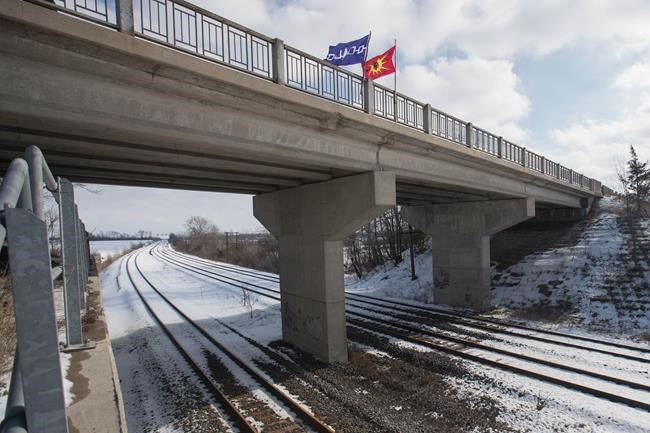
A Six Nations flag, left, and a Mohawk warrior flag fly on a bridge over the closed train tracks in Tyendinaga Mohawk Territory, Ont. on Wednesday, Feb. 12, 2020, in support of Wet'suwet'en's blockade of a natural gas pipeline in northern B.C. THE CANADIAN PRESS/Lars Hagberg

The blockades were erected after the RCMP enforced a court injunction last week against Wet’suwet’en hereditary chiefs and their supporters, who had been blocking construction of the pipeline, a key part of a $40-billion LNG Canada liquefied natural gas export project.

Another group of supporters took to the streets in Ottawa on Wednesday morning, moving from the office of the federal justice minister into a major intersection near the Supreme Court of Canada. The crowd caused a traffic jam that backed up vehicles for blocks, but the delay was cleared in less than an hour as protesters dispersed.

Similar protests in Vancouver tied up traffic at different points of the city throughout the day.

B.C. Premier John Horgan said anti-pipeline demonstrators who prevented people from entering the legislature for his government’s throne speech on Tuesday need to respect the rights of others.

“Peaceful demonstration is fundamental to our success as a democracy,” he told a news conference in Victoria on Wednesday. “But to have a group of people say to others you are illegitimate, you are not allowed in here, you are somehow a sellout to the values of Canadians is just plain wrong, and I want to underline that.”

The economic impact of the demonstrations has started to crystallize: Canadian National Railway Co. warned Tuesday that it would have to close “significant” parts of its network unless blockades on its rail lines were removed.

Passenger rail services have also been affected in Ontario, Quebec and B.C., with Via Rail cancelling service on its Montreal-Toronto and Ottawa-Toronto routes until at least the end of the day on Friday because of a blockade near Belleville, Ont. It had previously cancelled service on those routes until the end of the day on Thursday.

Via has also said a blockade near New Hazelton, B.C., means normal rail service is being interrupted between Prince Rupert and Prince George.
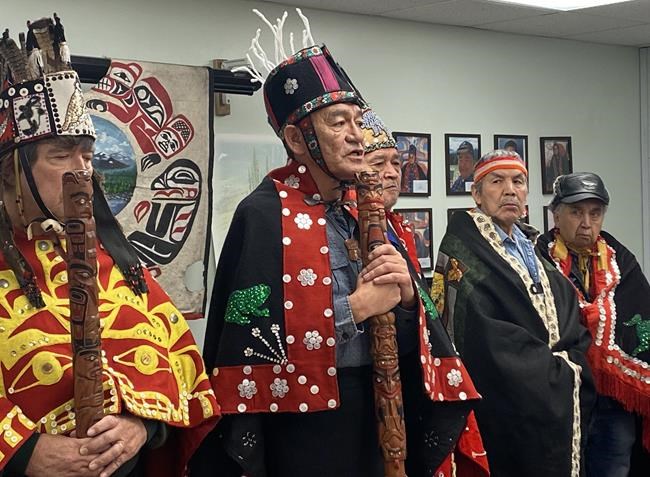
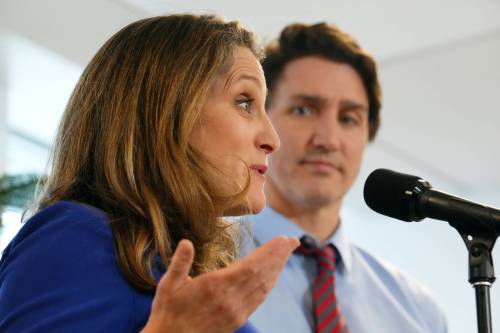
Na'moks (centre), a spokesman for the Wet'suwet'en hereditary chiefs, holds a press conference in Smithers, B.C., Tuesday, Jan.7, 2020, on the one-year anniversary of RCMP enforcement of an injunction granted to Coastal GasLink. Hereditary chiefs of the Wet'suwet'en Nation are pledging to continue fighting a natural gas pipeline through their traditional territory, days after 28 of their supporters were arrested for blocking access to a work site in northern British Columbia. THE CANADIAN PRESS/Amy Smart

In Manitoba, Premier Brian Pallister said the Justice Department will seek an injunction to end a rail blockade west of Winnipeg and have it enforced within a few days.

“As much as we will always respect the right of protesters to have a voice, they don’t have a veto and … they don’t have the right to put their rights ahead of everyone else and to disregard the laws of our province and country,” he said in an interview.

The Alberta wheat and barley commissions said rail disruptions of just a few days will cause economic loss for farmers, who have faced difficult harvest conditions.

“Delays will result in farmers being unable to deliver their grain, meaning they can’t be paid at least until service resumes,” said Dave Bishop, chair of the barley commission. “We are still recovering from the harvest from hell and need reliable grain movement in order to get back on track.”

Mohawks at a barricade that has disrupted rail traffic near Montreal said they’ll remain in place as long as the RCMP is present on Wet’suwet’en territory.

Tekarontake, a Kahnawake Mohawk, said the conflict is the result of a failure by governments and others to accept that the land belongs to the people who continue to adhere to the ways of their ancestors.

“That’s whose land this is, we have never disconnected ourselves from our mother. This land is our mother,” he said. “We haven’t abandoned her, we still love her, we care for her and we will defend her to the best of our ability.”

Natural Resources Minister Seamus O’Regan said Transport Minister Marc Garneau is “seized” with the blockades affecting railways.
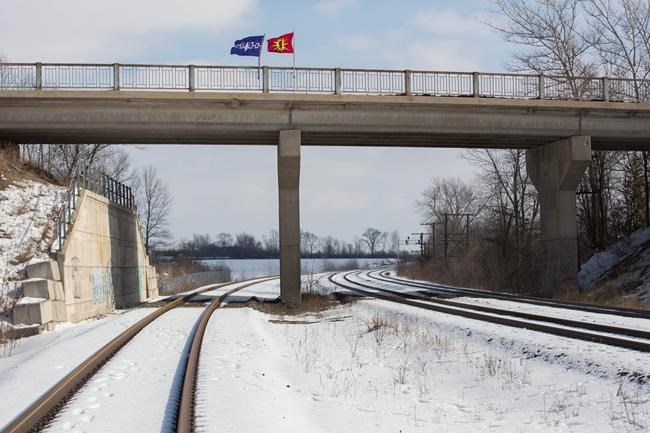
A Six Nations flag, left, and a Mohawk warrior flag fly on a bridge over the closed train tracks in Tyendinaga Mohawk Territory, Ont. on Wednesday, Feb. 12, 2020, in support of Wet'suwet'en's blockade of a natural gas pipeline in northern B.C. THE CANADIAN PRESS/Lars Hagberg

“Our economy really relies on our ability to safely transport goods across the country,” he said.

Asked how he could assure industry that natural resource projects can proceed in Canada, O’Regan said there will always be differing opinions.

“As we work toward net zero (emissions) by 2050 and considering we are an economy that relies heavily on natural resources and natural resource development, there’s always going to be that friction. There will always be that tension.”

This report by The Canadian Press was first published Feb. 12, 2020.

Companies in this story: (TSX:CNR)

Report Error Submit a Tip

More Stories

Winnipeg’s challenge: preparing for weather extremes

Adam Johnston 6 minute read Preview

Winnipeg’s challenge: preparing for weather extremes

Adam Johnston 6 minute read 2:00 AM CDT

A new United Nations report warns the world will exceed the 1.5 C Paris limit by 2030.

Winnipeg’s string of extreme weather events in recent years — this summer’s intense rainstorms that caused flash flooding, basement damage, power outages, prolonged heat waves, last summer’s wildfires, and the freakish October 2019 wet snowstorm — underscores the urgent need for stronger emergency plans and climate resilience in the face of the UN’s new report.

As the city enters an unknown era from increwasing extreme weather events, it must also confront this haunting truth or face future unprepared consequences.

Winnipeg faces persistent challenges, including limited library hours during the summer (they could act as cooling places for the most vulnerable), and gaps in public and active transportation which make it harder for many residents to reach essential services.

Read
2:00 AM CDT

As political jockeying begins, don’t forget job No. 1

Editorial 4 minute read Preview

As political jockeying begins, don’t forget job No. 1

Editorial 4 minute read 2:01 AM CDT

The goal, for all parties in a democracy, is to make the best legislation and bring in the strongest policy forward for voters and citizens.

And every party has a role to play in that effort.

Governments set policy and bring forward legislation. Official oppositions challenge that process with the goal of identifying weaknesses or flaws in proposed laws, bringing forward the positions of groups affected by proposed legislative change, and generally are supposed to bring a critical lens to the process in an effort to improve the final result.

Third parties bring forward still further viewpoints and analysis, often from a different political bent, but valuable insight and viewpoints nonetheless.

Read
2:01 AM CDT

Suspension upheld for teen hockey player involved in hazing

Free Press staff 3 minute read Preview

Suspension upheld for teen hockey player involved in hazing

Free Press staff 3 minute read Sunday, Aug. 9, 2026

A high school hockey player who was found to have been involved in sexualized hazing of rookie teammates lost his suspension appeal.

The youth player was barred from Hockey Canada-sanctioned activities. He was handed the four-year and nine-month suspension from sanctioned hockey after an interim ban issued in March 2024.

He appealed his suspension late last year to the Sport Dispute Resolution Centre of Canada, an independent conflict tribunal, but the centre upheld the youth’s suspension, according to a written decision issued earlier this year.

An independent investigator who probed the hockey player’s actions described the youth as a veteran player who both participated in and co-ordinated the “assigning” of rookie team members to veteran players to perform tasks for them. He himself was “assigned” a rookie, the decision said.

Read
Sunday, Aug. 9, 2026

No museum can tell the whole story

Stuart Williams 5 minute read Wednesday, Jul. 29, 2026

The continuing debate over the Canadian Museum for Human Rights’ Uprooted: Nakba Past and Present exhibit has focused significantly on what the exhibit leaves out.

Some critics argue that the exhibit should have explained the United Nations Partition Plan, the Arab rejection of that plan, the 1948 invasion by neighbouring Arab states, the displacement of Jews from Arab countries, Hamas, October 7, the hostages and the reasons for Israeli security measures.

Others argue with equal conviction that it should also have addressed the Deir Yassin massacre, the expansion of Israeli settlements, decades of occupation, the Right of Return, changing demographic realities and the experiences of Palestinian refugees throughout the Middle East.

All of those subjects matter. Many remain the subject of legitimate scholarly debate. But the controversy points to a broader question that extends well beyond this particular exhibit.

Winnipeg Book Festival starts a new chapter

Ben Sigurdson 4 minute read Preview

Winnipeg Book Festival starts a new chapter

Ben Sigurdson 4 minute read 2:01 AM CDT

Once known as Thin Air, the 2026 Winnipeg Book Festival marks a new chapter heading into its 29th year celebrating fiction, non-fiction and poetry with a new name, new staff and a shorter, more streamlined fest based at The Forks.

Thursday kicks off with a festival blessing and two events with Indigenous authors. Story Lodge (noon to 2 p.m.) features two videos from the new series by Rosanna Deerchild and Kim Wheeler profiling Indigenous authors working in a range of genres. From 3 to 4 p.m., a quartet of children’s authors will discuss the importance of storytelling and Indigenous languages and culture. The Love Local event on Thursday at 6 p.m., brings together a trio of Winnipeg authors — C.C. Benison, Philipp Schott and Margaret Sweatman — all working in different genres.

On Friday at noon, Niigaan Sinclair, Noé Préfontaine and Anna Dewar will discuss author Elaine Dewar’s posthumously released Oblivious, which explores the dark legacy of Canada’s residential schools and segregated hospitals. That event will be followed at 1:30 p.m. by a panel including Samantha Beiko, Ericka Fiddler and Kirsten Wurmann talking about a forthcoming graphic novel from the Prison Libraries Committee.

Aspiring writers will want to attend the 7x7 event Friday at 3 p.m., featuring seven speakers (including author Zilla Jones, publisher Kyla Neufeld and Chris Hall of McNally Robinson) each offering seven-minute presentations about writing and publishing. Both Saturday and Sunday kick off with river walks with writers at 10 a.m.

Read
2:01 AM CDT

Métis federation opens Louis Riel College campus

Tyler Searle 4 minute read Preview

Métis federation opens Louis Riel College campus

Tyler Searle 4 minute read Wednesday, Jul. 29, 2026

Thirteen years after establishing the Louis Riel College, the Manitoba Métis Federation opened the doors to the school’s first official campus on Wednesday — cutting the ribbon on what it hopes will become a thriving centre for Métis education in Winnipeg.

The campus, which occupies a handful of rooms on the ground floor of the MMF’s building at 200 Main St., primarily offers courses related to health care and Indigenous-focused early childhood education, but will expand its slate of training options, said JoAnne Remillard, the federation’s education minister.

“This new campus represents opportunity, education and a commitment to creating pathways for students to achieve their goals and build successful futures,” she said.

“Everyone is excited about this.”

Read
Wednesday, Jul. 29, 2026