Sales of electric vehicles plummet in Ontario after rebate cancellation
Advertisement
Read this article for free:
or
Already have an account? Log in here »
To continue reading, please subscribe:
Digital Subscription
One year of digital access for only $1.44 a week*
- Enjoy unlimited reading on winnipegfreepress.com
- Read the E-Edition, our digital replica newspaper
- Access News Break, our award-winning app
- Play interactive puzzles
*Billed as $5.77 plus GST every four weeks. After 52 weeks, price increases to the regular rate of $19.95 plus GST every four weeks. Offer available to new and qualified returning subscribers only. Cancel any time.
To continue reading, please subscribe:
Add Free Press access to your Brandon Sun subscription for only an additional
$1 for the first 4 weeks*
- Enjoy unlimited reading on winnipegfreepress.com
- Read the E-Edition, our digital replica newspaper
- Access News Break, our award-winning app
- Play interactive puzzles
*Your next Brandon Sun subscription payment will increase by $1.00 and you will be charged $17.95 plus GST for four weeks. After four weeks, your payment will increase to $24.95 plus GST every four weeks.
Read unlimited articles for free today:
or
Already have an account? Log in here »
Hey there, time traveller!
This article was published 15/12/2019 (2514 days ago), so information in it may no longer be current.
TORONTO – Sales of electric vehicles in Ontario have plummeted since the Progressive Conservative government cancelled a rebate last year, hampering progress toward a national target.
In the first six months of this year, sales in Ontario were down more than 55 per cent from the same period in 2018, according to data from Electric Mobility Canada. In the second quarter of this year 2,933 electric vehicles were sold in the province, down from 7,110 in the same period last year.
Ontario is the only province not seeing increases in sales, year over year.
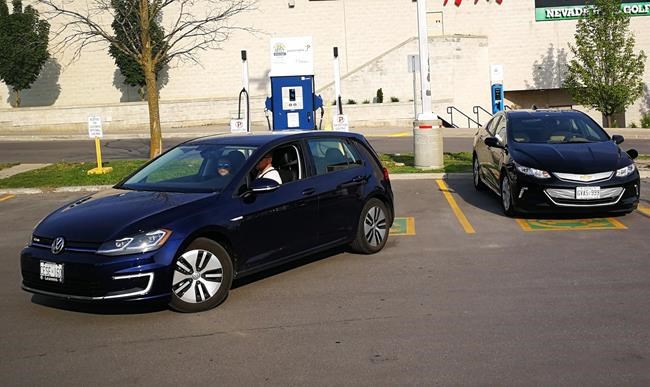
Quebec and British Columbia, which have their own provincial rebates, have long been leading in total sales. Ontario’s figures had been increasing on par with theirs until the province’s financial incentive disappeared.
Under the previous Liberal government, Ontario had offered up to $14,000 back for buyers of electric vehicles, but Premier Doug Ford’s government cancelled it after winning the June 2018 election, saying it was going to people who could already afford expensive cars.
Shortly after that, Ontario’s sales sharply dropped — and national sales did, too.
They rebounded after the introduction this spring of a $5,000 federal rebate, but national sales of electric vehicles are still only at 3.5 per cent, which is a far cry from the federal government’s target of 10 per cent in 2025.
“It’s going to be challenging for the federal government to meet that target…then even more by 2030 (when Ottawa hopes the number rises to 30 per cent),” said Al Cormier of Electric Mobility Canada.
“If Ontario was in the game again it would make the whole thing a lot easier.”
B.C. is now at 10 per cent of sales, with Quebec close behind at seven per cent. In Ontario, electric vehicle made up around three per cent of total passenger vehicle sales at its highest point, then dropped to below one per cent after the cancellation of the provincial rebate, then climbed to sit under two per cent after the introduction of the federal rebate.
Experts say rebates are key because the up-front cost of an electric vehicle can be anywhere from $10,000 to $30,000 more than a similar gas-powered car. Rebates take away some of that initial price shock, said Cara Clairman, the CEO of Plug’n Drive, a not for profit devoted to electric vehicles.
“The total cost of ownership, when you take into account that you’re not going to be paying for gas and there’s less maintenance,” she said. “The total cost of ownership today is actually lower for an EV than for most gas cars.”
Mark Nantais, president of the Canadian Vehicle Manufacturers’ Association, said that right now the auto industry is taking a loss on electric vehicles of upwards of $10,000 a car. The cost of the technology is still so much higher than that of gas-powered vehicles, he said, but it won’t always be that way.
“We see that gap, or that differential, there until probably where you see cost parity in late next decade,” Nantais said.
“We’ve been quite clear on the need to continue with the consumer point-of-purchase incentives. That’s really critical until we reach price parity with internal combustion engines.”
Transportation Minister Caroline Mulroney’s office refused to make her available for an interview.
A spokesman for Environment Minister Jeff Yurek later said the auto industry is giving people more options on electric vehicles than ever before.
“People have an individual choice and responsibility when they are purchasing their next vehicle and as charging infrastructure expands, we are confident there will be an increase in the uptake of electric vehicles,” Andrew Buttigieg wrote in a statement.
Clairman said a 2017 survey of about 1,200 drivers in the Greater Toronto Area found that price was a larger barrier to people purchasing electric vehicles than range anxiety — people’s worry that their electric vehicle will run out of power before reaching their destination.
It helps that vehicle manufacturers are now coming out with models with a battery range of 400 kilometres, Clairman said, but more public charging infrastructure is still needed.
In Ontario, the former government had put $20 million toward installing a network of 500 charging stations across the province. Nearly 350 of them were ultimately put into service, and the current government has not built any more. Metrolinx, the provincial transit agency, actually removed some earlier this year.
Private companies such as Petro-Canada are stepping in to build charging stations and there are now roughly 1,400 public chargers in Ontario, according to federal and provincial data. Experts say more are needed.
It would help, Cormier said, if the government put in place requirements for charging stations in new public buildings and garages. Earlier this year, the Ontario government removed a requirement for new homes to include the wiring for potential electric vehicle charging stations.
“It’s not just that they haven’t supported building these things up, they’ve actually got in the way of what we were already doing,” said Dianne Saxe, Ontario’s former environmental commissioner whose job was axed by the Ford government.
The transportation sector makes up Ontario’s largest chunk of greenhouse gas emissions, at 35 per cent. But electric vehicles are not the silver bullet, she suggested.

“I don’t start with saying we need to change gasoline cars into electric cars,” she said. “What we most need to do is reduce the need to travel by car.”
Building denser communities that reduce the need for vehicle travel is the best “bang for the buck,” Saxe said, followed by public transit, followed by electric vehicles for transportation needs that can’t be met the first two ways.
Clairman believes that the pace of electric vehicle sales will one day pick up in Ontario, just perhaps not as quickly as it otherwise would have.
“Do I think rebates would help?” she said. “Yes. We’ll get there eventually either way. We’d love to speed it up. With the urgency of climate change we really should speed it up.”
This report by The Canadian Press was first published Dec. 15, 2019.
Related Articles
One less obstacle for electric vehicles
Advertisement Advertise With Us
Advertisement Advertise With Us