Scheer promising carbon tax will be history by January if he gets majority
Advertisement
Read this article for free:
or
Already have an account? Log in here »
To continue reading, please subscribe:
Digital Subscription
One year of digital access for only $1.44 a week*
- Enjoy unlimited reading on winnipegfreepress.com
- Read the E-Edition, our digital replica newspaper
- Access News Break, our award-winning app
- Play interactive puzzles
*Billed as $5.77 plus GST every four weeks. After 52 weeks, price increases to the regular rate of $19.95 plus GST every four weeks. Offer available to new and qualified returning subscribers only. Cancel any time.
To continue reading, please subscribe:
Add Free Press access to your Brandon Sun subscription for only an additional
$1 for the first 4 weeks*
- Enjoy unlimited reading on winnipegfreepress.com
- Read the E-Edition, our digital replica newspaper
- Access News Break, our award-winning app
- Play interactive puzzles
*Your next Brandon Sun subscription payment will increase by $1.00 and you will be charged $17.95 plus GST for four weeks. After four weeks, your payment will increase to $24.95 plus GST every four weeks.
Read unlimited articles for free today:
or
Already have an account? Log in here »
Hey there, time traveller!
This article was published 17/10/2019 (2560 days ago), so information in it may no longer be current.
LITTLE HARBOUR, N.S. – Conservative Leader Andrew Scheer gave a glimpse Thursday of what kind of prime minister he might seek to be: one not tethered to conventions.
He promised to do whatever it takes to turn his marquee pledge to repeal the carbon tax into reality within his first 100 days in office, the first time he’s attached a deadline to the commitment.
“There is no time to lose,” he said during an event at a freight trucking company in Brampton, Ont., west of Toronto.
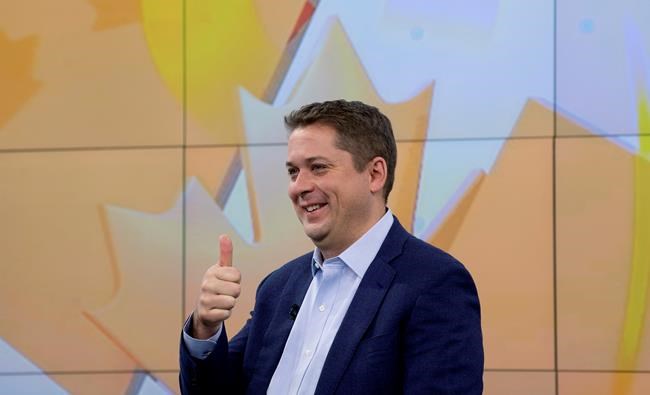
“We will use every available legislative tool to overcome any obstruction and delay so that we pass this legislation on time. Trudeau’s carbon tax will be history by Jan. 1, 2020.”
As a former Speaker of the House of Commons, Scheer is familiar with the tricks and strategies that governments can use to speed legislation into law.
As Speaker, he was also called upon at times to rule against or in favour of those efforts, many of which have previously proven controversial, including cutting off how much time MPs have to debate bills.
His promise on the carbon tax law came as opinion polls continue to suggest Monday’s vote will result in a minority Liberal or Conservative government.
Scheer has continually dodged questions about how he’d proceed with his platform if he forms government without a majority; all the other parties, for example, do not agree with his plan to cancel the carbon tax and would likely not vote in favour of the legislation he promised Thursday.
But the way the current bill is written, he might not even need a new law. According to the existing one, cabinet can set the pricing and where it applies, so, theoretically, a Conservative government could just amend the law to have a carbon price of zero that applies nowhere.
The party, however wants a law. That way, if a future government were to want to re-introduce a carbon tax, they’d have to fight it out in the House of Commons all over again.
There’s also the question of whether Liberal Leader Justin Trudeau could continue on as prime minister even if his party wins fewer seats than the Tories in a minority government.
Scheer told an overflow crowd at an evening rally in Pictou County, N.S. that wasn’t going to happen.
“Justin Trudeau started off his campaign a few weeks ago, asking for four more years,” he said.
“But I’m hear to tell you he’s only got four more days.”
But parliamentary convention leaves room for the scenario — as the incumbent prime minister, Trudeau could still form a government and face the House of Commons if he can cobble together a coalition or a less formal arrangement with other parties to support him on confidence votes.
Scheer said Thursday he takes a different view.
“Obviously, what we are asking Canadians for is a strong Conservative majority mandate,” he said.
“It is the case that the party that wins the most seats in modern Canadian history has been the party that forms the government.”
Though he might be dancing around minority government convention, there is another political precedent he appears to believe in.
“The other convention in modern Canadian politics is that the prime minister who enters into an election and comes out of that election with fewer seats than another party resigns,” Scheer said.
Scheer also suggested that under a Conservative government, he wouldn’t necessarily follow in Trudeau’s footsteps and put together a gender-balanced cabinet.
“We will have a cabinet made up of highly qualified candidates,” he said. “We will put the best people in the best jobs. We might even end up with more women in our cabinet depending on the results of Monday’s election.”
Scheer told Toronto radio host John Moore on Thursday morning that his party’s internal polling numbers are showing a majority, as the party polls exclusively in seats that can help determine who holds the balance of power.
“We are going to win on Monday. I am very optimistic,” he said
“There’s still a chunk of the electorate that is still undecided, still making up their mind, and we believe we have an edge on the types of issues they are looking at.”
But as Moore pointed out, some voters’ indecision is linked not to pocketbook promises but Scheer’s own beliefs. He pressed Scheer on his position on same-sex marriage, which Scheer has not clearly said whether he supports.
Moore said Scheer seems to hold an opinion that some relationships are “lesser.”
“I’ve been with my partner for 25 years — how is our marriage different from yours?” he asked.
Scheer said he supports equal rights, and also doesn’t judge how people live their lives.
“The only thing I am entitled to judge is Justin Trudeau’s record,” he said.
The same-sex marriage issue has followed Scheer throughout the campaign, nearly in tandem with questions about his position on abortion.
Scheer campaigned later Thursday with a staunchly pro-life candidate. Journalists travelling with him were unable to attend due to what his staff called logistical issues around the need to move on to the evening event in the riding of Central Nova.
It’s a district with historical Tory ties, including being the longtime political home of former Conservative cabinet minister Peter MacKay, who flew in for the event.

If Scheer fails to form a majority on Monday, MacKay’s name has already being tossed around in connection with another form of political convention: the meeting where the Tories’ next leader will be chosen.
But MacKay called those rumours “fake news” on Thursday night, even as supporters at the rally were stopping him to tell him he should run.
“People will talk,” he said.
“The suggestion that there is some movement afoot is just not happening. Period. Full stop.”
This report by the Canadian Press was first published Oct. 17, 2019.
Related Articles
What happens if nobody wins a majority on Monday
Advertisement Advertise With Us
Advertisement Advertise With Us