NDP pledges more money to prevent disastrous effects of climate change

Advertisement

Advertise with us

GATINEAU, Que. - The New Democrats promised Sunday to more than double the amount of federal money earmarked to prevent damage from natural disasters such as floods.

Read this article for free:


or

Already have an account? Log in here »

To continue reading, please subscribe:

Subscribe and receive a limited-edition Free Press branded hat or tote.

Digital Subscription

One year of digital access for only $205*

  • Enjoy unlimited reading on winnipegfreepress.com
  • Read the E-Edition, our digital replica newspaper
  • Access News Break, our award-winning app
  • Play interactive puzzles

*First annual payment billed as $205.00 + GST for one year. This annual subscription will automatically renew at $233.00 + GST every 52 weeks (10% off the regular annual price of $259.35). Offer available to new and qualified returning subscribers only. Cancel any time.

To continue reading, please subscribe:

Add Free Press access to your Brandon Sun subscription for only an additional

$1 for the first 4 weeks*

  • Enjoy unlimited reading on winnipegfreepress.com
  • Read the E-Edition, our digital replica newspaper
  • Access News Break, our award-winning app
  • Play interactive puzzles
Start now

*Your next Brandon Sun subscription payment will increase by $1.00 and you will be charged $17.95 plus GST for four weeks. After four weeks, your payment will increase to $24.95 plus GST every four weeks.

Hey there, time traveller!
This article was published 22/09/2019 (2570 days ago), so information in it may no longer be current.

GATINEAU, Que. – The New Democrats promised Sunday to more than double the amount of federal money earmarked to prevent damage from natural disasters such as floods.

NDP Leader Jagmeet Singh pledged to add $2.5 billion to the federal government’s disaster mitigation fund, saying he wants to help people and businesses prevent problems.

“What we’ve seen for too long is that there’s a crisis that happens and then afterwards there’s a response,” he said after meeting with property owners affected by recent floods in Quebec.
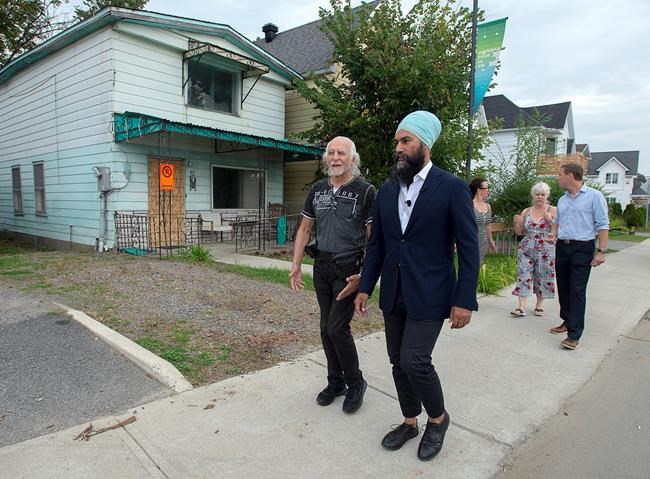
NDP Leader Jagmeet Singh, joined by area residents, tours a neighbourhood damaged by recent flooding during a campaign stop in Gatineau, Que. on Sunday, Sept. 22. 2019. THE CANADIAN PRESS/Andrew Vaughan

“A flood happens and the water damages a business, means it can’t be opened (and) has to shut down or it damages homes, and instead of responding after the case what we’re proposing is we give investments to municipalities right now so they can put in place the infrastructure to avoid this from happening.”

The national Disaster Mitigation and Adaptation Fund has currently set aside $2 billion to support large-scale infrastructure programs that help communities better manage such risks.

Projects must meet “national significance” criteria, such as reducing impacts on essential services, the health and safety of Canadians or a region’s economic activity. There must be at least $20 million in eligible expenses for a project to qualify for funding under the program.

Singh said the criteria are too restrictive. The funding also comes with cost-sharing requirements for provinces and municipalities, and the NDP leader said he would get rid of that hurdle as well as the minimum project amount.

“We would remove those barriers because our plan is to make sure it’s accessible to everyone who needs it, and the goal is to avoid responding after a crisis and instead to prevent the crisis,” he said.

Singh said the idea is to help people avoid disasters and be able to stay in their current homes.

The Federation of Canadian Municipalities welcomed the NDP announcement as a “critical first step.”

The federal government said an increasing number of Canadian communities have experienced significant weather-related events and disasters triggered by natural hazards such as floods, wildland fires and droughts.

It said these events are growing in frequency as a result of climate change.

The Liberals noted that they introduced the disaster mitigation and adaptation fund, and said that communities across the country have received funding to offset costs of building better protections.

This report by The Canadian Press was first published Sept. 22, 2019.

Report Error Submit a Tip

More Stories

Norway's Ruud wins Olympic gold year after father's death

Jake Seiner, The Associated Press 5 minute read Preview

Norway's Ruud wins Olympic gold year after father's death

Jake Seiner, The Associated Press 5 minute read Wednesday, Feb. 9, 2022

The decorated alpine athlete was disqualified from her first two races in Beijing, but still has plenty of events to come.

Read
Wednesday, Feb. 9, 2022

Today’s horoscope

Georgia Nicols 4 minute read Preview

Today’s horoscope

Georgia Nicols 4 minute read 2:00 AM CDT

MOON ALERT: There are no restrictions to shopping or important decisions today. The moon is in Leo.

ARIES (March 21-April 19)

Social plans are unpredictable. Likewise, sports and playful activities with children are potentially accident-prone. Be vigilant! Nevertheless, this is a powerful day to make creative advances in the arts, financial speculation and the entertainment world.

TAURUS (April 20-May 20)

Read
2:00 AM CDT

Province looks to boost safety for cannabis workers

Free Press staff 2 minute read 2:56 PM CDT

The province is introducing new legislation it hopes will improve safety for those working in cannabis stores.

“The safety of Manitobans is always a main priority for this government, so when we heard from the Manitobans that work in these stores that this is what was needed to help keep them safe, we listened,” Justice Minister Matt Wiebe said in a news release.

The province introduced Bill 56 on Monday, which would amend the Liquor, Gaming and Cannabis Control Act.

The first of two amendments would remove the requirement for cannabis stores to have window coverings on storefronts, which the province said will increase visibility from the outside and ensure workers are not secluded from public view.

The freedom to create can be a balm for the soul

Deborah Schnitzer 5 minute read 2:01 AM CDT

My mother-in-law, Malka, came to Toronto in 1958 from postwar Poland. She came with unbearable losses authored by the Third Reich fascist fantasies that had destroyed her world.

She suffered the murder of her husband and second child, a newborn. She endured a hatred of her very being that defies reason and reckoning, yet she came, nonetheless, with profound wits about her and a courage groomed by the black market in Siberia where she somehow kept her first-born toddler alive by placing her in an unlit closet where the child would be safe while Malka bartered for food.

After the war, she married a survivor whose wife and children and been exterminated. Together, they had a son; I married that son, his story and the longest hatred it embodied.

Even given the profound and forbidding ugliness of the world Malka fled, she somehow created, in her third act, a single piece of art she found beautiful.

The election of our discontent

Matthew Frank 7 minute read Preview

The election of our discontent

Matthew Frank 7 minute read Yesterday at 2:37 PM CDT

There’s an undercurrent of unhappiness running through the Winnipeg electorate as the municipal election day approaches.

One-half of Winnipeggers believe the city is heading in the wrong direction, according to a new Abacus Data poll, with nearly one-third unsure if Winnipeg is regressing or progressing.

Only 21 per cent of residents believe the city is on the right track, the Free Press-commissioned poll found.

That discontentment extends to how the city spends its tax dollars, with four in 10 Winnipeggers believing they receive poor value for what they pay in property taxes.

Read
Yesterday at 2:37 PM CDT

Thank Manitoba’s teachers by investing in students

Lillian Klausen 5 minute read 2:00 AM CDT

Manitoba’s students are settling into a new school year. Whether you graduated in 1986 or 2006, today’s classrooms look very different from the ones you remember.

Students reflect the changing makeup of our communities — differences in social, emotional, physical and cognitive abilities and socioeconomic stresses are all increasingly present and adding to the complexity of our classrooms.

Meeting these differing individual needs is no easy feat. It requires manageable class sizes, school counsellors, social workers, specialized resource teachers and investment in the systems that can help students thrive. But when those supports aren’t available, students’ needs don’t disappear. Increasingly, it falls to classroom teachers to try to fill the gaps.

When I started working as a teacher more than 30 years ago, we had budgets for resources when we needed them. Today, the needs of students have diversified and increased, but the funding for our public schools is failing to meet them.