WEATHER ALERT

Alberta set to pass law to kill provincial carbon tax, as federal tax looms

Advertisement

Advertise with us

EDMONTON - Alberta's consumer carbon tax is dead, setting the stage for a showdown with Ottawa over the imposition of a new one.

Read this article for free:


By clicking the button above, an account will be created and you will begin to receive some of our recommended newsletters. You may opt out of any newsletter by visiting your Email and Communication Preferences page or by clicking "unsubscribe" at the bottom of any email.

or

Already have an account? Log in here »

To continue reading, please subscribe:

Digital Subscription

One year of digital access for only $1.44 a week*

  • Enjoy unlimited reading on winnipegfreepress.com
  • Read the E-Edition, our digital replica newspaper
  • Access News Break, our award-winning app
  • Play interactive puzzles

*Billed as $5.77 plus GST every four weeks. After 52 weeks, price increases to the regular rate of $19.95 plus GST every four weeks. Offer available to new and qualified returning subscribers only. Cancel any time.

To continue reading, please subscribe:

Add Free Press access to your Brandon Sun subscription for only an additional

$1 for the first 4 weeks*

  • Enjoy unlimited reading on winnipegfreepress.com
  • Read the E-Edition, our digital replica newspaper
  • Access News Break, our award-winning app
  • Play interactive puzzles
Start now

*Your next Brandon Sun subscription payment will increase by $1.00 and you will be charged $17.95 plus GST for four weeks. After four weeks, your payment will increase to $24.95 plus GST every four weeks.

Hey there, time traveller!
This article was published 30/05/2019 (2713 days ago), so information in it may no longer be current.

EDMONTON – Alberta’s consumer carbon tax is dead, setting the stage for a showdown with Ottawa over the imposition of a new one.

The province cancelled its tax on gasoline at the pumps and on home heating fuels just after midnight Thursday morning.

Premier Jason Kenney told the house later in the day that the bill delivers a merciful end to a tax that didn’t stop the global rise of greenhouse gas emissions but did hurt working families.
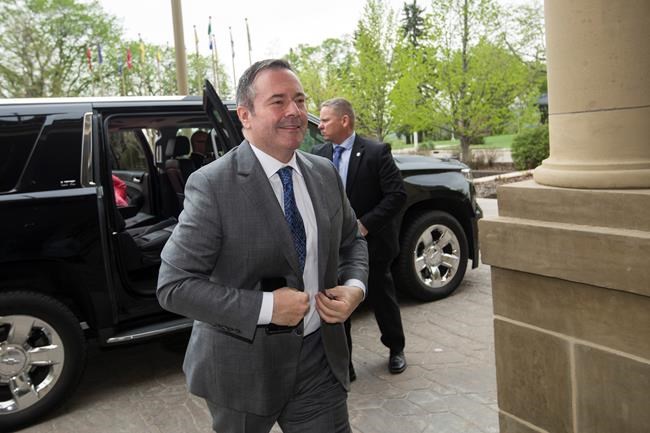
Premier Jason Kenney arrives to a meeting with Alberta NDP Leader Rachel Notley and senators in Edmonton, Alta., on Thursday, May 23, 2019. THE CANADIAN PRESS/Amber Bracken

“We have barely been in office for a month and we are already, today, delivering to Albertans the biggest tax break in our province’s history,” Kenney said as his United Conservative caucus members applauded.

Kenney criticized and mocked former premier Rachel Notley and the NDP for bringing in the tax, especially after not running on it in the 2015 election campaign.

He said the tax didn’t deal with climate change and didn’t deliver any “social licence” to garner further national or international support or acceptance of Alberta’s oil and gas industry.

“So what is the point?” Kenney said rhetorically.

“The best answer I can come up with is this: it makes them feel better about themselves. It makes them feel virtuous. And it makes the NDP feel like somehow they are saving the planet.”

Some critics labelled the day rich in irony as Kenney cancelled the tax at the same time as heavy smoke from raging forest fires in the north blanketed the capital city, turning the sky an eerie dark umber by noon and triggering the activation of street lights.

Kenney was to hold an outdoor afternoon news event at a gas station to officially mark the end of the tax, but cancelled it to get an update on the fires.

Opposition NDP House Leader Deron Bilous wouldn’t draw a link between the wildfires and the cancelled tax but said humans do have an impact on climate that needs to be addressed. There has been debate on the links between global warming and the increase in extreme weather events like forest fires.

The legislature is now in the final stage of debate of An Act to Repeal the Carbon Tax to make the change official. The bill is expected to pass early next week.

Killing the carbon tax was a signature campaign promise of Kenney’s UCP, which won a majority government last month.

In Ottawa, Federal Environment Minister Catherine McKenna decried Alberta’s decision to end the provincial carbon tax, which she dubbed the “make pollution free again bill.”

She said Canada will move quickly to impose the federal version on Alberta.

“We’re looking to do it as soon as possible,” said McKenna.

Alberta now joins New Brunswick, Ontario, Manitoba and Saskatchewan — provinces that have declined to impose their own carbon levies, leaving Ottawa to impose one for them.

Kenney has said if Ottawa impose its fee, he will join Saskatchewan and Ontario in fighting it in court.

Alberta is expected to argue that Ottawa does not have the constitutional authority to levy the tax and that, in any event, Alberta is already paying one with its current tax of greenhouse gases on large emitters.

Alberta’s fee, launched on Jan. 1, 2017, by the previous NDP government, taxed carbon at $30 tonne. Drivers were paying almost seven cents a litre more this year with the provincial carbon tax, along with $1.51 a gigajoule on natural gas for heating. Energy Efficiency Alberta says the typical Alberta household uses 120 gigajoules a year.

The federal tax is $20 a tonne but is set to rise annually until it hits $50 a tonne in 2022.

The Alberta tax brought in an estimated $2 billion, much of that rebated to low and middle-income families. It also funded a range of green projects from rapid transit to energy saving light bulbs.

Families will also get rebates from the federal tax.

McKenna said her department has already done preliminary math, given that Kenney’s bill was expected pass, and estimates a family of four in Alberta will get $700 in rebates when they file their 2019 taxes a year from now.

That’s higher than the $377 expected in New Brunswick, $451 in Ontario and $449 in Manitoba. A family in Saskatchewan would get $903.

The rebates are based on the expected amount people will pay. Provinces where coal and natural gas are used more heavily for heating and electricity are likely to shoulder higher carbon tax bills.

McKenna said Kenney is taking a page from the same playbook as Ontario Premier Doug Ford.

“They don’t have a plan to tackle climate change and they don’t have a plan to grow the economy,” said McKenna.

— With files from Mia Rabson in Ottawa
Report Error Submit a Tip

More Stories

China’s electric car sales grow in 2024, as sales of gasoline cars plunge

Ken Moritsugu And Zen Soo, The Associated Press 2 minute read Monday, Jan. 13, 2025

BEIJING (AP) — Sales of all types of electric vehicles rose more than 40% in China last year, while those of gasoline-powered automobiles plunged, industry data showed Monday.

A total of 31.4 million vehicles were sold last year in the world's biggest market by sales, up 4.5% compared from a year earlier, the China Association of Automobile Manufacturers reported. Growth in sales outpaced production, which rose 3.7%.

China's exports of passenger cars jumped almost 20% in 2024, to almost 5 million vehicles. Out of that, exports of what China calls “new energy vehicles,” including battery EVs, fuel-cell cars and plug-in hybrids -- electric vehicles with a small gasoline-powered engine to back up the batteries -- reached 1.28 million. That was a 6.7% increase from 2023.

Domestically, sales of passenger cars rose 13.6% in December, driven in part by rebates for trade-ins, raising sales of all passenger cars in China by 3.1% for the year, to 22.6 million.

Why are Manitoba's school immunization programs so far from achieving herd immunity?

Maggie Macintosh  26 minute read Preview

Why are Manitoba's school immunization programs so far from achieving herd immunity?

Maggie Macintosh  26 minute read Saturday, May. 1, 2021

Sometimes, neither a lollipop nor a dinosaur sticker is enough to convince someone to get a needle.

Dr. Michele Feierstein, a pediatrician for more than 35 years, knows that all too well.

Feierstein has given thousands of immunizations to young patients throughout her career, but she has also had her fair share of difficult conversations with parents who are vaccine-hesitant or outright anti-vaxxers.

She does not bar families who have lukewarm feelings about or adamant views against immunization, whether they be rooted in misinformation, distrust, religious belief, or any other reason, from her practice at the Manitoba Clinic.

Read
Saturday, May. 1, 2021

Fact Check

1 minute read Thursday, Nov. 30, 2023

Fact Check

Having problems with the form?Contact Us Directly |

New council, new opportunies for Winnipeg

Brent Bellamy 6 minute read Preview

New council, new opportunies for Winnipeg

Brent Bellamy 6 minute read 2:00 AM EST

Last week, Winnipeg voters returned Mayor Scott Gillingham to city hall for a second term, but the more surprising election storyline is that nine of the 15 councillors surrounding him will be new faces.

One encouraging aspect of the results is the community-building experience several of these new councillors bring to the job. Their backgrounds in urban planning, neighbourhood advocacy and community development offer valuable perspectives as Winnipeg confronts difficult questions about how it grows.

These perspectives will be particularly important because some of the most consequential decisions councillors can make happen when they evaluate residential development proposals at committee meetings. Over the next four years, the 16 people we’ve just elected will bear the enormous responsibility of deciding where and how Winnipeggers live. These choices will have profound implications for quality of life, social opportunity and the economic viability of our city. They will shape not only the Winnipeg we know today, but the city we leave to our children and grandchildren.

At committee meetings, councillors will hear endless arguments about parking, traffic, and protecting “neighbourhood character.”

Read
2:00 AM EST

Bob Saget, beloved TV dad of 'Full House,' dead at 65

Lynn Elber, The Associated Press 6 minute read Preview

Bob Saget, beloved TV dad of 'Full House,' dead at 65

Lynn Elber, The Associated Press 6 minute read Monday, Jan. 10, 2022

LOS ANGELES (AP) — Bob Saget, the actor-comedian known for his role as beloved single dad Danny Tanner on the sitcom “Full House” and as the wisecracking host of “America’s Funniest Home Videos,” died while on a stand-up tour. He was 65.

Deputies in Orange County, Florida, were called Sunday about an “unresponsive man” in a hotel room at the Ritz-Carlton in Orlando and found Saget dead, according to a sheriff’s statement on Twitter. Detectives found “no signs of foul play or drug use in this case.”

Saget was in Florida as part of his “I Don't Do Negative Comedy Tour.” After warm audience receptions to his gigs Friday in Orlando and Saturday in the Ponte Vedra Beach resort area, he celebrated online.

“I’m back in comedy like I was when I was 26. I guess I’m finding my new voice and loving every moment of it,” he posted Saturday on Instagram.

Read
Monday, Jan. 10, 2022

The ‘Gang of Nine’ and business as usual at city hall

Editorial 4 minute read Preview

The ‘Gang of Nine’ and business as usual at city hall

Editorial 4 minute read 2:00 AM EST

In the early 1990s, after the province reduced the number of municipal wards in Winnipeg to 15, critics spoke at length of how a theoretical “Gang of Eight” could control all decision making at city hall. In subsequent years, there were various incarnations of a Gang of Eight, although it was never conclusively shown that eight members of city council could consistently stay on the same page long enough to dominate civic affairs.

That is an apt tale to consider now, as Winnipeg city hall welcomes nine rookie councillors, the largest number of non-incumbents elected in more than 30 years.

Theoretically, this new group of councillors could band together and push through various reforms. It’s a highly intriguing scenario for anyone who has watched the city, on occasion, shun riskier strategies in favor of status quo politics.

However, as was the case in the early 1990s, the chances of that happening begin to fall apart once you consider the work of building and sustaining a coalition of rookie councillors who come from a broad array of backgrounds.

Read
2:00 AM EST