Equalization protests from Alberta likely pre-election talk: Quebec minister

Advertisement

Advertise with us

OTTAWA - Quebec's finance minister brushed off complaints from Alberta on Monday about his province's share of the federal equalization-funding pie, calling them pre-election posturing in the Prairie province.

Read this article for free:


or

Already have an account? Log in here »

To continue reading, please subscribe:

Subscribe and receive a limited-edition Free Press branded hat or tote.

Digital Subscription

One year of digital access for only $205*

  • Enjoy unlimited reading on winnipegfreepress.com
  • Read the E-Edition, our digital replica newspaper
  • Access News Break, our award-winning app
  • Play interactive puzzles

*First annual payment billed as $205.00 + GST for one year. This annual subscription will automatically renew at $233.00 + GST every 52 weeks (10% off the regular annual price of $259.35). Offer available to new and qualified returning subscribers only. Cancel any time.

To continue reading, please subscribe:

Add Free Press access to your Brandon Sun subscription for only an additional

$1 for the first 4 weeks*

  • Enjoy unlimited reading on winnipegfreepress.com
  • Read the E-Edition, our digital replica newspaper
  • Access News Break, our award-winning app
  • Play interactive puzzles
Start now

*Your next Brandon Sun subscription payment will increase by $1.00 and you will be charged $17.95 plus GST for four weeks. After four weeks, your payment will increase to $24.95 plus GST every four weeks.

Hey there, time traveller!
This article was published 10/12/2018 (2852 days ago), so information in it may no longer be current.

OTTAWA – Quebec’s finance minister brushed off complaints from Alberta on Monday about his province’s share of the federal equalization-funding pie, calling them pre-election posturing in the Prairie province.

Canada’s often contentious equalization program has come under fire again after the public learned over the weekend that Alberta, despite dealing with a painful collapse in oil prices, once again failed to qualify to receive payments from Ottawa.

The energy-producing province has been struggling with the economic consequences of a global oil-price drop as well as an extra discount on the price of western Canadian crude caused by transportation constraints.
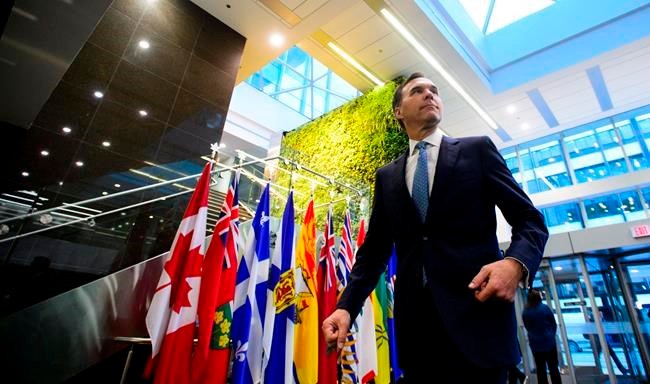
Finance Minister Bill Morneau makes his way to a meeting with his provincial and territorial counterparts in Ottawa on Monday, Dec. 10, 2018. THE CANADIAN PRESS/Sean Kilpatrick

Opposition politicians in Alberta’s legislature and other observers quickly expressed anger that Quebec will see its payment from the $19.8-billion program rise nearly $1.4 billion to $13.1 billion next year.

Quebec will receive two-thirds of the entire national envelope, even though its economy has strengthened in recent years and its government is predicting a budgetary surplus.

In comparison, Alberta is facing several years of deficits. Critics charge that equalization is based on a flawed formula.

“Equalization does not work for Alberta,” said Alberta’s Finance Minister Joe Ceci, at a national meeting of finance ministers in Ottawa.

Quebec Finance Minister Eric Girard said protests about his province’s equalization share are likely louder than usual because of Alberta’s forthcoming provincial election in May 2019.

“The fact that Alberta will be in an election may be raising the volume on the equalization payment,” Girard said.

Girard, part of the newly elected Coalition Avenir Quebec government, said he recognizes and sympathizes with Alberta’s difficult situation caused by the recent plunge in oil prices — which has meant cheaper gasoline for consumers but punched holes in Alberta’s finances. He said he hopes things will improve for the province.

“For me, it has nothing to do with equalization,” he said.

The complex equalization formula is based on a three-year moving average of economic performance, so a province’s have- or have-not status can lag behind economy-altering events. It’s designed to help poorer provincial governments provide public services that are reasonably comparable to those in other provinces.

Girard also defended Quebec’s equalization payment, arguing his province is 20-per-cent less rich than the Canadian average and has the second-highest debt burden after Newfoundland and Labrador. He said Quebec is also home to 23 per cent of Canada’s population, but only 19 per cent of the national economy.

The goal for his government is to improve on all these fronts with the aim of eventually reducing Quebec’s dependence on equalization, Girard said.

British Columbia, Saskatchewan, Ontario and Newfoundland will also not get equalization payments in 2019-20. Alberta and other so-called “have” provinces have been calling for a review of the program, which was renewed last year for another five-year term.

Federal Finance Minister Bill Morneau, who hosted Monday’s meeting, showed no willingness to re-open the equalization formula until its next renewal. He said the system was renewed after a “robust discussion.”

Even with renewal years away, Alberta’s Ceci said there are changes that can be made right away. For example, Ceci said provinces with strong economies should not receive “floor payments” under equalization, loans that go to provinces that are no longer eligible for equalization payments they had been expecting.

And he pitched for help solving his province’s oil-transportation trouble.

Ceci said the entire national economy will benefit if Alberta can get its oil to international markets beyond the United States and he insisted pipelines are the safest way to get crude to ocean ports.

TransCanada Corporation had proposed a $15.7-billion pipeline called Energy East, to carry western crude through Quebec to New Brunswick for shipment overseas — but the company abandoned the project more than a year ago, citing market changes and red tape.

With a shortage of pipeline capacity, Alberta recently announced it will buy rail cars to ship another 120,000 barrels of oil a day. The province has been seeking help from the federal government, but Ottawa has been reluctant to offer financial support.

Following Monday’s meeting, Ceci said he repeatedly pressed Morneau to pitch in.

“It’s Christmas, I’m certainly hopeful that there are some things under the tree,” Ceci said.

Asked about rail cars Monday, Morneau said he believes the most important thing Ottawa can do is focus on long-term solutions such as its purchase of the Trans Mountain pipeline. The goal is to get it expanded and carry more Alberta oil to the B.C. coast.

Report Error Submit a Tip

More Stories

Winnipeg Book Festival starts a new chapter

Ben Sigurdson 4 minute read Preview

Winnipeg Book Festival starts a new chapter

Ben Sigurdson 4 minute read 2:01 AM CDT

Once known as Thin Air, the 2026 Winnipeg Book Festival marks a new chapter heading into its 29th year celebrating fiction, non-fiction and poetry with a new name, new staff and a shorter, more streamlined fest based at The Forks.

Thursday kicks off with a festival blessing and two events with Indigenous authors. Story Lodge (noon to 2 p.m.) features two videos from the new series by Rosanna Deerchild and Kim Wheeler profiling Indigenous authors working in a range of genres. From 3 to 4 p.m., a quartet of children’s authors will discuss the importance of storytelling and Indigenous languages and culture. The Love Local event on Thursday at 6 p.m., brings together a trio of Winnipeg authors — C.C. Benison, Philipp Schott and Margaret Sweatman — all working in different genres.

On Friday at noon, Niigaan Sinclair, Noé Préfontaine and Anna Dewar will discuss author Elaine Dewar’s posthumously released Oblivious, which explores the dark legacy of Canada’s residential schools and segregated hospitals. That event will be followed at 1:30 p.m. by a panel including Samantha Beiko, Ericka Fiddler and Kirsten Wurmann talking about a forthcoming graphic novel from the Prison Libraries Committee.

Aspiring writers will want to attend the 7x7 event Friday at 3 p.m., featuring seven speakers (including author Zilla Jones, publisher Kyla Neufeld and Chris Hall of McNally Robinson) each offering seven-minute presentations about writing and publishing. Both Saturday and Sunday kick off with river walks with writers at 10 a.m.

Read
2:01 AM CDT

Being in the black, doesn’t mean being out of the woods

Tom Brodbeck 5 minute read Preview

Being in the black, doesn’t mean being out of the woods

Tom Brodbeck 5 minute read Tuesday, Dec. 10, 2019

The Pallister government may be planning to balance the books in two years. But it doesn’t mean the province will stop borrowing and racking up debt even after it’s in the black. That’s something Premier Brian Pallister alluded to in a year-end press conference Tuesday.

The idea that government still has to borrow money to pay the bills, even with a balanced budget, may sound counterintuitive. But if you look a little deeper into how the province reports its finances, it’s easy to see how the province will still have to borrow money years after it officially balances the books.

That may be disappointing to those who thought a balanced budget — now expected in 2022 — might allow the province to loosen the purse strings. But the way government accounting works, eliminating the deficit doesn’t necessarily mean the province no longer has borrowing requirements.

“We’re not out of the woods yet,” Pallister said Tuesday when talking about the province’s financial status. “We have the highest debt per capita in Canada.”

Read
Tuesday, Dec. 10, 2019

As political jockeying begins, don’t forget job No. 1

Editorial 4 minute read Preview

As political jockeying begins, don’t forget job No. 1

Editorial 4 minute read 2:01 AM CDT

The goal, for all parties in a democracy, is to make the best legislation and bring in the strongest policy forward for voters and citizens.

And every party has a role to play in that effort.

Governments set policy and bring forward legislation. Official oppositions challenge that process with the goal of identifying weaknesses or flaws in proposed laws, bringing forward the positions of groups affected by proposed legislative change, and generally are supposed to bring a critical lens to the process in an effort to improve the final result.

Third parties bring forward still further viewpoints and analysis, often from a different political bent, but valuable insight and viewpoints nonetheless.

Read
2:01 AM CDT

No museum can tell the whole story

Stuart Williams 5 minute read Wednesday, Jul. 29, 2026

The continuing debate over the Canadian Museum for Human Rights’ Uprooted: Nakba Past and Present exhibit has focused significantly on what the exhibit leaves out.

Some critics argue that the exhibit should have explained the United Nations Partition Plan, the Arab rejection of that plan, the 1948 invasion by neighbouring Arab states, the displacement of Jews from Arab countries, Hamas, October 7, the hostages and the reasons for Israeli security measures.

Others argue with equal conviction that it should also have addressed the Deir Yassin massacre, the expansion of Israeli settlements, decades of occupation, the Right of Return, changing demographic realities and the experiences of Palestinian refugees throughout the Middle East.

All of those subjects matter. Many remain the subject of legitimate scholarly debate. But the controversy points to a broader question that extends well beyond this particular exhibit.

Legislation needed on vacant buildings

Editorial 4 minute read Preview

Legislation needed on vacant buildings

Editorial 4 minute read Tuesday, Sep. 29, 2026

There is something deeply backwards about a system that lets a property owner keep a building boarded up indefinitely while neighbours are left to live with the consequences.

In Winnipeg, as long as the owner pays the taxes, follows the city’s vacant-building rules and pays the required fees, there is no hard deadline for the building to be dealt with.

The building can remain a neighbourhood eyesore. It can attract drug use and crime. It can become a fire hazard. And the people living nearby can be left wondering how long they are expected to put up with it.

Yet when Premier Wab Kinew was asked Friday whether his government would change provincial legislation to give Winnipeg the power to impose a time limit on such properties, he declined to answer.

Read
Tuesday, Sep. 29, 2026

WP Router Placeholder Page

0 minute read Thursday, Dec. 22, 2022