A spiritual vision will help anchor a health civic outlook

Advertisement
Read this article for free:
or
Already have an account? Log in here »
To continue reading, please subscribe:
Digital Subscription
One year of digital access for only $1.44 a week*
- Enjoy unlimited reading on winnipegfreepress.com
- Read the E-Edition, our digital replica newspaper
- Access News Break, our award-winning app
- Play interactive puzzles
*Billed as $5.77 plus GST every four weeks. After 52 weeks, price increases to the regular rate of $19.95 plus GST every four weeks. Offer available to new and qualified returning subscribers only. Cancel any time.
To continue reading, please subscribe:
Add Free Press access to your Brandon Sun subscription for only an additional
$1 for the first 4 weeks*
- Enjoy unlimited reading on winnipegfreepress.com
- Read the E-Edition, our digital replica newspaper
- Access News Break, our award-winning app
- Play interactive puzzles
*Your next Brandon Sun subscription payment will increase by $1.00 and you will be charged $17.95 plus GST for four weeks. After four weeks, your payment will increase to $24.95 plus GST every four weeks.
Read unlimited articles for free today:
or
Already have an account? Log in here »
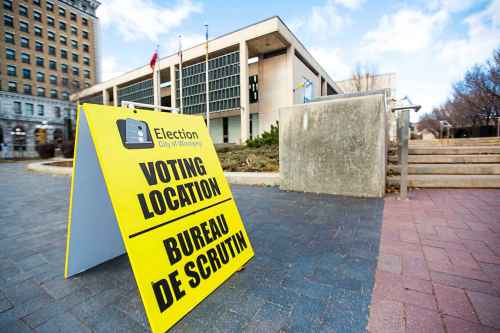
We have an election coming up. With that in mind, the Free Press asked some of their columnists to write about the challenges ahead and how the city can become better.
For Tom Brodbeck, the main challenge is finances — and how candidates will pay for their many promises for fixing roads, improving public safety and making transit better.
Rebecca Chambers said that the concerns of inner-city residents need to be taken seriously by those who aspire to work at city hall.
Niigaan Sinclair said the most pressing issue in Winnipeg isn’t construction projects, light-rail transit, public safety, taxes or social services. For him, it’s the city’s relationship with Indigenous people.
And Brent Bellamy offered that what voters really need is not more managers as elected officials, but people with vision.
What could a faith columnist say about the election?
During the 2022 mayoral race, I sent the leading candidates some questions about what they would do if elected mayor. I am doing the same thing for this election.
Among my questions, I ask how they might support efforts by faith groups to serve marginal and vulnerable people in the city; how they can help churches turn their buildings into affordable housing; and what they will do about antisemitism and Islamophobia. Their answers will be published soon.
Engaging candidates about how they will relate to issues raised by religious communities isn’t unique to Winnipeg. It happens in a few other Canadian cities, too, although not through their media.
One place where that happens is in Vancouver, where faith groups have joined up with other community organizations through the Metro Vancouver Alliance over this month’s election for mayor.
Together, they are asking mayoral candidates about issues like housing, climate change and transit. They are also asking how they would help local churches turn their buildings into affordable housing.
Another place was Ottawa in 2022, when the Anglican Diocese of Ottawa’s Affordable Housing Working Group called on church members to vote for candidates in that city who had a commitment to make housing affordability a priority.
Also in 2022, the Anglican Diocese of Toronto published an election guide to help its members research candidates and their positions and ask questions about issues affecting their communities.
Noting the Ontario provincial election that year saw the lowest turnout for a provincial election ever recorded in Ontario — and that municipal election turnouts are even lower — it also encouraged their members to get out and vote.
“As Christians, we cannot give in to cynicism and apathy,” the diocese said. “We are called to seek the welfare of the places in which God has placed us, to seek justice and uphold the rights of those in need, not selfishly to seek our own interests but also that of others, loving our neighbours as ourselves.”
In Alberta in 2025, Catholic bishops in that province encouraged voters to apply Catholic social teaching when they voted municipally. For the bishops, that meant voting for candidates who respected human dignity and human life, care for vulnerable people and promotion of the common good.
“Prayerful discernment is important in making such decisions to vote for candidates who most closely reflect the moral and social teachings of the Catholic Church rather than by ideology or political rhetoric,” the bishops said.
All of this thinking about the coming local election reminded me of what Christian author and philosopher G. K. Chesterton wrote more than 100 years ago about a horrible slum in London called Pimlico.
Pimlico is a great place to live today. But in 1908 it was filled with poverty, disease and despair.
The only way to fix a problem like Pimlico, Chesterton wrote, was not to just address the economic, housing and social issues that made it such a terrible place to live. Those things were important, he said, but what was also needed was a change of perspective.
“The only way out of it seems to be for somebody to love Pimlico,” he said. “To love it with a transcendental tie and without any earthly reason.”
If that happened, “then Pimlico would rise into ivory towers and golden pinnacles … if men loved Pimlico as mothers love children, arbitrarily, because it is theirs, Pimlico in a year or two might be fairer than Florence.”
Some people, he noted, “will say that this is a mere fantasy.” But for Chesterton this was “how cities did grow great … men did not love Rome because she was great. She was great because they had loved her.”
Or, as people of faith might say, changing Pimlico — or Winnipeg — involves a change of heart, a decision to love even when some things in the city seem unlovable, to have a new spiritual vision for what it can be, not just what it is.
Jdl562000@yahoo.com
The Free Press is committed to covering faith in Manitoba through our Religion in the News project. This reporting continues because readers like you step forward to fund it.
Donate now to support our reporting on religion.
Your donation is eligible for a charitable tax receipt.
BECOME A FAITH JOURNALISM SUPPORTER
John Longhurst has been writing for Winnipeg's faith pages since 2003. He also writes for Religion News Service in the U.S., and blogs about the media, marketing and communications at Making the News.
Our newsroom depends on a growing audience of readers to power our journalism. If you are not a paid reader, please consider becoming a subscriber.
Our newsroom depends on its audience of readers to power our journalism. Thank you for your support.
Advertisement Advertise With Us
Advertisement Advertise With Us
The Free Press acknowledges the financial support it receives from members of the city’s faith community, which makes our coverage of religion possible.