Palestinian Christians’ faith under fire
Advertisement
Read this article for free:
or
Already have an account? Log in here »
To continue reading, please subscribe:

Digital Subscription
One year of digital access for only $205*
- Enjoy unlimited reading on winnipegfreepress.com
- Read the E-Edition, our digital replica newspaper
- Access News Break, our award-winning app
- Play interactive puzzles
*First annual payment billed as $205.00 + GST for one year. This annual subscription will automatically renew at $233.00 + GST every 52 weeks (10% off the regular annual price of $259.35). Offer available to new and qualified returning subscribers only. Cancel any time.
To continue reading, please subscribe:
Add Free Press access to your Brandon Sun subscription for only an additional
$1 for the first 4 weeks*
- Enjoy unlimited reading on winnipegfreepress.com
- Read the E-Edition, our digital replica newspaper
- Access News Break, our award-winning app
- Play interactive puzzles
*Your next Brandon Sun subscription payment will increase by $1.00 and you will be charged $17.95 plus GST for four weeks. After four weeks, your payment will increase to $24.95 plus GST every four weeks.
Read unlimited articles for free today:
or
Already have an account? Log in here »
Christians in Palestine are crying out to their spiritual siblings worldwide for solidarity and support as they face death, displacement and genocide.
“We’ve witnessed our church members being bombed in Gaza, we have witnessed our brothers and sisters being arrested. My family has received death threats,” John Munayer, a Palestinian Christian, told a room full of Mennonites, Anglicans, Lutherans, United Church members, Muslims and Jews who gathered at Canadian Mennonite University for a two-day conference on the plight of Palestinian Christians earlier this month.
John and his brother Samuel Munayer had planned to travel to Winnipeg for the conference, but the war in Iran made travel unsafe, so the brothers addressed the room via Zoom from their home in Jerusalem.
Gwen Friesen photo
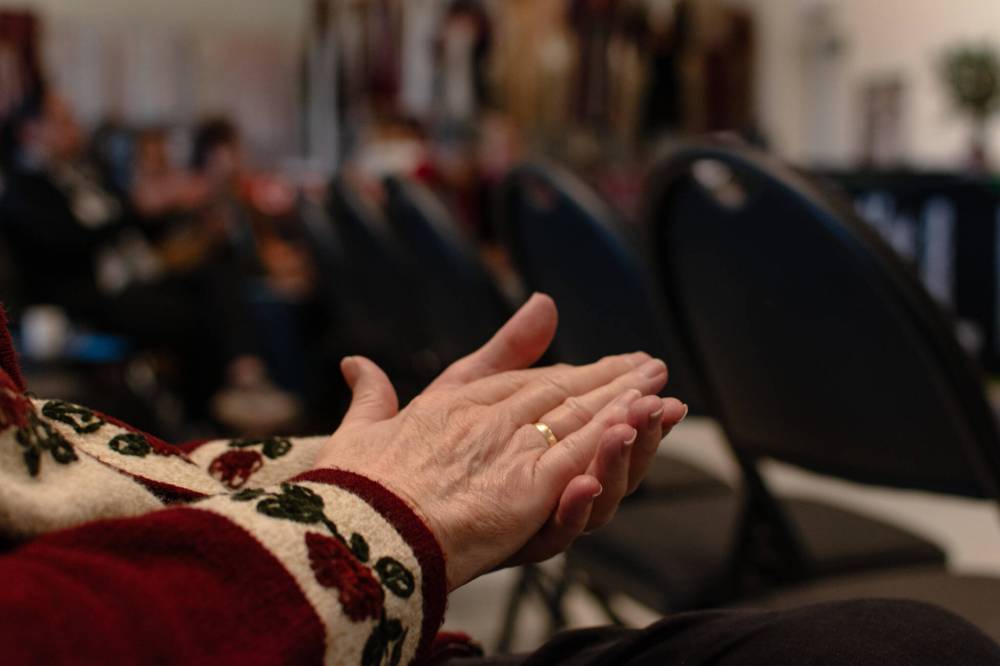
An attendee at the conference.
“We are the sons and daughters of the first church,” said John Munayer.
Christians in Palestine, descended from the very earliest Christians, make up a small minority in the region — less than two per cent of the population of the West Bank and less than one per cent of Gaza. Among them are Roman Catholics, Greek Orthodox, Armenian Orthodox, Copts and other Protestant denominations.
That number is constantly shrinking. Before the Israeli military’s expulsion of 750,000 Palestinians from their homeland during the establishment of the state of Israel in 1948, 12 per cent of the population was Christian.
Since Hamas’s attack on Oct. 7, 2023, and Israel’s retaliation, Israeli forces have bombed churches in which people were sheltering and Palestinian Christians have watched Israeli soldiers shoot family members in front of their eyes.
Like their Muslim neighbours, Palestinian Christians have been physically assaulted by Israeli settlers who have seized their olive trees, land and homes.
Gwen Friesen photo
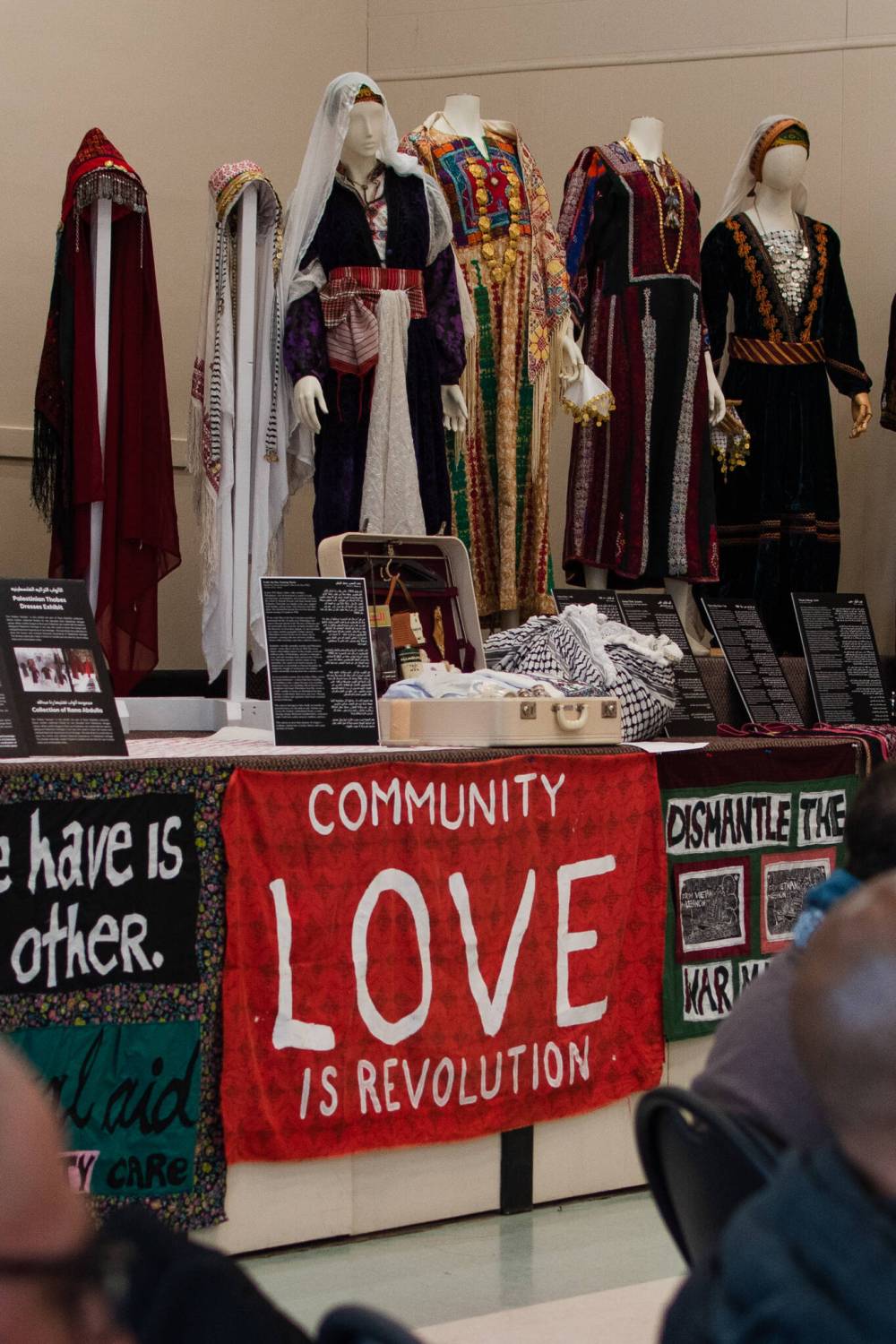
A display of Palestinian art and posters of support.
Samuel Munayer said some American Christians try to create a false narrative that pits Muslims against Christians in Palestine. In fact, relations between Muslim and Christian Palestinians are largely peaceful. “The situation here has been portrayed as the Judeo-Christian tradition against Islam,” he said. “When it’s Judeo-Christian, it’s seen as this white tradition, so it’s erasing the Middle-Eastern Christian identity. We’re used as pawns for colonial political purposes.”
Jane Barter, a former Anglican priest who teaches religion and culture at the University of Winnipeg, says she was motivated to organize the conference by the manifesto and theological declaration issued by Palestinian Christian leaders titled Kairos Palestine II: A moment of truth. Faith in a time of Genocide.
“They were aghast at the fact churches have responded very little,” says Barter. “They see Christian silence as moral and spiritual failure.”
The 14-page statement urges Christians worldwide to reject Christian Zionism and theologies that support racism, supremacy or genocide, and to advocate for Israel to be held accountable for its actions according to international law.
Samuel Munayer works for a humanitarian organization that works in Gaza and the West Bank. He’s seen first-hand the enforced starvation of people in Gaza. The Israeli military is still blocking aid from reaching the area.
Gwen Friesen photo
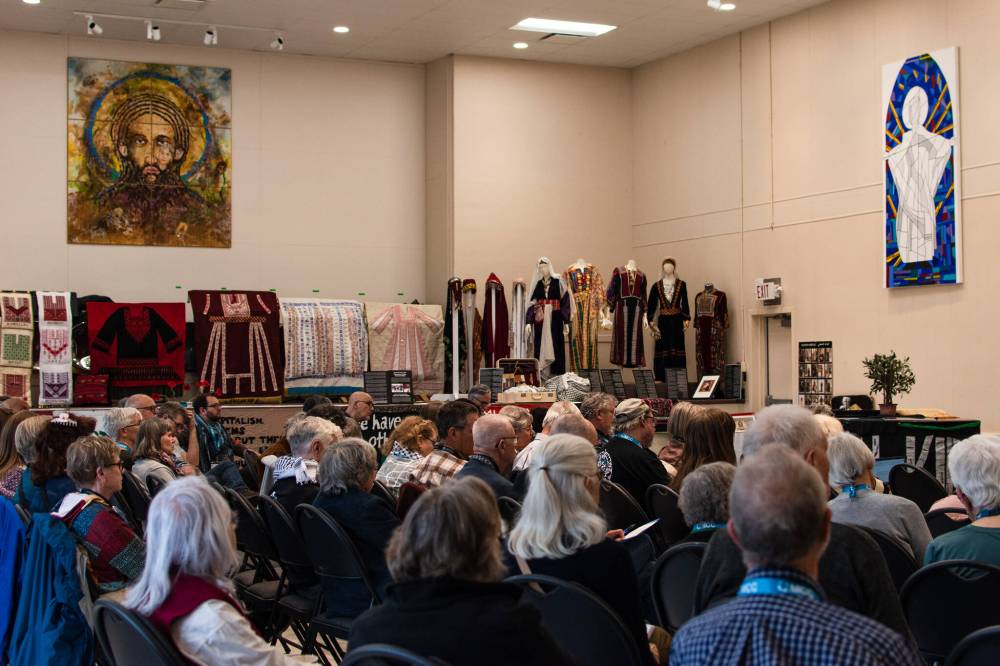
The conference on the plight of Palestinian Christians brought together Mennonites, Anglicans, Lutherans, United Church members, Muslims and Jews.
He’s also a theologian with degrees from universities in Durham and Exeter in the U.K. For him, the most important thing is developing a Palestinian theology that connects with other liberation struggles around the world.
He likened Palestinian theology to an olive tree that survives in harsh conditions where other trees would wither. The Munayer brothers recently edited a book called The Cross and the Olive Tree that contains essays by Palestinian theologians situating their struggle alongside liberation struggles in South Africa and Guatemala, and of Indigenous people in Canada. The title of the book echoes The Cross and the Lynching Tree, a book of Black liberation theology written by James Cone in which he connects the suffering of Black lives with the crucifixion of Christ.
Shadia Qubti, who contributed to the book and helped organize the conference, is a Palestinian Christian who grew up in Nazareth. Her father was raised Coptic and her mother Greek Orthodox. She can trace her spiritual ancestry back to the early apostles. Qubti grew up attending a Baptist church in Nazareth started by American missionaries.
As she grew older, she learned about Christian Zionism — the religious and political ideology based on the belief God has given the Holy Land to the modern state of Israel and that Israel will play a key role in Christ’s return. “They believed because I am a Palestinian I don’t belong here and I’m a stranger and I’m an obstacle to this plan that Jesus is coming again and I’m standing in his way,” she says.
Eventually Qubti moved to British Columbia to study at the Vancouver School of Theology and found a spiritual home in the United Church of Canada. “It’s a beautiful theology. It aligns with the values of my Palestinian theology,” she said.
Gwen Friesen photo
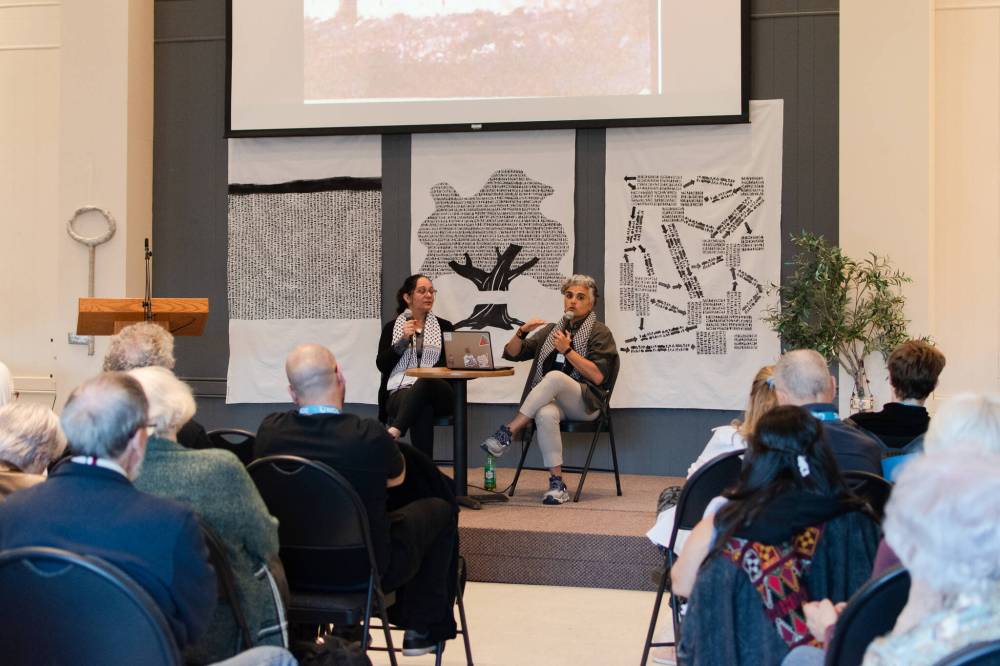
Samia Odeh (left) and Shadia Qubti talk about their experiences as Palestinian Christians.
Noir Masri, a neuroscience student at the University of Winnipeg, helped organize the event. As a Muslim, she says, she was surprised and excited to see advocacy for Palestinians coming from the Christian community. “It’s been good meeting all these people and finding common ground,” she said.
Harold Shuster, an organizer with the advocacy organization Independent Jewish Voices, moderated a panel called Jewish Allies in the Struggle. “What the Christian Palestinians are going through is a result of what the Israeli government is doing in some attempt to try to make me, as Jew in Canada, feel safer. I’m not willing to be complicit in that,” he said. “The fight against antisemitism has to be done in concert and collaboration with other marginalized groups. It cannot be fought and won in isolation from other struggles against bigotry and hate.”

Emèt Eviatar, a Jewish rabbinical student, also attended part of the conference and spoke on a panel. “During the panel I was just looking out at all these earnest Christians doing the work. It was a beautiful sight,” she said afterwards. “There needs to be more multi-faith conversation. That’s the only way.”
Carmen Lansdowne, an Indigenous theologian and the former moderator of the United Church of Canada, offered the closing address, connecting the struggle of Palestinians with the struggle of Indigenous people in Canada. “The policies that govern Indigenous child welfare, land title, resource extraction and political recognition in Canada are not historical curiosities. They are the present tense of a colonial structure that never stopped operating. Just like the Nakba.”
“If you want to do peacebuilding, it’s costly,” said Qubti, who for 15 years did peace and reconciliation work between Palestinians and Israelis. “Something needs to change. We’re (moving in) a very violent direction. We can still stop it.”
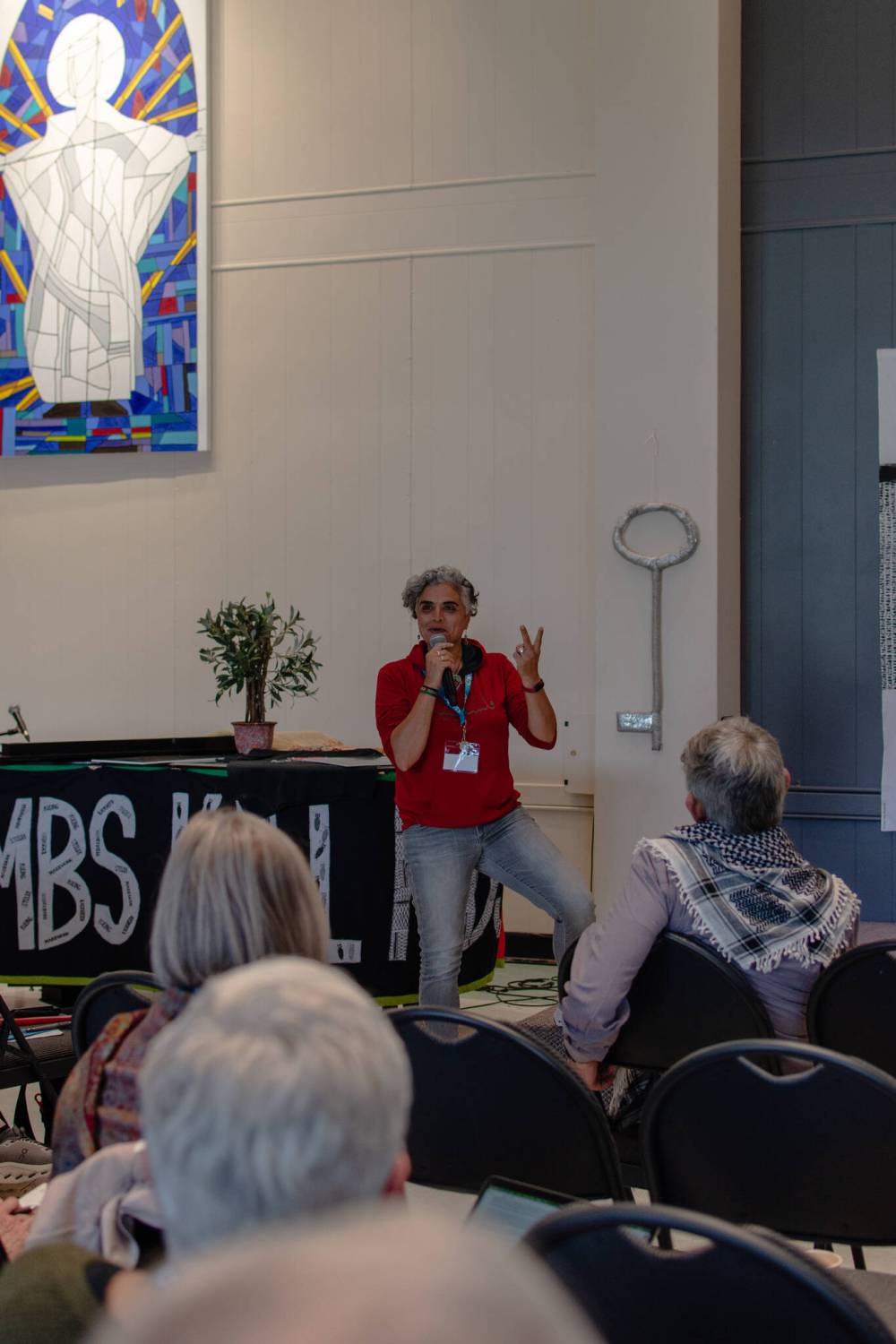
Supplied
Shadia Qubti speaks at the conference.
This story was produced in conjunction with Broadview, as part of a joint Religion in the News partnership covering issues of faith in Manitoba and nationally.
josiah.neufeld@winnipegfreepress.com
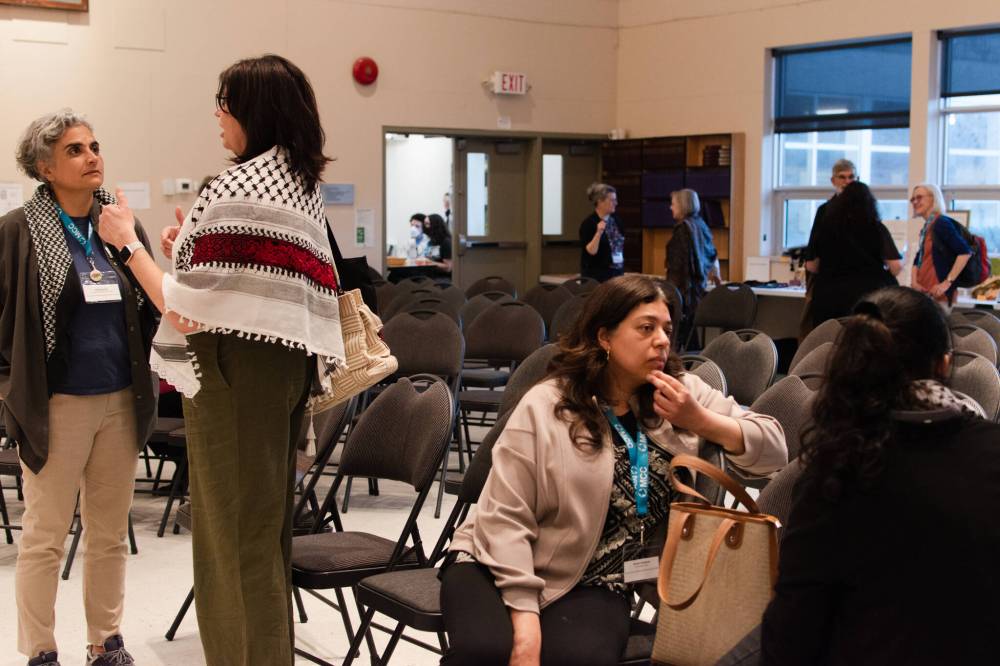
Supplied
Shadia Qubti talks to a conference attendee.
The Free Press is committed to covering faith in Manitoba through our Religion in the News project. This reporting continues because readers like you step forward to fund it.
Donate now to support our reporting on religion.
Your donation is eligible for a charitable tax receipt.
BECOME A FAITH JOURNALISM SUPPORTER
The Free Press acknowledges the financial support it receives from members of the city’s faith community, which makes our coverage of religion possible.