Supreme Court backs coach in praying on field after games

Advertisement

Advertise with us

WASHINGTON (AP) — The Supreme Court said Monday that a high school football coach who knelt and prayed on the field after games was protected by the Constitution, a decision that opponents said would open the door to “much more coercive prayer" in public schools.

Read this article for free:


By clicking the button above, an account will be created and you will begin to receive some of our recommended newsletters. You may opt out of any newsletter by visiting your Email and Communication Preferences page or by clicking "unsubscribe" at the bottom of any email.

or

Already have an account? Log in here »

To continue reading, please subscribe:

Digital Subscription

One year of digital access for only $1.44 a week*

  • Enjoy unlimited reading on winnipegfreepress.com
  • Read the E-Edition, our digital replica newspaper
  • Access News Break, our award-winning app
  • Play interactive puzzles

*Billed as $5.77 plus GST every four weeks. After 52 weeks, price increases to the regular rate of $19.95 plus GST every four weeks. Offer available to new and qualified returning subscribers only. Cancel any time.

To continue reading, please subscribe:

Add Free Press access to your Brandon Sun subscription for only an additional

$1 for the first 4 weeks*

  • Enjoy unlimited reading on winnipegfreepress.com
  • Read the E-Edition, our digital replica newspaper
  • Access News Break, our award-winning app
  • Play interactive puzzles
Start now

*Your next Brandon Sun subscription payment will increase by $1.00 and you will be charged $17.95 plus GST for four weeks. After four weeks, your payment will increase to $24.95 plus GST every four weeks.

Hey there, time traveller!
This article was published 27/06/2022 (1586 days ago), so information in it may no longer be current.

WASHINGTON (AP) — The Supreme Court said Monday that a high school football coach who knelt and prayed on the field after games was protected by the Constitution, a decision that opponents said would open the door to “much more coercive prayer” in public schools.

The court ruled 6-3 for the coach with the conservative justices in the majority and the liberals in dissent. The case was the latest in a line of rulings for religious plaintiffs.

The case forced the justices to wrestle with how to balance the religious and free speech rights of teachers and coaches with the rights of students not to feel pressured into participating in religious practices. The liberal justices in the minority said there was evidence that Bremerton (Washington) High School Coach Joseph Kennedy’s prayers at the 50-yard-line had a coercive effect on students and allowed him to incorporate his “personal religious beliefs into a school event.”
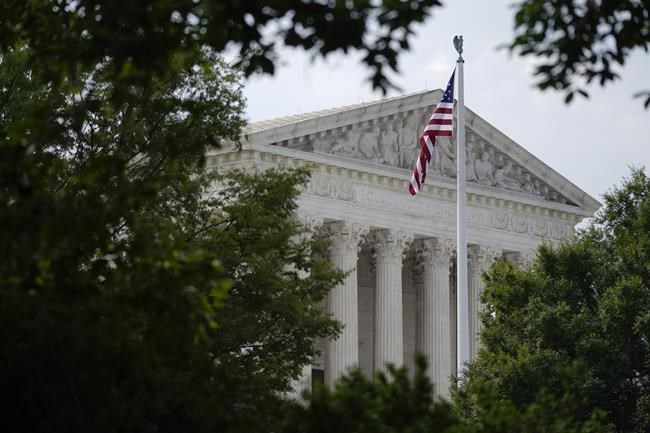
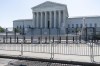
An American flag waves in front of the U.S. Supreme Court building, Monday, June 27, 2022, in Washington. (AP Photo/Patrick Semansky)

Dissenting Justice Sonia Sotomayor wrote that the decision “sets us further down a perilous path in forcing states to entangle themselves with religion.”

But the justices in the majority emphasized that the coach’s prayers came after the games were over and at a time when he wasn’t responsible for students and was free to do other things.

The coach and his attorneys at First Liberty Institute, a Christian legal group, were among those cheering the decision. Kennedy said in an interview that his first reaction was one of pure joy.

“Just like in all my football games I just threw my arms up, you know, ‘touchdown,’” he said. He described the seven years since the dispute began as tough on his family but “absolutely worth it.”

Justice Neil Gorsuch, writing for the majority in the ruling, declared, “The Constitution and the best of our traditions counsel mutual respect and tolerance, not censorship and suppression, for religious and nonreligious views alike.

Gorsuch noted that the coach “prayed during a period when school employees were free to speak with a friend, call for a reservation at a restaurant, check email, or attend to other personal matters” and “while his students were otherwise occupied.”
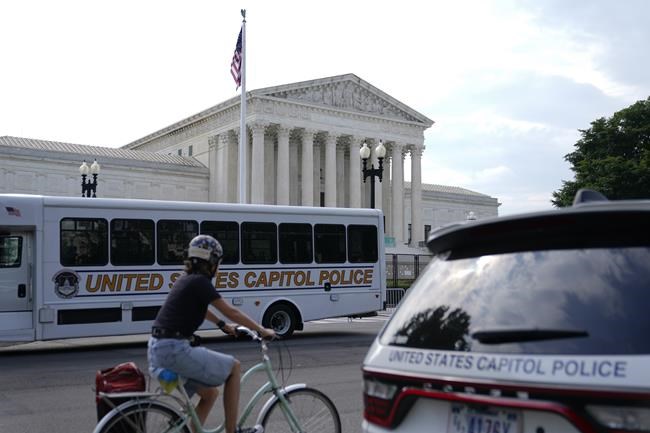
A bicyclist rides past police vehicles parked outside the U.S. Supreme Court building, Monday, June 27, 2022, in Washington. (AP Photo/Patrick Semansky)

It would be wrong to treat everything public school teachers and coaches say and do as speech subject to government control, he wrote. If that were the case, “a school could fire a Muslim teacher for wearing a headscarf in the classroom or prohibit a Christian aide from praying quietly over her lunch in the cafeteria,” he wrote.

He closed by writing that: “Respect for religious expressions is indispensable to life in a free and diverse Republic—whether those expressions take place in a sanctuary or on a field, and whether they manifest through the spoken word or a bowed head.”

The decision continues a pattern in which the court has ruled in favor of religious plaintiffs. Last week the court ruled that Maine can’t exclude religious schools from a program that offers tuition aid for private education, a decision that could ease religious organizations’ access to taxpayer money.

In dissent, Sotomayor wrote Monday that players “recognize that gaining the coach’s approval may pay dividends small and large, from extra playing time to a stronger letter of recommendation to additional support in college athletic recruiting.” And she said “some students reported joining Kennedy’s prayer because they felt social pressure to follow their coach and teammates.”

Sotomayor was joined in her dissent by Justices Stephen Breyer and Elena Kagan.

Paul Clement, the attorney who argued the case on behalf of Kennedy, said in a statement that the decision would allow the coach “to finally return to the place he belongs – coaching football and quietly praying by himself after the game.”
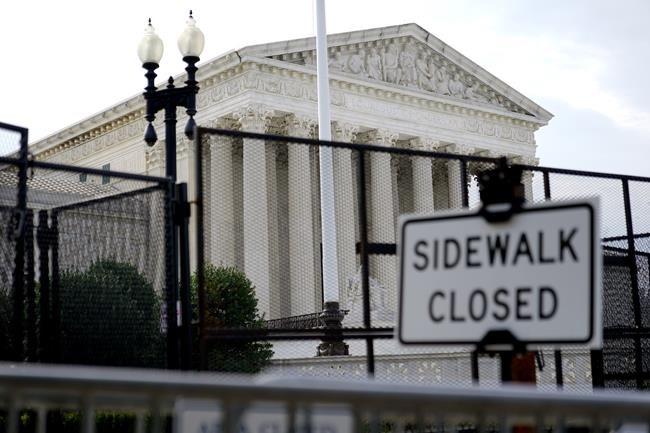
Security fencing surrounds the U.S. Supreme Court building, Monday, June 27, 2022, in Washington. (AP Photo/Patrick Semansky)

Kennedy now lives in Florida, and it was unclear when — or if — he might move back across the country to Washington state for a part-time job that had paid him less than $5,000. He said in the interview that he is in Florida to help his father-in-law but his family remains in Washington and it was never his intention to remain in Florida permanently. He said his lawyers and the school district would need to work things out for him to return to coaching.

He started coaching at the school in 2008 and initially prayed alone on the 50-yard line at the end of games. Students started joining him, and over time he began to deliver a short, inspirational talk with religious references. Kennedy did that for years and also led students in locker room prayers. The school district learned what he was doing in 2015 and asked him to stop out of concerns the district could be sued for violating students’ religious freedom rights.

He stopped leading students in prayer in the locker room and on the field but wanted to continue kneeling and praying on the field himself after games. The school asked him not to do so while still “on duty” as a coach after the games. When he continued, the school put him on paid leave. The head coach of the varsity team later recommended he not be rehired because, among other things, he failed to follow district policy.

In a statement, the Bremerton School District and its attorneys at Americans United for the Separation of Church and State, said the decision undermines the separation required by the Constitution. The school district said in a statement that it had “followed the law and acted to protect the religious freedom of all students and their families.”

Rachel Laser, the head of Americans United, said the decision “opens the door to much more coercive prayer in our public schools” and undermines the religious freedom of students.

The school district’s attorney, Richard Katskee, said it is studying the decision and considering its next steps.
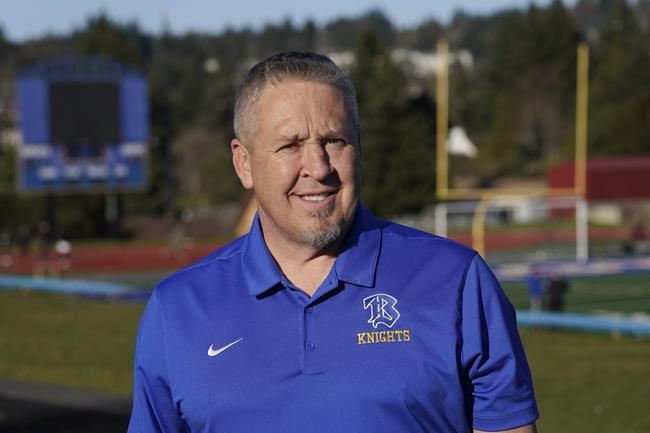
FILE - Joe Kennedy, a former assistant football coach at Bremerton High School in Bremerton, Wash., poses for a photo March 9, 2022, at the school's football field. The Supreme Court has sided with a football coach from Washington state who sought to kneel and pray on the field after games. The court ruled 6-3 along ideological lines for the coach. The justices said Monday the coach's prayer was protected by the First Amendment. (AP Photo/Ted S. Warren, File)

Three justices on the court — Breyer, Kagan and Justice Samuel Alito — attended public high schools, while the other six attended Catholic schools.

The case is Kennedy v. Bremerton School District, 21-418.

Report Error Submit a Tip

The Free Press acknowledges the financial support it receives from members of the city’s faith community, which makes our coverage of religion possible.
More Stories

Submit a news tip

1 minute read Monday, Mar. 16, 2026

Submit a news tip

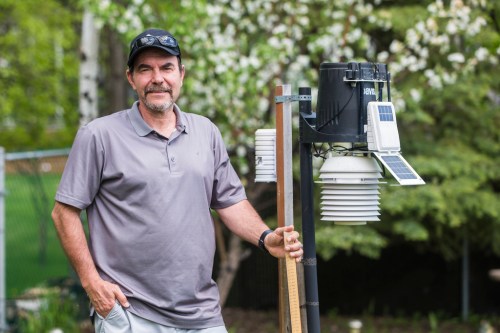
Meteorologist behind Rob’s Obs is moving weather station to Ontario

Ben Waldman 8 minute read Preview

Meteorologist behind Rob’s Obs is moving weather station to Ontario

Ben Waldman 8 minute read Monday, Jun. 13, 2022

In a Winnipeg winter, there are always at least two certainties: it will be cold, and it will snow. A third certainty: the people will talk endlessly about how frigid the temperature is, and argue about how much snow is cloaking their driveways. Is it colder than it ever has been? Is there more snow today than the same time last year?

Rob Paola likely knows the answers to those questions.

Paola possesses no super powers. He is but a man with a metre stick and 40 years of professional meteorological experience, in the midst of a lifelong love affair with Mother Nature, a most turbulent mistress who rarely, if ever, reciprocates.

Each year when snow begins to fall, Paola heads outside his Charleswood home to figure out how much. He sticks his ruler in the ground, grabs his clipboard, and clicks his pen. In neat script, he records the temperature, what time precipitation began, how deep the powder is stacked. Then, he shares his data and insights online with thousands of followers who want a clear answer to the eternal questions: Why is this happening? When will it stop? How much snow has fallen in the city of Winnipeg?

Read
Monday, Jun. 13, 2022

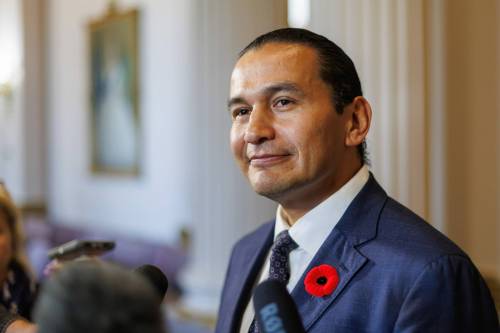
Kinew will listen to city request for new taxes — but no promises

Nicole Buffie 5 minute read Preview

Kinew will listen to city request for new taxes — but no promises

Nicole Buffie 5 minute read Friday, Nov. 1, 2024

Premier Wab Kinew remained coy about whether he would support a new municipal tax in Winnipeg as the city struggles to maintain services.

Kinew dodged questions on the matter Friday afternoon.

“We want to see services strong, we want to see roads getting fixed,” Kinew said. “Affordability is really top of mind … we got to keep life affordable for the average person out there.”

Some of the items being considered for a new tax are: alcohol, online deliveries, vehicle registration, vacant homes, commercial parking and land transfers with an exemption for first-time homebuyers.

Read
Friday, Nov. 1, 2024

‘All females are at risk’: serial sex offender released from prison

Erik Pindera 4 minute read Preview

‘All females are at risk’: serial sex offender released from prison

Erik Pindera 4 minute read Yesterday at 1:43 PM CDT

Law enforcement are warning the public that a dangerous sex offender with a lengthy history of abusing women is expected to live in Winnipeg after his release from prison.

Douglas Wayne Bowman, 62, left prison on Thursday after serving a lengthy sentence for two sexual assaults he committed at knifepoint, said the Manitoba Integrated High Risk Sex Offender Unit, a joint force of the Winnipeg Police Service and RCMP that keeps an eye on certain sex criminals.

Bowman was handed the 14-year sentence in 2018, less six years time served, and designated a dangerous offender. Criminals deemed dangerous offenders are given indefinite federal sentences until parole officials decide it is safe enough to release them.

Now that he’s leaving prison, Bowman will be subject to a 10-year long-term supervision order, which allows corrections and parole officials to continue to monitor him in the community even though his sentence is complete.

Read
Yesterday at 1:43 PM CDT

City rec facilities crumbling

Ryan Thorpe 7 minute read Preview

City rec facilities crumbling

Ryan Thorpe 7 minute read Monday, Oct. 22, 2018

Throughout Winnipeg, decades-old community assets — pools, arenas and recreation and leisure centres — are deteriorating so quickly that service disruptions are inevitable.

Meanwhile, the city’s community services department, which is responsible for managing those assets, operates with an annual deficit of roughly $80 million, meaning there are scant resources to do little more than bail water on a sinking ship.

Soon, Winnipeggers will have a choice: fewer community services or higher costs.

“It poses a huge challenge because we have very limited dollars that we have to invest in our existing facilities. We also have growing demands for new amenities in new areas. We have to be very strategic,” said Ken McKim, manager of asset management for the department.

Read
Monday, Oct. 22, 2018

Trump touts USMCA win in state of the union

James McCarten, The Canadian Press 6 minute read Preview

Trump touts USMCA win in state of the union

James McCarten, The Canadian Press 6 minute read Tuesday, Feb. 4, 2020

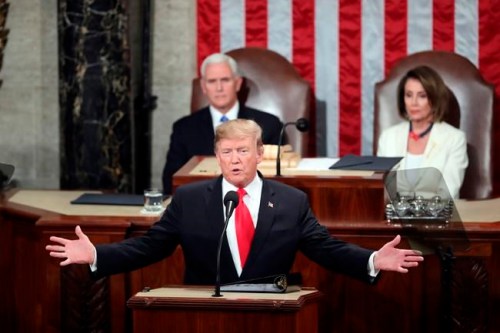
WASHINGTON - President Donald Trump declared his scorched-earth political style an unmitigated success Tuesday in a fiercely partisan, made-for-TV state of the union speech that made it clear he expects to be back in the White House next year on the strength of the U.S. economy and his trade deals with Canada, Mexico and China.

Trump, addressing a joint session of Congress in the very chamber where House Democrats voted to impeach him less than two months ago, became only the second president in American history — Bill Clinton was the first — to deliver a state of the union while standing trial in the Senate.

Unrepentant, he pointedly refused to shake the offered hand of House Speaker Nancy Pelosi on the dais before singing the praises of what he billed as "the great American comeback," pointing to strong job growth, a soaring stock market and low unemployment as evidence of his leadership. And when he was done, Pelosi ripped up the speech in full view of the television cameras.

"America's enemies are on the run, America's fortunes are on the rise, and America's future is blazing bright. The years of economic decay are over," Trump declared, taking full credit for the country's "roaring economy," including what he billed as seven million new jobs and the lowest jobless rate in half a century — a "blue-collar boom" that he's counting on to help his re-election chances in November.

Read
Tuesday, Feb. 4, 2020