Notre Dame fire highlights importance of detailed documentation for rebuilding

Advertisement

Advertise with us

MONTREAL - The fire that swept through Notre Dame Cathedral in Paris on Monday should serve as a reminder that having proper plans and documentation of valued Canadian buildings is crucial, heritage advocates say.

Read this article for free:


By clicking the button above, an account will be created and you will begin to receive some of our recommended newsletters. You may opt out of any newsletter by visiting your Email and Communication Preferences page or by clicking "unsubscribe" at the bottom of any email.

or

Already have an account? Log in here »

To continue reading, please subscribe:

Digital Subscription

One year of digital access for only $1.44 a week*

  • Enjoy unlimited reading on winnipegfreepress.com
  • Read the E-Edition, our digital replica newspaper
  • Access News Break, our award-winning app
  • Play interactive puzzles

*Billed as $5.77 plus GST every four weeks. After 52 weeks, price increases to the regular rate of $19.95 plus GST every four weeks. Offer available to new and qualified returning subscribers only. Cancel any time.

To continue reading, please subscribe:

Add Free Press access to your Brandon Sun subscription for only an additional

$1 for the first 4 weeks*

  • Enjoy unlimited reading on winnipegfreepress.com
  • Read the E-Edition, our digital replica newspaper
  • Access News Break, our award-winning app
  • Play interactive puzzles
Start now

*Your next Brandon Sun subscription payment will increase by $1.00 and you will be charged $17.95 plus GST for four weeks. After four weeks, your payment will increase to $24.95 plus GST every four weeks.

Hey there, time traveller!
This article was published 16/04/2019 (2754 days ago), so information in it may no longer be current.

MONTREAL – The fire that swept through Notre Dame Cathedral in Paris on Monday should serve as a reminder that having proper plans and documentation of valued Canadian buildings is crucial, heritage advocates say.

The blaze, which destroyed the cathedral’s roof and spire, has triggered an outpouring of unity and financial support as well as a promise from French President Emmanuel Macron to rebuild within five years.

When they do, they’ll have a wealth of information to rely on, said Martin Bressani, director of the Peter Fu School of Architecture at McGill University.

Firefighters work near the rose window of Notre Dame cathedral Tuesday April 16, 2019, following the devastating fire Monday night in Paris. Experts are assessing the blackened shell of Paris' iconic Notre Dame Cathedral to ascertain what artifacts can be saved and what has been lost in the blaze. (AP Photo/Thibault Camus)

“Notre Dame is obviously the greatest historical monument in France,” he said. “It’s completely documented, every square inch.”

Bressani said most major Canadian landmark buildings and structures likely have detailed plans and documentation. “I would say yes, every major prestigious building in Canada, which is often not much older than 19th Century, is documented,” he said.

Jerry Dick, executive director of the Heritage Foundation of Newfoundland and Labrador, said the Basilica of St. John the Baptist in the province’s capital underwent a digital scan two years ago that would be of great value if the building were ever damaged. Such detailed plans are important for two reasons — restoration and reproduction but also for a historical record if rebuilding is impossible.

“Every square inch of that building, inside and outside, was scanned to a very high degree, so they have the type of documentation right now that, heaven forbid, should something like that happen, they would have the information to restore or reproduce elements,” Dick said.

Other properties, often in smaller communities, may slip through the cracks when it comes to having proper files, said Ali Piwowar of the National Trust of Canada, a not-for-profit organization that advocates for heritage sites.

“Obviously there’s a benefit of having a record like that if you were to capture the exact condition of the building in order to reconstruct it,” Piwowar said. “But when you’re looking at something in a small town … it’s probably pretty unlikely they’ve had recording done, so being able get a hold of the original construction drawings is always recommended for the owners to have something on file.”

In terms of protecting heritage, many properties have seen sprinkler and fire-safety systems installed in recent years, Piwowar added.

Stephane Corriveau, operations chief for the Montreal fire department, noted that Montreal’s Notre-Dame Basilica was hit by fire in 1978 and reopened in 1983 with fire protection, alarms, interior sprinklers and a dry-pipe sprinkler system for the exterior of the building.

“From our perspective, we can’t have any better than that,” said Corriveau, calling it one of the safest churches in Canada. “But for most churches, putting them up to code is very expensive.”

There are about 400 churches in Montreal, including St. Joseph’s Oratory, Canada’s largest church, which is built from stone and is largely fireproof with the exception of its contents, Corriveau said. Meanwhile, Mary Queen of the World Cathedral in downtown Montreal, completed in 1894, never had a fire and was never outfitted with modern fire prevention measures.

Montreal Archbishop Christian Lepine, who conducted a special midday mass at the basilica Tuesday in honour of its Paris namesake, told reporters that Montreal churches are equipped with alarms connected to the fire service and some of the bigger venues have video surveillance.

As for rebuilding Notre Dame Cathedral, Bressani noted the spire that was felled by the flames was actually a more recent edition from the mid-19th century, the work of Eugene-Emmanuel Viollet-le-Duc.

“When he created this in the mid-19th century, the spire had been destroyed for centuries and there was no documentation coming from the Middle Ages as to what the original spire looked like,” Bressani noted.

But current restoration officials will have access to Viollet-le-Duc’s drawings in the archives as they rebuild. The questions will centre on design and materials.

“To do something like the spire is an incredible challenge, so that will be interesting to see,” Bressani said.

Report Error Submit a Tip

The Free Press acknowledges the financial support it receives from members of the city’s faith community, which makes our coverage of religion possible.

More Stories

Meteorologist behind Rob’s Obs is moving weather station to Ontario

Ben Waldman 7 minute read Preview

Meteorologist behind Rob’s Obs is moving weather station to Ontario

Ben Waldman 7 minute read Monday, Jun. 13, 2022

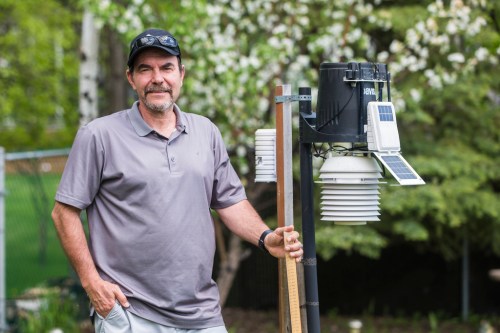
In a Winnipeg winter, there are always at least two certainties: it will be cold, and it will snow. A third certainty: the people will talk endlessly about how frigid the temperature is, and argue about how much snow is cloaking their driveways. Is it colder than it ever has been? Is there more snow today than the same time last year?

Rob Paola likely knows the answers to those questions.

Paola possesses no super powers. He is but a man with a metre stick and 40 years of professional meteorological experience, in the midst of a lifelong love affair with Mother Nature, a most turbulent mistress who rarely, if ever, reciprocates.

Each year when snow begins to fall, Paola heads outside his Charleswood home to figure out how much. He sticks his ruler in the ground, grabs his clipboard, and clicks his pen. In neat script, he records the temperature, what time precipitation began, how deep the powder is stacked. Then, he shares his data and insights online with thousands of followers who want a clear answer to the eternal questions: Why is this happening? When will it stop? How much snow has fallen in the city of Winnipeg?

Read
Monday, Jun. 13, 2022

Shocking development

Kelly Taylor 6 minute read Preview

Shocking development

Kelly Taylor 6 minute read 2:00 AM CDT

HOCKLEY VALLEY, Ont. — It’s not too often you get into a new vehicle, look at the interior, and say to yourself, “Wow, this is different… in a good way.”

Automakers tend to stick pretty close to defined norms, and when they differ, it’s not always successful. I’m looking at you, Toyota Yaris and Nissan X-Trail.

So, stepping into the 2027 BMW iX3 was refreshing. A bright parallelogram of a main touchscreen is closer to the driver than most, aided in no small part by pushing the instrument cluster to a narrow band just under the windscreen.

The effect is to clean up the look of the dash but without moving to a centre-mount instrument panel like the Yaris and X-Trail. The most valuable information (speed, battery charge, range) is right in front of the driver, visible above the top rim of the steering wheel.

Read
2:00 AM CDT

Is Canada headed for time chaos this weekend?

Michelle Bastian 5 minute read 2:00 AM CDT

When Manitoba Premier Wab Kinew declared Sept. 17 that the province would remain on permanent daylight time, he suggested it was a historical moment people would share with their “great-great-grandkids.” But, while Sunday, Nov. 1 has been heralded as the date many Canadians will stop changing their clocks, there are rumblings behind the scenes suggesting this will actually cause more trouble than ever before.

There are, of course, the warnings from chrono-biologists and sleep scientists about the damage permanent daylight time will do. The lighter evenings will mean many more dark mornings. But there is another set of problems in the offing in the critical infrastructure that underpins our digital lives.

While it used to be common to spend the Sunday morning after a time change going around our homes updating the clocks, we now wake up to devices that have already adjusted to the new time. These automatic updates occur regularly for daylight time, as well as when we travel to new time zones.

Our clocks are able to change by themselves owing to the hard work of a group of volunteers who were recently named in a list of the people who hold up the internet. This group, led by Paul Eggert, a computer scientist at UCLA, maintains a little-known tool called the Time Zone Database. Since the 1980s, it has kept track of regional, national and international debates about clock time and provided an up-to-date table of what time it should be on our walls.

City rec facilities crumbling

Ryan Thorpe 6 minute read Preview

City rec facilities crumbling

Ryan Thorpe 6 minute read Monday, Oct. 22, 2018

Throughout Winnipeg, decades-old community assets — pools, arenas and recreation and leisure centres — are deteriorating so quickly that service disruptions are inevitable.

Meanwhile, the city’s community services department, which is responsible for managing those assets, operates with an annual deficit of roughly $80 million, meaning there are scant resources to do little more than bail water on a sinking ship.

Soon, Winnipeggers will have a choice: fewer community services or higher costs.

“It poses a huge challenge because we have very limited dollars that we have to invest in our existing facilities. We also have growing demands for new amenities in new areas. We have to be very strategic,” said Ken McKim, manager of asset management for the department.

Read
Monday, Oct. 22, 2018

Notable quotes from 2020 Tokyo Olympics

The Canadian Press 4 minute read Sunday, Jul. 25, 2021

Correctional Services Canada is reopening prison farms. But in B.C., where it has no such programs, a wife and her late husband, who killed a man in a botched holdup, started Emma’s Acres, a unique prison farm she hopes to see expanded.

Waiting for Cormier verdict the ‘calm before the storm’

Katie May 6 minute read Preview

Waiting for Cormier verdict the ‘calm before the storm’

Katie May 6 minute read Thursday, Feb. 22, 2018

As the jury room door closed behind the seven women and four men who are now deliberating on the evidence against Tina Fontaine’s accused killer, Thelma Favel rose from the chair she’s occupied for most of Raymond Cormier’s second-degree murder trial.

Almost every day over the past three weeks, Favel, the woman who raised 15-year-old Tina, has sat right up front, directly across from the jury box, listening, sobbing and soaking in disturbing details of the teen’s last days that have come to light over the course of Cormier’s second-degree murder trial.

On Wednesday afternoon, after Court of Queen’s Bench Chief Justice Glenn Joyal instructed the jury and sent them off to be sequestered until they decide whether 56-year-old Raymond Cormier is guilty of killing Tina, Favel got up and hugged Crown prosecutor Breta Passler. It was one of many moments, this one shielded from jurors, that have long since proven the emotional impact of the case and the lasting power of Tina’s legacy.

Tina’s death sparked a public outcry that renewed calls for a national inquiry into disproportionately high rates of missing and murdered Indigenous women and girls across Canada, and the criminal trial for the man accused of killing her hasn’t happened in a vacuum.

Read
Thursday, Feb. 22, 2018