Kateri a saint for everyone
Aboriginal woman inspires local church

Advertisement
Read this article for free:
or
Already have an account? Log in here »
To continue reading, please subscribe:

Digital Subscription
One year of digital access for only $205*
- Enjoy unlimited reading on winnipegfreepress.com
- Read the E-Edition, our digital replica newspaper
- Access News Break, our award-winning app
- Play interactive puzzles
*First annual payment billed as $205.00 + GST for one year. This annual subscription will automatically renew at $233.00 + GST every 52 weeks (10% off the regular annual price of $259.35). Offer available to new and qualified returning subscribers only. Cancel any time.
To continue reading, please subscribe:
Add Free Press access to your Brandon Sun subscription for only an additional
$1 for the first 4 weeks*
- Enjoy unlimited reading on winnipegfreepress.com
- Read the E-Edition, our digital replica newspaper
- Access News Break, our award-winning app
- Play interactive puzzles
*Your next Brandon Sun subscription payment will increase by $1.00 and you will be charged $17.95 plus GST for four weeks. After four weeks, your payment will increase to $24.95 plus GST every four weeks.
Read unlimited articles for free today:
or
Already have an account? Log in here »
Hey there, time traveller!
This article was published 29/12/2012 (4999 days ago), so information in it may no longer be current.
Long a presence in Winnipeg’s West End, an aboriginal Roman Catholic parish is slowly discovering a new identity after their patron was elevated to sainthood earlier this year.
“We’ve come a long way and struggled and we’ve always been a poor parish,” explains Joan Molloy, a member of St. Kateri Tekakwitha Aboriginal Catholic Parish.
“I think sometimes in poverty there’s shame. Now we don’t have to be ashamed anymore.”

Molloy was one of several parishioners who travelled to Rome to witness the canonization of Kateri Tekakwitha on Oct. 21, 2012. St. Kateri is the first North American aboriginal woman to become a saint in the Roman Catholic Church.
Born to a Mohawk father and Algonquin mother in 1656 in New York, she was orphaned as a young child, converted to Catholicism as a teenager, and was baptized at age 20. Facing hostility from her tribe for her Christian faith, St. Kateri moved north to Kahnawake, near Montreal, devoting her life to prayer and caring for the sick and elderly. She died in 1680 at the age of 24.
“Kateri is not just for Winnipeg and for Canada,” says Rev. Sebastian Maria Susairaj, who has served the only aboriginal Catholic parish in Winnipeg for four years.
“She’s for the whole universal church. Now the whole world is claiming her as the model.”
Although many Catholics around the world may just now be learning more about this new saint, the story of St. Kateri has always been integral to parishioner Eva Solomon’s life. Born in 1943, the same year St. Kateri was venerated, the Catholic sister and Ojibwa woman originally from Killarney, Ont., grew up hearing stories from her mother about the holy woman known as the Lily of the Mohawks.
“We considered her a saint, whether the church did or not,” explains the Winnipeg-based Solomon, a member of Sisters of St. Joseph of Sault Ste. Marie.
She says St. Kateri blazed a trail in combining traditional aboriginal beliefs and practices with Christianity, something that aboriginal Christians in Canada are still learning to do.
“The aboriginal people who have become Christians are going through the same struggles as the early church,” says Solomon, who works on that sort of integration for the Assembly of the Western Catholic Bishops Standing Committee on Aboriginal Affairs.
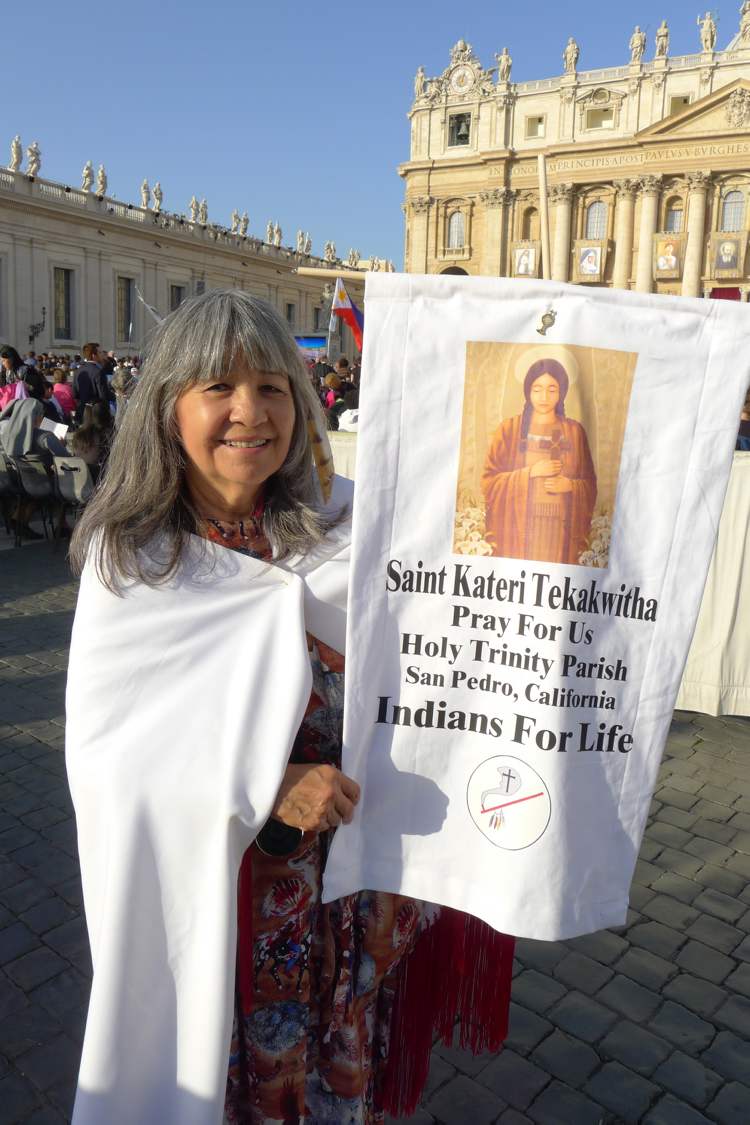
“We’re learning how to be Christian in this dialogue with tradition.”
Part of that dialogue means incorporating aboriginal practices into mass, such as the prayer in four directions, drumming and reading Christian texts in Cree and Ojibwa, explains Sebastian.
He says the Kateri parish is unique because it serves aboriginal people from all over Manitoba who travel to Winnipeg for family or medical reasons. Unlike most Catholic parishes, the people of St. Kateri stay for a midday meal and social gathering every Sunday, as well as sharing food and prizes in a weekly raffle, he says.
“Gathering is very important for the First Nations community,” says Sebastian, a native of India.
For Solomon, the recognition of the new aboriginal saint marks a resurgence of interest in aboriginal spirituality among the broader church. She says discussions are underway to establish an institute of St. Kateri at a Catholic college to train aboriginals for ministry.
In the past, the Catholic Church has not always made a significant effort to understand aboriginal beliefs and culture, says Archbishop James Weisgerber of Winnipeg. For instance, while aboriginal women like Solomon have joined Catholic religious orders, very few, if any aboriginal men have studied for the priesthood. Weisgerber says the Archdiocese of Winnipeg has no priests of aboriginal descent serving its parishes.
“The fact Kateri has been proclaimed as a saint means she could bring together her aboriginal culture and her spirituality,” says Weisgerber, who was in Rome for the canonization.

“We still have to figure out how to do that.”
The ceremonies in Rome last fall were a beginning, says Molloy, who was surprised to hear cheers and applause from the crowd when St. Kateri’s name was called out.
“For a humble person of aboriginal descent, I felt honoured,” says Molloy.
“So we were walking tall and walking proud.”
brenda@suderman.com
The Free Press is committed to covering faith in Manitoba through our Religion in the News project. This reporting continues because readers like you step forward to fund it.
Donate now to support our reporting on religion.
Your donation is eligible for a charitable tax receipt.
BECOME A FAITH JOURNALISM SUPPORTER
Brenda Suderman has been a columnist in the Saturday paper since 2000, first writing about family entertainment, and about faith and religion since 2006.
Our newsroom depends on a growing audience of readers to power our journalism. If you are not a paid reader, please consider becoming a subscriber.
Our newsroom depends on its audience of readers to power our journalism. Thank you for your support.
Statue installed in new year
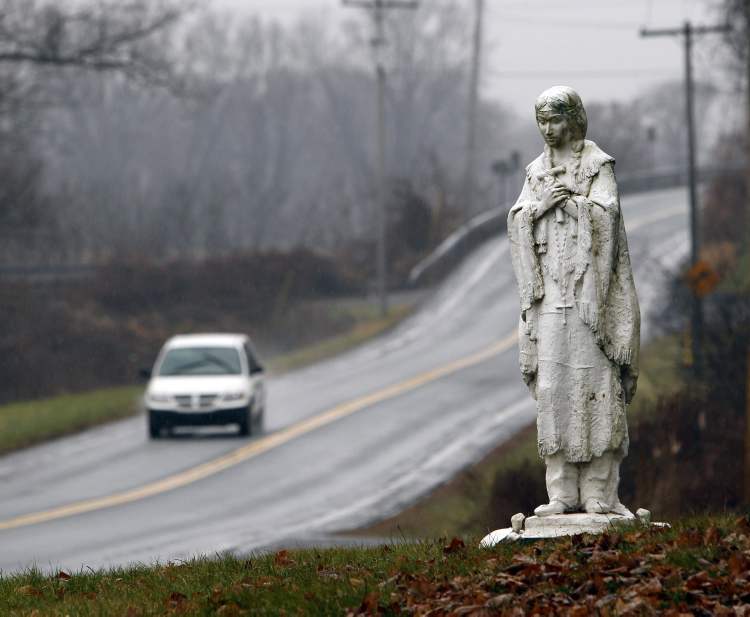
A life-size statue of the only aboriginal woman in North America to be canonized by the Roman Catholic Church should be installed in Winnipeg in the new year.
Parishioners of St. Kateri Tekakwitha Aboriginal Catholic Parish have already raised about $9,000 of the estimated $13,000 price tag, says Rev. Sebastian Maria Susairaj. That figure includes shipping the statue to Winnipeg and installing it inside their West End church, located at 548 Home St.
Artist Benoit Deschenes, of Saint-Jean-Port-Joli, Que., has been commissioned to carve the statue, and is using local Algonquin residents as models, says Eva Solomon, a parishioner at St. Kateri.
“St. Kateri’s mother came right from the Algonquin people in that area,” she says.
She says Tekakwitha will be portrayed barefoot, wearing traditional clothing, including leggings and a shawl.
The statue is scheduled to be completed by February.
The Free Press is committed to covering faith in Manitoba through our Religion in the News project. This reporting continues because readers like you step forward to fund it.
Donate now to support our reporting on religion.
Your donation is eligible for a charitable tax receipt.
BECOME A FAITH JOURNALISM SUPPORTER
Brenda Suderman has been a columnist in the Saturday paper since 2000, first writing about family entertainment, and about faith and religion since 2006.
Our newsroom depends on a growing audience of readers to power our journalism. If you are not a paid reader, please consider becoming a subscriber.
Our newsroom depends on its audience of readers to power our journalism. Thank you for your support.
Advertisement Advertise With Us
Advertisement Advertise With Us
History
Updated on Saturday, December 29, 2012 12:57 PM CST: replaces photos, adds fact box
The Free Press acknowledges the financial support it receives from members of the city’s faith community, which makes our coverage of religion possible.

![WINNIPEG FREE PRESS ARCHIVES
On Wednesday, June 4, 1919 In front of the government Building Norris, with policeman, to the left of the [illegible] Loyal Returned Soldiers](https://staging.winnipegfreepress.com/wp-content/uploads/sites/2/2022/05/NEP8820082.jpg?w=500)