Parsimonious partnership
Mazda CX-50 Hybrid combines the best of Mazda, Toyota engineering for fuel-efficient fun

Advertisement
Read this article for free:
or
Already have an account? Log in here »
To continue reading, please subscribe:

Digital Subscription
One year of digital access for only $205*
- Enjoy unlimited reading on winnipegfreepress.com
- Read the E-Edition, our digital replica newspaper
- Access News Break, our award-winning app
- Play interactive puzzles
*First annual payment billed as $205.00 + GST for one year. This annual subscription will automatically renew at $233.00 + GST every 52 weeks (10% off the regular annual price of $259.35). Offer available to new and qualified returning subscribers only. Cancel any time.
To continue reading, please subscribe:
Add Free Press access to your Brandon Sun subscription for only an additional
$1 for the first 4 weeks*
- Enjoy unlimited reading on winnipegfreepress.com
- Read the E-Edition, our digital replica newspaper
- Access News Break, our award-winning app
- Play interactive puzzles
*Your next Brandon Sun subscription payment will increase by $1.00 and you will be charged $17.95 plus GST for four weeks. After four weeks, your payment will increase to $24.95 plus GST every four weeks.
Read unlimited articles for free today:
or
Already have an account? Log in here »
Hey there, time traveller!
This article was published 09/05/2025 (484 days ago), so information in it may no longer be current.
Mazda’s newest hybrid — the CX-50 Hybrid — is its best-driving, thanks to a partner with the most experience in building hybrids.
The CX-50 Hybrid powertrain is Toyota’s Hybrid Synergy Drive, and it arguably is more fun to drive than the CX-50’s hybrid stablemates CX-70 and CX-90. Toyota has been refining the Hybrid Synergy Drive since the mid to late 1990s, having launched the first Prius in 1999.
The CX-50 is smaller and lighter than the other two, so it’s more nimble. The planetary gearset transmission transfers energy more efficiently, it seems, than the eight-speed automatics in the 70 and 90. Acceleration is direct and immediate, and it pulls hard — thanks to the electric assist from the hybrid system.
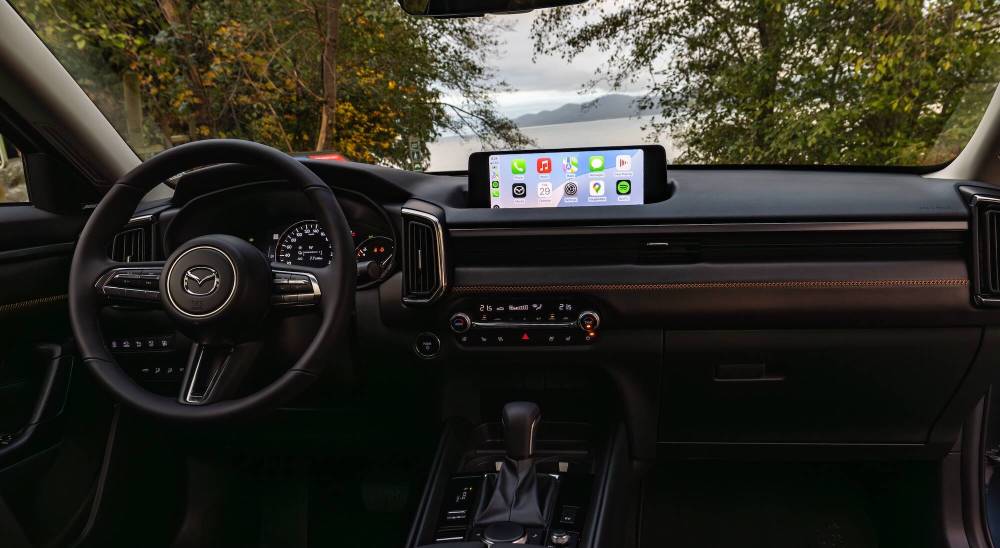
Supplied
The CX-50 interior is nicely minimalist, with interesting details such as the contrasting stitching on the dashboard trim piece.
Sure, it’s still a CVT, something a Mazda chief engineer once swore it would never do, but it’s also the best in the business. So while it will still do that annoying thing CVTs do — run the engine to a certain R.P.M. and stay there during acceleration — it doesn’t seem as droning and annoying as other CVTs.
Unlike certain Toyota hybrids, such as the Prius, the CX-50 employs a standard console-mounted shift lever, with PRND and a manual gate to mimic manual gearshifting.
The CX-50 is a hair larger than the CX-5, so there’s an inch or two more cargo space. As well, the interior is done to usual Mazda standards, which typically means Mazda can put its interiors confidently against the best in the business.
On the road, the CX-50 is Mazda’s excellent handling incarnate, driving more like a car than a mid-size SUV. It hits 100 km/h in less than eight seconds and carves through corners in ways that suggest it has an independent rear suspension. It does not: instead, it uses a torsion beam suspension, which Mazda first introduced on the current generation of the Mazda3. I own a Mazda3 and it, and the CX-50, handle in ways engineers didn’t think possible with torsion beam suspensions just a few years ago.
“We didn’t do it to make the car worse,” Dave Coleman, one of Mazda’s senior engineers, told me about the rear suspension during a Mazda3 press event.
To make it work, Mazda experimented with the position of attachment points, direction of travel of various suspension pieces and choices in various components to make a torsion beam work as well as, say, a multi-link suspension.
Mazda spokesman Chuck Reimer says the powertrain is, in essence, plucked straight from the Toyota RAV-4 Hybrid.
“The handling (steering, braking/acceleration response), however, is where you would find the unique Mazda tuning, as this is all done by our R&D team in the U.S. and is tuned to feel dynamically as closely as possible to the CX-50 with our own Skyactiv-G powertrains,” he wrote in an email.
It does this all with superlative fuel economy: 6.2 litres per 100 km combined, or nearly 2 litres per 100 km less than non-hybrid models.
But here’s the rub: the CX-50 is built at a joint Mazda-Toyota plant in Huntsville, Ala. So while many Mazdas slip into Canada tariff-free from Japan or Mexico, the CX-50 will be subject to Canada’s 25 per cent retaliatory tariffs on U.S.-built vehicles.

kelly taylor / free press
The CX-50 shares some of the CX-5’s overall lines, but is a touch larger and has a different design for the front facade.
How that all shakes out remains to be seen: Prime Minister Mark Carney and U.S. President Donald Trump have committed to working out a new trade deal, and there appears to be a carve-out for certain vehicles built in compliance with the Canada-U.S.-Mexico Agreement on trade, or CUSMA.

Still, Mazda Canada reports it will pause production of Canadian CX-50 models May 12. Spokeswoman Sandra Lemaitre said overall production at the plant — into which Mazda and Toyota invested a combined US$1.6-billion — will not be affected. A date to restart production has not been set, pending the outcome of trade talks.
Inventory of all CX-50 vehicles is listed as “limited inventory” on Mazda Canada’s website. There is a CX-50 Hybrid built in China, but to different regulatory standards and, as Lemaitre points out, the hybrid would be subject to even stiffer Canadian tariffs (106 per cent on electrified Chinese vehicles) than U.S. models. Winnipeg’s two Mazda dealerships, Gerry Gordon’s Mazda and Crown Mazda, both have some models available as of Thursday.
Other Mazda models, including the CX-5, CX-30, Mazda3, CX-70 and CX-90, are built in Japan or in Mexico and are not subject to retaliatory tariffs.
The CX-50 Hybrid combines the excellent handling that is Mazda’s hallmark with the superlative fuel economy of the Toyota hybrid powertrain. With a price just a hair about $46,000, including an unspecified destination fee and air-conditioning and tire levies, it’s more expensive than the RAV-4, but also larger.
kelly.taylor@winnipegfreepress.com
Our newsroom depends on a growing audience of readers to power our journalism. If you are not a paid reader, please consider becoming a subscriber.
Our newsroom depends on its audience of readers to power our journalism. Thank you for your support.
The specs
2025 Mazda CX-50 Hybrid
Engine: 2.5-litre Atkinson-cycle four cylinder the Toyota Hybrid Synergy Drive
Power: 219 hp combined
Torque: 163 lb-ft. @ 3,600-5,200 r.p.m.
Transmission: eCVT (planetary gearset continuously variable)
Brakes: four-wheel disc with regenerative braking
Suspension: MacPherson strut with coil springs and stabilizer bar (front); torsion beam (rear)
Steering: electrically assisted rack-and-pinion
Fuel economy (l/100 km, city/highway/combined): 6.1/6.4/6.2
Price: $46,058.75, incl. destination fee, air-conditioning and tire levies (GS-L); $48,258.75 (Kuro); $51,758 (GT).
Our newsroom depends on a growing audience of readers to power our journalism. If you are not a paid reader, please consider becoming a subscriber.
Our newsroom depends on its audience of readers to power our journalism. Thank you for your support.
Advertisement Advertise With Us
Advertisement Advertise With Us