Used car prices, sector inventory stabilizing

Advertisement
Read this article for free:
or
Already have an account? Log in here »
To continue reading, please subscribe:

Digital Subscription
One year of digital access for only $205*
- Enjoy unlimited reading on winnipegfreepress.com
- Read the E-Edition, our digital replica newspaper
- Access News Break, our award-winning app
- Play interactive puzzles
*First annual payment billed as $205.00 + GST for one year. This annual subscription will automatically renew at $233.00 + GST every 52 weeks (10% off the regular annual price of $259.35). Offer available to new and qualified returning subscribers only. Cancel any time.
To continue reading, please subscribe:
Add Free Press access to your Brandon Sun subscription for only an additional
$1 for the first 4 weeks*
- Enjoy unlimited reading on winnipegfreepress.com
- Read the E-Edition, our digital replica newspaper
- Access News Break, our award-winning app
- Play interactive puzzles
*Your next Brandon Sun subscription payment will increase by $1.00 and you will be charged $17.95 plus GST for four weeks. After four weeks, your payment will increase to $24.95 plus GST every four weeks.
Read unlimited articles for free today:
or
Already have an account? Log in here »
Hey there, time traveller!
This article was published 24/07/2024 (769 days ago), so information in it may no longer be current.
There’s a little relief starting to emerge from the COVID-19 pandemic-era high-priced used car market. However, the days of patiently waiting it out for a steal of a price on the exact car you’ve been looking for appear likely over.
The good news for consumers is average used car prices in Canada have gone down by 8.3 per cent over the past 12 months and, on some dealers lots, the used inventory is significantly higher.
Average prices for both new and used cars in Canada, however, remain significantly higher than they were before the pandemic — and Baris Akyurek, vice-president of insights and intelligence at AutoTrader.ca, does not believe they will be crashing back down.
JOHN WOODS / FREE PRESS
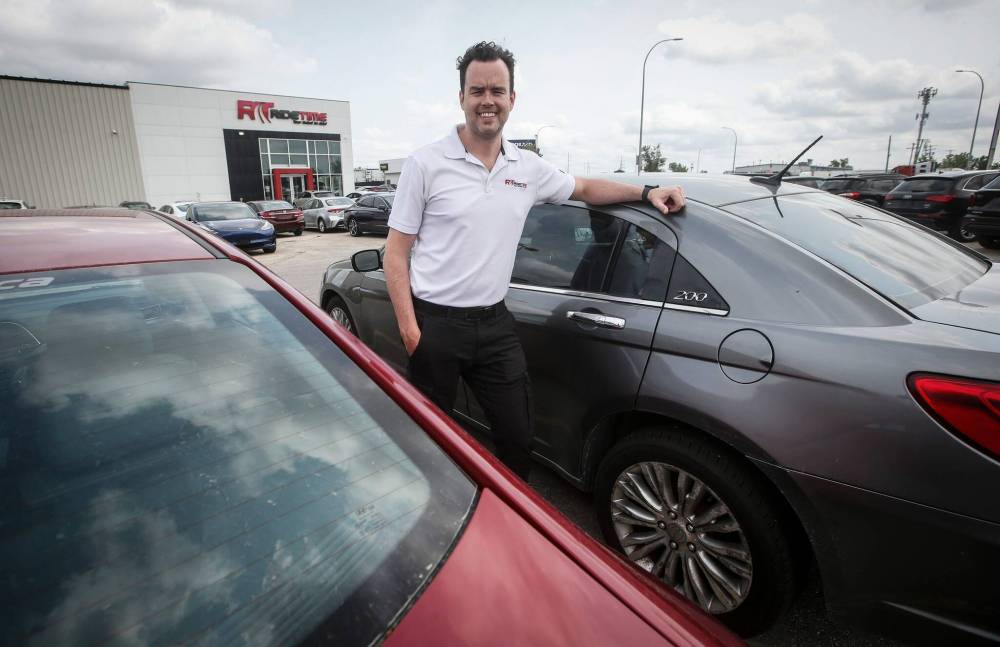
Andrew MacIver, co-owner of Ride Time, an independent used car dealership in Winnipeg, says sector dealerships are facing unique postCOVID-9 pandemic struggles, including a lack of affordable inventory and increased competition in the auction market.
In AutoTrader’s most recent quarterly price index report, Akyurek notes both used and new inventory availability is much better – up 28.2 per cent and 70.4 per cent, respectively, since a year ago. He points out that since 2019 — “the last normal year” — prices of new vehicles are up 48 per cent (to $66,807 from $45,204) and used cars are up 40 per cent (to $36,342 from $26,042).
(Black Book Canada and other car price services have slightly different numbers.)
Even still, Akyurek said: “On a general level, things are moving in the right direction. That is the point we are trying to make.”
Meantime, the realities on the street are tough when it comes to affordability.
Andrew MacIver, one of the so-called “Bargain Brothers” of Winnipeg used car dealership Ride Time, said: “Being in the used car side of the business post-pandemic has been a lot more challenging than being in the new car side.”
When the pandemic hit and auto manufacturers started shipping fewer new vehicles to dealers, those dealerships started to hit the used car auctions to beef up their inventories (whereas previously about 70 per cent of used inventories would have come from trade-ins).
That drove up the sticker price of used cars.
Then, there was the rental car businesses, which had let inventories decline and then had to replenish them … at the used car auctions.
“They were able to pay prices more than the used car dealers were willing to pay because they could charge more to rent that car to offset the cost,” said MacIver. “They were the better end user for some of those vehicles.”
As well, dealers and manufacturers cut back on leases during the pandemic, which effectively culled what, now three years later, would otherwise have been a healthy source of used inventories now.
Many other factors came into play — not the least of which were inflation and rising interest rates — which all contributed to jacking prices up some more.
But consumer demand remains, because people need cars.
MacIver said consumers waiting for the right car at the right price can only wait so long.
“It’s like an airplane circling a runway waiting to land. At some point, it will run out of gas and be forced to land,” he said, adding Ride Time’s business is up about 20 per cent this year.
Steve Chipman, president of Birchwood Automotive Group in Winnipeg, owners of 22 dealerships, said: “Our used inventory is significantly higher now than it was a couple of years ago. It would be more if we could get the right used vehicles.”
That said, Birchwood sales are trending up about 10 per cent this year.
MacIver has the same concerns. His dealership changed its focuses to lower-priced vehicles — “Everyday cars for everyday people” is the way he puts it.
He figures the noted 8.3 per cent decline in prices on used vehicles is mostly coming from the higher-priced ones.
AutoTrader’s website has an average of about 410,000 vehicles at any given time — down from about 450,000 before the pandemic — while the selling price declined on 31 per cent of cars listed in June, Akyurek said. That’s the most in a single month dating to the start of the pandemic.
Ride Time has been able to maintain about 100 cars on its lot through the last few years. “Whereas other lots looked like maybe they were going out of business,” MacIver said, because of inventory challenges,
He pointed out another anomalous factor that has added to the demand pressure on the market: the influx of new Canadians.
“They’re not looking to buy $66,000 cars,” he said, which is Black Book Canada’s average price of new car. “They’re not even looking to buy a $34,000 car,” which is the average price of a used car.
Partially because of that new demand, cohort prices at the low end of the used car market haven’t decreased by that noted 8.3 per cent total average. MacIver said those lower-end prices (around $25,000) have held steady for a couple of months.

“We had a better time at the auction earlier in the year,” he said.
Meantime, higher-priced used vehicles are coming down, partially because of rebates and incentives manufacturers are now offering on new cars.
Chipman said, during the pandemic, manufactures were not delivering a lot of “lower-trim” inventory, loading up instead on more profitable, fully loaded models.
That’s starting to change, theoretically making new vehicles more affordable.
martin.cash@freepress.mb.ca
Martin Cash has been writing a column and business news at the Free Press since 1989. Over those years he’s written through a number of business cycles and the rise and fall (and rise) in fortunes of many local businesses.
Our newsroom depends on a growing audience of readers to power our journalism. If you are not a paid reader, please consider becoming a subscriber.
Our newsroom depends on its audience of readers to power our journalism. Thank you for your support.
Martin Cash has been writing a column and business news at the Free Press since 1989. Over those years he’s written through a number of business cycles and the rise and fall (and rise) in fortunes of many local businesses.
Our newsroom depends on a growing audience of readers to power our journalism. If you are not a paid reader, please consider becoming a subscriber.
Our newsroom depends on its audience of readers to power our journalism. Thank you for your support.
Advertisement Advertise With Us
Advertisement Advertise With Us