The broom and the barbell
How E.J. Harnden changed curling forever

Advertisement
Read this article for free:
or
Already have an account? Log in here »
To continue reading, please subscribe:
Digital Subscription
One year of digital access for only $1.44 a week*
- Enjoy unlimited reading on winnipegfreepress.com
- Read the E-Edition, our digital replica newspaper
- Access News Break, our award-winning app
- Play interactive puzzles
*Billed as $5.77 plus GST every four weeks. After 52 weeks, price increases to the regular rate of $19.95 plus GST every four weeks. Offer available to new and qualified returning subscribers only. Cancel any time.
To continue reading, please subscribe:
Add Free Press access to your Brandon Sun subscription for only an additional
$1 for the first 4 weeks*
- Enjoy unlimited reading on winnipegfreepress.com
- Read the E-Edition, our digital replica newspaper
- Access News Break, our award-winning app
- Play interactive puzzles
*Your next Brandon Sun subscription payment will increase by $1.00 and you will be charged $17.95 plus GST for four weeks. After four weeks, your payment will increase to $24.95 plus GST every four weeks.
Read unlimited articles for free today:
or
Already have an account? Log in here »
Hey there, time traveller!
This article was published 14/03/2026 (218 days ago), so information in it may no longer be current.
I was a young sports reporter the first time I saw E.J. Harnden throw his broom.
It was February 2009 at the Northern Ontario Curling Association playdowns in Fort Frances. The Brad Jacobs rink — Jacobs at skip, E.J. at third, his younger brother Ryan at second — had just absorbed a 9-4 loss to Mike Jakubo in the final, their third straight defeat to the same Copper Cliff team that week. When Harnden’s last rock failed to disturb a pair of Jakubo stones sitting fat in scoring position, he didn’t shake his head or mutter under his breath. He threw his broom.
I remember thinking: that’s not how curlers act. This was, after all, a game still broadly associated with potluck socials and Canadian Club rye whisky. Curlers were supposed to be serene. Stoic. These guys were something else.
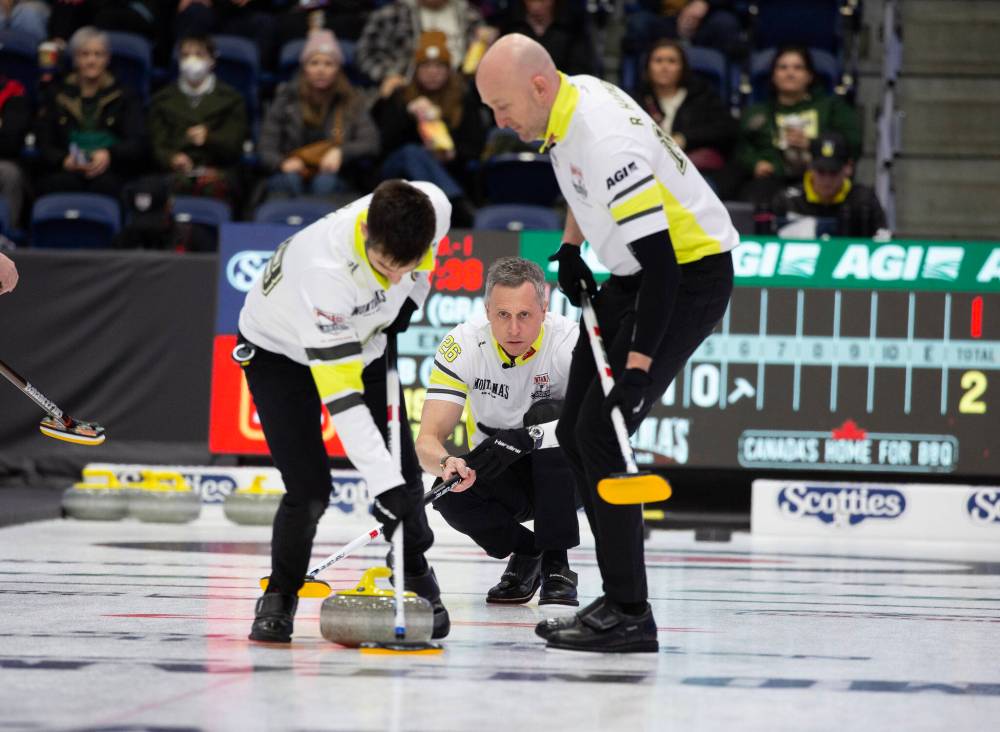
PAUL DALY / THE CANADIAN PRESS
E.J. Harnden (centre) committed himself to a strength and fitness routine that help to revolutionize the game of curling.
Seventeen years later, E.J. Harnden — now 42, and in the final chapter of a career that reshaped Canadian curling — just swept his way to a fourth national Brier title on a retirement tour with Matt Dunstone’s Manitoba rink. He was named tournament MVP, shooting 88 per cent accuracy for the week. He shared a long embrace with Ryan when it was over. And somewhere in that moment, the broom that once hit the ice in frustration became a symbol of everything that followed.
Family business
Curling has always been the family business in Sault Ste. Marie. E.J.’s father, Eric Harnden Sr., was a four-time Brier competitor. Brad Jacobs is the Harnden boys’ cousin — the son of another uncle, Al Harnden, who also competed at the Brier. They grew up running around curling ice in hockey helmets during their father’s practices. Ryan started curling competitively at nine. E.J. at 14.
In 2008, the brothers played on a team skipped by their father at the Brier, going 3-8. Then E.J. and Ryan joined forces with Jacobs to form their own team. That crew — rounded out with Caleb Flaxey — made their first Northern Ontario provincial final in 2009 and walked straight into Jakubo.
They lost three times that week. The broom hit the ice. The Brier berth went elsewhere.
Most teams would have broken up. This one went to the gym.
If you watched any curling before the Jacobs era, you know the esthetic: sensible sweaters, generous midsections, the occasional cigarette between ends. The sport had athletic demands, but they were easy to hide under a fleece vest.
E.J., Ryan and Jacobs did not look like that. Jacobs is built like a tight end. E.J. and Ryan swept with visible, aggressive power — shoulders churning, legs driving, brooms attacking the ice. By the time they landed on the international stage, journalists were calling them the “Buff Boys” and noting, with some bewilderment, that they trained like college football players. They warmed up to thumping house music. They watched motivational highlight reels before big games. They preferred to be called athletes rather than curlers.
This was not an accident. After the 2009 heartbreak in Fort Frances, the team recognized that the sweeping game — the ability to control where a stone ends up through the sheer physical work of brushing the ice — could be a decisive edge. E.J. and Ryan were already strong. They got stronger. They embraced what the sport’s older guard resisted: that vigorous sweeping changed outcomes, and that conditioning changed sweeping.
The sport hasn’t looked the same since.
A team transformed
After the 2009 defeat, the Jacobs rink won the Northern Ontario provincial title in 2010 — the first time since 1993 that a team from the region had made the Brier playoffs, where they earned a bronze. They came back in 2011, again in 2012. The results kept improving.
In 2013, they became the first Northern Ontario rink to win the Brier since 1985. They represented Canada at the world championship that year, losing to Sweden in the final. Despite their credentials, they still had to fight through a pre-trials qualifier to reach the 2013 Canadian Olympic Curling Trials — and they were the last team to qualify.
They won those trials, and then they went to the Sochi Winter Olympics in 2014.
In Sochi, Team Jacobs started 1-2. They held a frank team conversation. Then they won six straight, beat China in the semifinals and defeated Great Britain 9-3 in the gold-medal game. Jacobs curled at 95 per cent efficiency in the final.
The Harnden brothers swept every stone with the same ferocity I’d first seen expressed by a broom thrown on the ice in Fort Frances five years earlier. The coach of the British team complained publicly about Canada’s aggressive, emotional style. Ryan said the criticism made them stronger.
After the final stone settled and the gold medal was confirmed, Jacobs and E.J. ran a victory lap around the arena carrying a Canadian flag. It was not the kind of thing you did at curling. It was exactly the kind of thing they would do.
Jacobs took a short hiatus from the game in 2022. E.J. joined Brad Gushue’s powerhouse team, winning Brier titles in 2023 and ’24 and earning silver at the world championships both years. Ryan connected with Dunstone’s younger rink out of Manitoba. In 2024, the brothers reunited on the same team.
E.J., now 42, announced in December that this season would be his last. His daughter is almost 11. His son just turned eight. He’s missed dance recitals. He knows it’s time.
“What a way to go, though,” he said before the final. “What a way to end it.”
On Sunday night in St. John’s, Dunstone’s rink beat Kevin Koe’s Alberta team 6-3 for the Brier title. E.J. was named tournament MVP. He and Ryan shared a lengthy hug on the ice.
‘Buff Boys’ reframed game
You can see the Harnden effect in every elite curling team today. The idea that you train for this sport the way you train for any other — dedicated gym time, conditioning programs, athletic discipline — is now standard across the top tier of the game. The Buff Boys didn’t just win; they reframed what winning required.
It’s the same thing I tell my fitness clients. Nobody gets results from one perfect week. E.J. didn’t go from throwing a broom in frustration to standing on an Olympic podium because he found a magic program. He showed up, consistently, for years. Put in the reps on and off the sheet. Moved his body. Recovered properly. The boring fundamentals, stacked day after day, are what actually build something.

Whether you’re sweeping for a Brier title or just trying to feel better at 42, the work is the same. Sleep. Move. Lift. Practise your craft. Eat well. Drink your water. Then do it again tomorrow.
I’ve covered a lot of local athletes over the years, and the story I return to most is the one I wrote in a hurry on a Saturday night in 2009, about a rink that went home empty-handed. At the time, I noted a moment of frustration — a broom thrown in the heat of a painful loss — and moved on to the next assignment.
I didn’t know I was watching the beginning of something.
E.J. Harnden picked up that broom. And then he spent the next 17 years making sure he’d never have reason to throw it again.
Mitch Calvert is a Winnipeg-based fitness coach. Visit mitchcalvert.com for more information.
Our newsroom depends on a growing audience of readers to power our journalism. If you are not a paid reader, please consider becoming a subscriber.
Our newsroom depends on its audience of readers to power our journalism. Thank you for your support.
Our newsroom depends on a growing audience of readers to power our journalism. If you are not a paid reader, please consider becoming a subscriber.
Our newsroom depends on its audience of readers to power our journalism. Thank you for your support.
Advertisement Advertise With Us
Advertisement Advertise With Us