Pope in headdress stirs deep emotions in Indian Country
Advertisement
Read this article for free:
or
Already have an account? Log in here »
To continue reading, please subscribe:

Digital Subscription
One year of digital access for only $205*
- Enjoy unlimited reading on winnipegfreepress.com
- Read the E-Edition, our digital replica newspaper
- Access News Break, our award-winning app
- Play interactive puzzles
*First annual payment billed as $205.00 + GST for one year. This annual subscription will automatically renew at $233.00 + GST every 52 weeks (10% off the regular annual price of $259.35). Offer available to new and qualified returning subscribers only. Cancel any time.
To continue reading, please subscribe:
Add Free Press access to your Brandon Sun subscription for only an additional
$1 for the first 4 weeks*
- Enjoy unlimited reading on winnipegfreepress.com
- Read the E-Edition, our digital replica newspaper
- Access News Break, our award-winning app
- Play interactive puzzles
*Your next Brandon Sun subscription payment will increase by $1.00 and you will be charged $17.95 plus GST for four weeks. After four weeks, your payment will increase to $24.95 plus GST every four weeks.
Read unlimited articles for free today:
or
Already have an account? Log in here »
Hey there, time traveller!
This article was published 26/07/2022 (1528 days ago), so information in it may no longer be current.
It was a stunning image: Pope Francis briefly wearing a full Indigenous headdress, its rows of soft white feathers fastened in place by a colorful, beaded headband after he apologized for the Catholic Church’s role in Canada’s “disastrous” residential school system for Indigenous children.
Chief Wilton Littlechild, a residential school survivor himself, gave Francis the headdress Monday, placing it on his head amid cheering by an audience in Maskwacis, Alberta, that included many school survivors.
The Vatican and the pope clearly appreciated the gesture: Francis kissed Littlechild’s hands after receiving the headdress, something he has done in the past as a sign of respect for Holocaust survivors, and has done on this trip for residential school survivors.
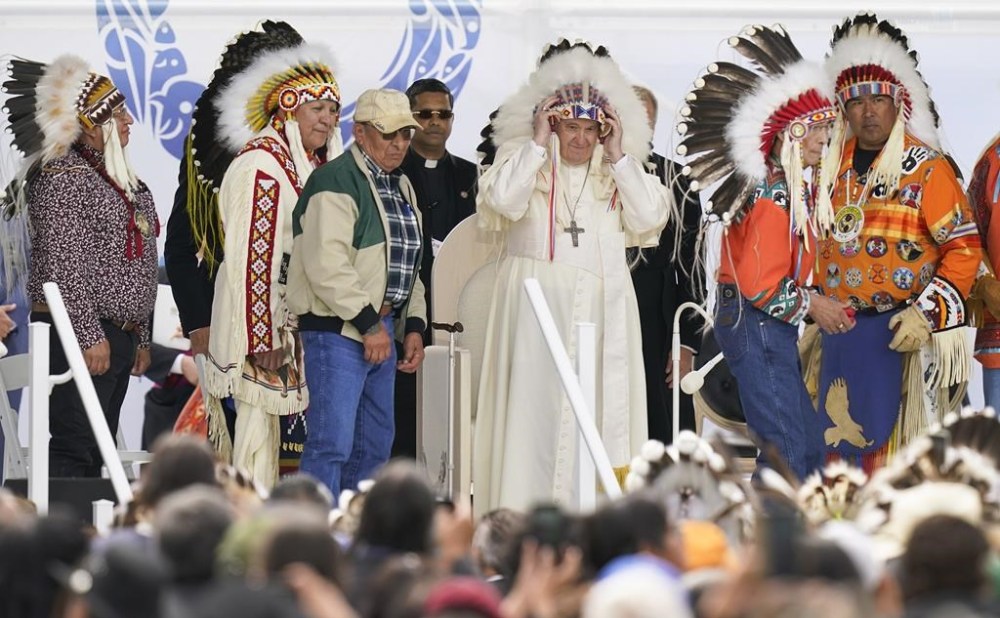
The Vatican obviously understood the symbolic significance of the moment, putting the photo on the front page of the Vatican newspaper L’Osservatore Romano under the headline “I humbly beg forgiveness.”
Headdresses historically are a symbol of respect, worn by Native American war chiefs and warriors. For many Plains tribes, for example, each feather placed on a headdress has significance and had to be earned through an act of compassion or bravery. Some modern-day Native American leaders have been given war bonnets in ceremonies accompanied by prayers and songs.
Yet this revered regalia also represents an image that has been co-opted from tribes in popular culture for decades, feeding stereotypes in everything from Hollywood films, to fashion runways to Halloween costumes.
Some members of Indigenous tribes said they found the gesture incongruous with the past transgressions at church-run schools that Francis apologized for.
Russ Diabo, a member of the Kahnawake Mohawk tribe in Canada and an Indigenous advocate and policy analyst, described the scene as “pageantry” and the pope’s statements as “facile.”
Diabo said on Twitter it was “the Catholic Church and Canada collaborating in creating a mythology for a shared ‘Reconciliation’ agenda narrated by prominent federal collaborators/residential school survivors!”
“I have so much to say about this, and all of it negative,” tweeted Joe Horse Capture, vice president of native collections and curator of Native American History and Culture at the Autry Museum of the American West in Los Angeles.
“I am practicing ‘If you can’t say anything positive, don’t say anything at all’ mantra. But I’ll be honest, it’s difficult!,” added Horse Capture, a member of the A’aniiih Nation.
More than 150,000 Native children in Canada were forced to attend government-funded Christian schools from the 19th century until the 1970s in an effort to isolate them from the influence of their homes and culture. The aim was to Christianize and assimilate them into mainstream society, which previous Canadian governments considered superior.
The discoveries of hundreds of potential burial sites at former schools in the past year have drawn international attention to the schools in Canada and their counterparts in the United States.
Leading U.S.-based Indigenous news outlet ICT made a deliberate decision to not make the war bonnet a focus of their papal visit coverage.
“When I saw the headdress being placed on the Pope, I immediately thought ‘absolutely not.’ We are not running that photo,” said Jourdan Bennett-Begaye, editor of ICT, formerly Indian Country Today. “It distracts readers from the Pope’s apology and survivors’ stories who sat in those chairs listening to his every word. Something they’ve been waiting for, for decades.
“It creates unnecessary noise regarding Indigenous peoples’ choices where the real scrutiny should be placed on the Pope and that entire institution.”
Maka Black Elk, executive director of Truth and Healing at Red Cloud Indian School in Pine Ridge, South Dakota, described the scene on Twitter as a “#toosoon moment.”
“The discourse around the #PopeFrancis headdress is unfortunate,” wrote Black Elk. “He did not request that. It wasn’t his fault. But it’s also clear the givers did not consider how it would make other Indigenous people feel.”
Black Elk said later in a telephone interview that the mixed reaction to the headdress being placed on the pope’s head “reflects the reality of native people and our need for more dialogue” about the past.
“I do think that Chief Littlechild felt it was important to honor this moment, and this was a significant moment,” he added.
A spokeswoman for Littlechild didn’t immediately respond Tuesday to a message seeking comment.
But Keeshon Littlechild used a Facebook post to defend his grandfather for giving Francis one of his own many headdresses.
“Bugs me to see people bashing my grandfather and I understand how much respect is needed to be gifted one but at the end of the day that was him showing the pope respect for coming all the way to maskwacis to apologize,” he wrote.
Among those coming to Littlechild’s defense was Phil Fontaine, a former Assembly of First Nations chief and a residential school survivor.
“Chief Littlechild followed his protocols,” Fontaine said. “There is a protocol for that kind of gift. He went to the elders, he went to the leadership and requested permission to present that gift. It is entirely consistent with the way they follow their customs and protocol here.”
Jon Crier, a First Nations elder and school survivor, said during a news conference after the apology that the gesture meant tribal leaders “adopted him as one of our leaders in the community.
“It’s an honoring of the man, it’s an honoring of the work he has done and it’s also recognizing … here’s a man that belongs in our tribe,” Crier said.

Marie-Anne Day Walker Pelletier, former chief of Okanese First Nation, told CTV, “I thought it was pretty cool. The chief of all chiefs now I guess.”
—-
Nicole Winfield and Peter Smith in Maskwacis, Alberta, and Rob Gillies in Toronto contributed reporting. Snow reported from Phoenix.
——
Associated Press religion coverage receives support through the AP’s collaboration with The Conversation US, with funding from Lilly Endowment Inc. The AP is solely responsible for this content.
Related Articles
Truth must be foundation for building true reconciliation

Advertisement Advertise With Us
Advertisement Advertise With Us
The Free Press acknowledges the financial support it receives from members of the city’s faith community, which makes our coverage of religion possible.