Oil price cap could strike Russia’s war chest – if enforced

Advertisement

Advertise with us

GARMISCH-PARTENKIRCHEN, Germany (AP) — Leaders of the world’s biggest developed economies are weighing a cap on the price of Russian oil meant to strike at the main pillar of the Kremlin's finances following its invasion of Ukraine — and to limit the havoc that high energy prices are wreaking worldwide.

Read this article for free:


or

Already have an account? Log in here »

To continue reading, please subscribe:

Subscribe and receive a limited-edition Free Press branded hat or tote.

Digital Subscription

One year of digital access for only $205*

  • Enjoy unlimited reading on winnipegfreepress.com
  • Read the E-Edition, our digital replica newspaper
  • Access News Break, our award-winning app
  • Play interactive puzzles

*First annual payment billed as $205.00 + GST for one year. This annual subscription will automatically renew at $233.00 + GST every 52 weeks (10% off the regular annual price of $259.35). Offer available to new and qualified returning subscribers only. Cancel any time.

To continue reading, please subscribe:

Add Free Press access to your Brandon Sun subscription for only an additional

$1 for the first 4 weeks*

  • Enjoy unlimited reading on winnipegfreepress.com
  • Read the E-Edition, our digital replica newspaper
  • Access News Break, our award-winning app
  • Play interactive puzzles
Start now

*Your next Brandon Sun subscription payment will increase by $1.00 and you will be charged $17.95 plus GST for four weeks. After four weeks, your payment will increase to $24.95 plus GST every four weeks.

Hey there, time traveller!
This article was published 27/06/2022 (1562 days ago), so information in it may no longer be current.

GARMISCH-PARTENKIRCHEN, Germany (AP) — Leaders of the world’s biggest developed economies are weighing a cap on the price of Russian oil meant to strike at the main pillar of the Kremlin’s finances following its invasion of Ukraine — and to limit the havoc that high energy prices are wreaking worldwide.

Details haven’t been agreed at the Group of Seven summit in Elmau, Germany, but the basic idea would be to tie the price cap to the services that make trading oil possible. For instance, insurers would be barred from dealing with shipments that are above the cap, wherever it winds up being set.

Because such service providers are largely based in the European Union and United Kingdom, Russia would be expected to face difficulty finding large-scale workarounds.
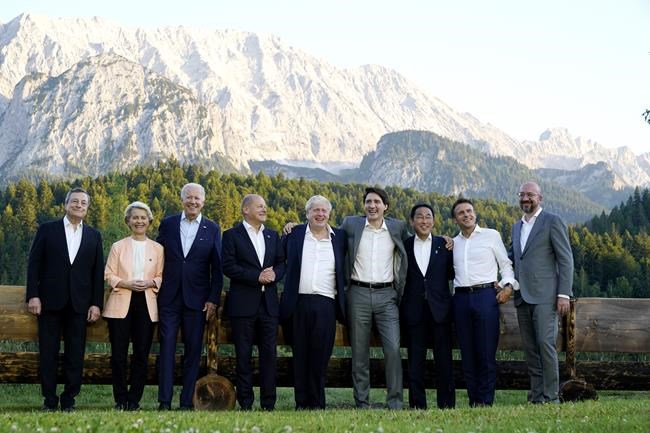
Members of the G7 from left, Prime Minister of Italy Mario Draghi, European Commission President Ursula von der Leyen, President Joe Biden, German Chancellor Olaf Scholz, British Prime Minister Boris Johnson, Canadian Prime Minister Justin Trudeau, Prime Minister of Japan Fumio Kishida, French President Emmanuel Macron and European Council President Charles Michel stand for a photo at Schloss Elmau following their dinner at G7 Summit in Elmau, Germany, Sunday, June 26, 2022. The bench behind them became famous when former German Chancellor Angela Merkel and former President Barack Obama were photographed talking by it. (AP Photo/Susan Walsh)

Limiting the price would reduce the Kremlin’s income from oil — at the start of the war, it was about $450 million per day from Europe alone. The cap also would limit the impact of higher oil prices on inflation in consuming countries, with the cost of gasoline and diesel squeezing consumers and businesses.

But much would depend on whether Asian countries like India would go along with the price cap. A key question is enforcement, and European officials are also cautious about side effects.

“We want to go more into the details. … We want to make sure that the goal is to target Russia and not to make our life more difficult,” said Charles Michel, head of the European Union’s 27-member council of governments. “We need to have a clear common understanding about what are the direct effects and what could be the collateral consequences.”

The EU has agreed to phase out the 90% of Russian oil that comes by ship by the end of the year but is chagrined that it is still paying into the Kremlin’s war chest. EU countries, however, need time to line up new sources of oil and are under pressure from the high price of crude.

Governments are facing calls for even tougher action, such as an immediate end to Russian oil and natural gas shipments, a move that many economists say would trigger a recession in Europe.

Already, fears that supply from Russia would be lost to the global market has helped send global oil prices sharply higher, along with recovering demand from the COVID-19 pandemic. The OPEC+ alliance of oil-producing countries, including Saudi Arabia and Russia, has increased output but too slowly to lower prices.

Russia is selling less oil as Western buyers shun its supply, but the higher prices have erased much of the loss to state finances.

The country’s central bank has managed to stabilize the ruble despite Western sanctions, in part with help from oil earnings. International benchmark Brent crude is trading at $113 per barrel, up from $79 per barrel at the start of the year.

One result has been pump prices hitting an all-time high of over $5 per gallon in the U.S. and over $7.50 in Germany.

“At current prices, this entails massive profits for the Kremlin,” said Simone Tagliapietra, an energy policy expert at the Bruegel think tank in Brussels. “Should the G-7 agree on a price cap for Russian oil, that would be a very important step to limit Putin’s windfall revenues.”

Tagliapietra said the delayed EU boycott on Russian oil was “too little too late,” especially considering Russia’s cutoff or reduction of natural gas to 10 EU countries in recent weeks. Western officials say Russia is “weaponizing” energy and exploiting Europe’s dependence on Moscow’s supplies.

Russia has been able to find buyers outside the West as Asian customers — like India and China — have replaced the EU as the biggest buyers of oil shipped by sea.

Due to sanctions, Russian oil is trading at a steep discount to international benchmark Brent, fattening the profit margins of refiners in India who turn crude into gasoline. And some Russian oil sales have simply gone off the books.

Once Russia oil is refined into gasoline or blended with other crude, it’s hard to say where it came from, especially if no one wants to look too closely.

“It is questionable whether countries like India and China will agree to cease purchasing Russian oil, especially as it is trading at a significant discount on the global market price,” said commodities analyst Carsten Fritsch at Commerzbank in Frankfurt, Germany. “Instead, India is helping Russia to continue selling its oil despite the West’s sanctions.”

Fritsch said India was willing to provide safety certification for more than 80 ships belonging to a Dubai-based subsidiary of the state Russian shipping company Sovcomflot after Western certification bodies were unable to do so because of sanctions.

Since European refiners started shunning Russian oil in late February, Russian crude oil imports to Europe fell from 2.04 million barrels per day to 1.49 million between March and May, according to Rystad Energy. Russian-origin oil imports by Asian refiners including China saw a corresponding 503,000-barrel-per-day increase.

“The expectation that Russian crude would cease to be traded on international markets has not transpired, and instead the steep discount on Russian crude has seen vessels redirected to alternative markets,” said Wei Cheong Ho, a vice president at Rystad Energy.

“While the cost of financing these vessels and trades has increased significantly due to be freezing out of the Western financial system, the discount on Urals is too attractive for some refiners to ignore,” Ho added.

Report Error Submit a Tip

More Stories

Botched execution revives death penalty debate

Arthur Chapman 5 minute read 2:00 AM CDT

The United States of America’s seemingly endless, often futile, search for the painless, bloodless method of executing prisoners continues. The latest horrifying chapter occurred in Tennessee on Sept. 30, when the state tried to kill convicted murderer Christa Pike by lethal injection.

It didn’t work. Pike survived two dosages of pentobarbital. She was rushed to a hospital where, according to her lawyer, she was receiving “lifesaving care”.

Tennessee governor Bill Lee has cancelled upcoming executions, but he isn’t moving away from capital punishment.

Lee said, as quoted in the New York Times: “The people of Tennessee have determined that capital punishment is the appropriate sentence for the most heinous of crimes. The people of Tennessee expect those sentences to be carried out in a manner that’s not only legal and constitutional but effective, and that didn’t happen.”

Olympic soccer, boxing qualifiers in China affected by virus

The Associated Press 2 minute read Preview

Olympic soccer, boxing qualifiers in China affected by virus

The Associated Press 2 minute read Wednesday, Jan. 22, 2020

KUALA LUMPUR, Malaysia - Olympic qualifying events in two sports were moved from the Chinese city of Wuhan on Wednesday because of an outbreak of a deadly viral illness.

A four-nation Asian qualifying group for the women’s soccer tournament was switched from the city at the centre of the health scare to Nanjing.

The Asia-Oceania boxing qualifying tournament scheduled for Feb. 3-14 in Wuhan was cancelled. No new plans were announced.

The decisions followed Chinese health authorities telling people in Wuhan to avoid crowds and public gatherings.

Read
Wednesday, Jan. 22, 2020

Tokyo Olympic aftermath still being untangled a year later

Stephen Wade, The Associated Press 7 minute read Preview

Tokyo Olympic aftermath still being untangled a year later

Stephen Wade, The Associated Press 7 minute read Thursday, Jul. 21, 2022

TOKYO (AP) — The Tokyo Olympics survived the COVID-19 postponement, soaring expenses and some public opposition. A year later, the costs and benefits remain as difficult to untangle as the Games were to pull off.

In his speech at the closing ceremony, IOC President Thomas Bach said a major accomplishment of the Games was simply reaching the end.

“We did it,” Bach said. “We did it together," he repeated, crediting the athletes, Japanese government officials, and deep-pocketed broadcasters for refashioning the Games despite no fans, disappointed sponsors, and no buzz around the city.

Organizers said the Games would drive tourism, showcase Japan's technological prowess, and create memories similar to the 1964 Tokyo Olympics. The pandemic erased that.

Read
Thursday, Jul. 21, 2022

Oil price cap could strike Russia's war chest - if enforced

The Associated Press 6 minute read Preview

Oil price cap could strike Russia's war chest - if enforced

The Associated Press 6 minute read Monday, Jun. 27, 2022

GARMISCH-PARTENKIRCHEN, Germany (AP) — Leaders of the world’s biggest developed economies are weighing a cap on the price of Russian oil meant to strike at the main pillar of the Kremlin's finances following its invasion of Ukraine — and to limit the havoc that high energy prices are wreaking worldwide.

Details haven't been agreed at the Group of Seven summit in Elmau, Germany, but the basic idea would be to tie the price cap to the services that make trading oil possible. For instance, insurers would be barred from dealing with shipments that are above the cap, wherever it winds up being set.

Because such service providers are largely based in the European Union and United Kingdom, Russia would be expected to face difficulty finding large-scale workarounds.

Limiting the price would reduce the Kremlin's income from oil — at the start of the war, it was about $450 million per day from Europe alone. The cap also would limit the impact of higher oil prices on inflation in consuming countries, with the cost of gasoline and diesel squeezing consumers and businesses.

Read
Monday, Jun. 27, 2022

City emergency crews to administer drug that stops opioid withdrawal symptoms

Joyanne Pursaga 5 minute read Preview

City emergency crews to administer drug that stops opioid withdrawal symptoms

Joyanne Pursaga 5 minute read Monday, Aug. 10, 2026

Winnipeg Fire Paramedic Service crews will soon give out a medication that stops withdrawal symptoms after someone is treated for an opioid overdose.

Emergency workers will be administering a drug called buprenorphine, after Health Canada granted WFPS permission to use the controlled substance.

“Buprenorphine is a medication that offers people who are in active addiction — so those people who have received naloxone as a result of an overdose and those that are experiencing significant and, at times, dangerous withdrawal symptoms — just a bit of a reprieve … (It) reduces cravings and prevents those immediate withdrawal symptoms, which allows more time to connect those patients to further care,” said Michelle Long, WFPS assistant chief of paramedic operations.

The treatment option is in response to a persistently high number of WFPS opioid calls.

Read
Monday, Aug. 10, 2026

Wasteful operations should be held accountable

Barry E. Prentice 5 minute read Preview

Wasteful operations should be held accountable

Barry E. Prentice 5 minute read Yesterday at 2:00 AM CDT

Rising water bills are a top-of-mind issue for residents of Winnipeg going into the fall election. Management of the water and waste system is under question, with citizen’s groups, as well as the Free Press, calling for proper oversight of rates (Time for the PUB to review Winnipeg water rates, Editorial, Sept. 26).

The need to increase rates to build the North End sewage plant is understandable. Siphoning off utility proceeds to make up other tax revenue shortfalls is another matter. But it is not the only questionable practice. If there was Public Utilities Board oversight of Winnipeg’s water and sewer rates, it would certainly be asking why the city is spending more than $3 million annually to operate the 164-kilometre-long, Greater Winnipeg Water District railway (GWWD) on ratepayers’ behalf.

The GWWD has come to the attention of the Railway Relocation Study, led by Lloyd Axworthy. All existing rail lines within the city are under review, as is the feasibility of a new railway bypass.

The GWWD is an example of a railway that has outlived its usefulness and sits on a pocket of land close to downtown that could be converted to higher-value uses.

Read
Yesterday at 2:00 AM CDT