Protect the body: Ukraine volunteers craft armor, camouflage

Advertisement

Advertise with us

ZAPORIZHZHIA, Ukraine (AP) — Sparks fly as a circular saw slices into metal, while welders nearby work feverishly to the sound of blaring heavy metal. Upstairs, sewing machines clatter as women mark patterns on cloth being shaped into bulletproof vests.

Read this article for free:


or

Already have an account? Log in here »

To continue reading, please subscribe:

Subscribe and receive a limited-edition Free Press branded hat or tote.

Digital Subscription

One year of digital access for only $205*

  • Enjoy unlimited reading on winnipegfreepress.com
  • Read the E-Edition, our digital replica newspaper
  • Access News Break, our award-winning app
  • Play interactive puzzles

*First annual payment billed as $205.00 + GST for one year. This annual subscription will automatically renew at $233.00 + GST every 52 weeks (10% off the regular annual price of $259.35). Offer available to new and qualified returning subscribers only. Cancel any time.

To continue reading, please subscribe:

Add Free Press access to your Brandon Sun subscription for only an additional

$1 for the first 4 weeks*

  • Enjoy unlimited reading on winnipegfreepress.com
  • Read the E-Edition, our digital replica newspaper
  • Access News Break, our award-winning app
  • Play interactive puzzles
Start now

*Your next Brandon Sun subscription payment will increase by $1.00 and you will be charged $17.95 plus GST for four weeks. After four weeks, your payment will increase to $24.95 plus GST every four weeks.

Hey there, time traveller!
This article was published 08/05/2022 (1590 days ago), so information in it may no longer be current.

ZAPORIZHZHIA, Ukraine (AP) — Sparks fly as a circular saw slices into metal, while welders nearby work feverishly to the sound of blaring heavy metal. Upstairs, sewing machines clatter as women mark patterns on cloth being shaped into bulletproof vests.

An old industrial complex in the southeastern Ukrainian riverside city of Zaporizhzhia has become a hive of activity for volunteers producing everything from body armor and anti-tank obstacles to camouflage nets, portable heating stoves and rifle slings for Ukrainian soldiers fighting Russia’s invasion. One section specializes in vehicles, armor-plating some, converting others into ambulances. Another organizes food and medical deliveries.

With the front line about 50 kilometers (30 miles) from the city, some sections of the operation, such as the stitching of bulletproof vests, are working around the clock in shifts to meet demand. Crowdfunding has brought in enough money to buy steel from Sweden, Finland and Belgium, which is lighter than local steel, organizers say, a crucial quality for body armor.
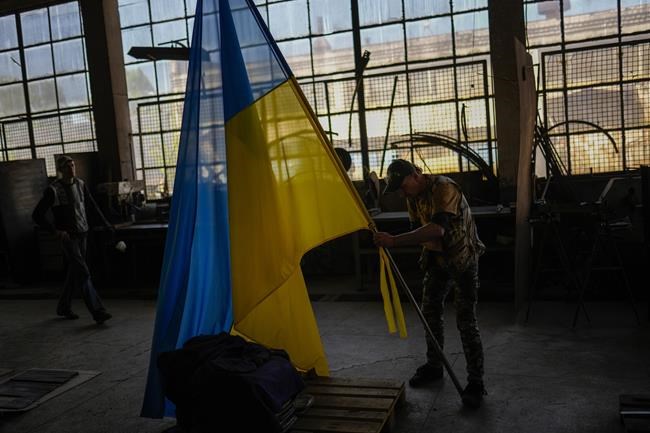
A volunteer places a Ukraine flag on a metal bar at a facility producing material for Ukrainian soldiers in Zaporizhzhia, Ukraine, Friday, May 6, 2022. An old industrial complex in the southeastern Ukrainian riverside city of Zaporizhzhia has become a hive of activity for volunteers producing everything from body armor to camouflage nets, anti-tank obstacles to heating stoves and rifle slings for Ukrainian soldiers fighting the Russian invasion. (AP Photo/Francisco Seco)

The operation is the brainchild of local celebrity Vasyl Busharov and his friend Hennadii Vovchenko, who ran a furniture-making business. They named it Palianytsia, a type of Ukrainian bread whose name many Ukrainians say cannot be pronounced properly by Russians.

The operation relies entirely on volunteers, who now number more than 400 and come from all walks of life, from tailors to craftsmen to lawyers. Apart from those involved in production, there are also drivers delivering humanitarian aid and medical equipment bought through donated funds.

“I feel I am needed here,” said fashion designer Olena Grekova, 52, taking a brief break from marking fabric for vests.

When Russia invaded on Feb. 24, she was in Thailand seeking inspiration for her spring collection. Initially, she said, she wondered whether it was a sign from God that she shouldn’t return. Her husband and two adult sons urged her not to.

“But I made a decision that I had to go back,” she said.

She had known Busharov for years. Arriving home on March 3, she gathered her equipment the next day and by March 5 was at Palianytsia. She’s been working there every day since, bar one, sometimes even at night.

Shifting from designing backless ballgowns to creating functional bulletproof vests was “a new experience for me,” Grekova said. But she sought feedback from soldiers for her designs, which have armor plates added. Now she is helping to produce several versions, including a prototype summer vest.

In another section of the industrial complex, 55-year-old Ihor Prytula was busy making a new camouflage net, winding pieces of dyed fabric through a string frame. A furniture-maker by trade, he joined Palianytsia at the start of the war. He had some military experience, he said, so it was easy to get feedback from soldiers on what they needed.

“We speak the same language,” he said.

For Prytula, the war is personal. His 27-year-old son was killed in late March as he helped evacuate people from the northern town of Chernihiv.

“The war and death, it’s bad, trust me, I know this,” he said. “It’s bad, it’s tears, it’s sorrow.”

The call for volunteers went out as soon as the war began. Busharov announced his project on Facebook on Feb. 25. The next day, 50 people turned up. “Next day 150 people, next day 300 people. … And all together, we try (to) protect our city.”

They started out making Molovov cocktails in case Russian soldiers advanced on Zaporizhzhia. In 10 days, they produced 14,000, he said. Then they turned to producing anti-tank obstacles known as hedgehogs — three large metal beams soldered together at angles — used as part of the city’s defenses. Soon, Busharov and Vovchenko said, they discovered another pressing need: there weren’t enough bulletproof vests for Ukraine’s soldiers.

But learning how to make something so specialized wasn’t easy.
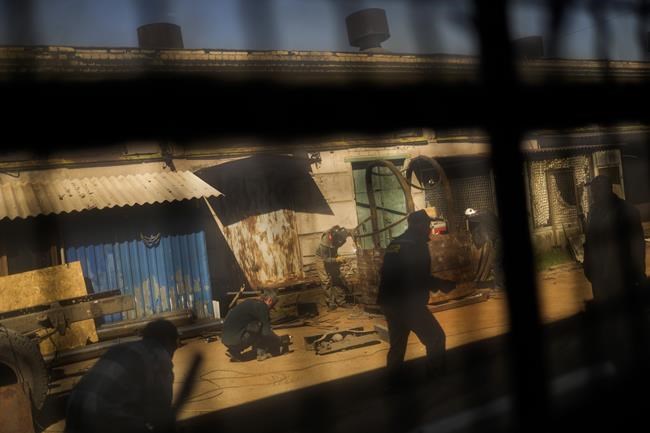
Volunteer welders work on metal pieces at a facility producing material for Ukrainian soldiers in Zaporizhzhia, Ukraine, Friday, May 6, 2022. An old industrial complex in the southeastern Ukrainian riverside city of Zaporizhzhia has become a hive of activity for volunteers producing everything from body armor to camouflage nets, anti-tank obstacles to heating stoves and rifle slings for Ukrainian soldiers fighting the Russian invasion. (AP Photo/Francisco Seco)

“I wasn’t actually connected with the military at all,” said Vovchenko. “It took two days and three sleepless nights to understand what needs to be done.”

The team went through various types of steel, making plates and testing them to check bullet penetration. Some didn’t offer enough protection, others were too heavy to be functional. Then they had a breakthrough.

“It turns out that steel used for car suspension has very good properties for bullet penetration,” Vovchenko said, standing in front of four shelves of test plates with varying degrees of bullet damage. The one made of car suspension steel showed dozens of bullet marks but none that penetrated.

The vests and everything else made at Palianytsia are provided free to soldiers who request them, so long as they can prove they are in the military. Each plate is numbered and each vest has a label noting it is not for sale.

So far, Palianytsia has produced 1,800 bulletproof vests in two months, Busharov said, adding there was a waiting list of around 2,000 more from all over Ukraine.

Vovchenko said they have heard about up to 300 people whose lives have been saved by the vests.

Knowing that is “incredibly inspiring and it keeps us going,” he said.

____

Inna Varenytsia in Zaporizhzhia, Ukraine, contributed.

___

Follow all AP stories on the war in Ukraine at https://apnews.com/hub/russia-ukraine

Report Error Submit a Tip

More Stories

Mayoral candidate denounced for online comments

Morgan Modjeski 3 minute read Preview

Mayoral candidate denounced for online comments

Morgan Modjeski 3 minute read Updated: Yesterday at 2:34 PM CDT

A Winnipeg mayoral candidate is facing criticism after he posted derogatory comments about immigrants and used the word “gay” as an insult online.

Sydney Adams said the response she got from Zac Uminski, who is seeking the city’s top office alongside 12 other individuals, left her baffled. She recently criticized Uminski over his use of artificial intelligence to produce campaign material, to which he replied he can’t afford to hire people to make art or “do whatever gay s—- you think is better than AI.”

“What was going through my head was that this is just unacceptable,” she said.

Adams said Uminski also posted other disparaging remarks about newcomers.

Read
Updated: Yesterday at 2:34 PM CDT

Mourinho’s return to Real Madrid a classic rebound

Jerrad Peters 6 minute read Preview

Mourinho’s return to Real Madrid a classic rebound

Jerrad Peters 6 minute read Friday, Aug. 14, 2026

Not quite a month ago, nearly two million people lined the streets of Madrid to see the World Cup paraded by the Spanish national team. It might as well have been another lifetime.

By the time the Plaza de Cibeles was swept up and sprayed down, the country’s attention had shifted to the only thing — or person — it seemed anyone wanted to be talking about: José Mourinho.

And they haven’t stopped talking about him. He hasn’t let them.

On June 11, the same day the World Cup kicked off in Mexico City, Mourinho was appointed head coach of Real Madrid for a second time. In his initial stint at the sport’s biggest club, which had ended 13 years prior, he’d won the Copa del Rey his first season, La Liga in his second and nothing in his third.

Read
Friday, Aug. 14, 2026

Port of Churchill expansion could chase belugas away, U of M researcher says

Nicole Buffie 4 minute read Preview

Port of Churchill expansion could chase belugas away, U of M researcher says

Nicole Buffie 4 minute read Yesterday at 9:07 AM CDT

As plans to expand the Port of Churchill into a four-season trade corridor gathers momentum, a University of Manitoba researcher has published a report on what ship traffic could mean for the beluga whales that gather in the Churchill River estuary each summer.

Veronica Coppolaro said more vessels in the waterways bring a risk that belugas will stop using the estuary for migration, which would impact the ecological landscape, tourism and communities that rely on the animals for food and cultural purposes.

“There are studies showing that (noises) change the way they swim, they change the way (the whales) are vocalizing, they change their main activity, and so this (expansion) can have consequences at different levels,” she said.

The Churchill river estuary is a marine habitat where the Churchill River empties into Hudson Bay. During the summer months belugas gather in the area to feed and give birth.

Read
Yesterday at 9:07 AM CDT

Beware invasive, ‘frightening’ waterhemp

Laura Rance-Unger 4 minute read Preview

Beware invasive, ‘frightening’ waterhemp

Laura Rance-Unger 4 minute read Saturday, Aug. 29, 2026

There’s a threat lurking on the edge of Manitoba farmers’ fields this fall that’s even scarier than the escalating trade war with their biggest customer.

Provincial extension advisers are warning farmers to watch for a weed known as “tall waterhemp,” which, true to its name, may already be towering above ready-to-harvest crops.

Those wispy tentacles waving in the breeze look pretty innocuous from a distance. But this highly invasive member of the pigweed family produces hundreds of thousands of seeds that are just itching for dispersal through farmers’ combines and across their fields.

Each of those tiny seeds — one small pill container filled halfway holds 44,000 — can produce plants with stems the width of saplings and heights of two to five metres. One or two plants can quickly turn into a patch. If waterhemp takes over a field, it can choke out the growing crop and cut yields by more than 90 per cent.

Read
Saturday, Aug. 29, 2026

Citizen reports help highlight connectivity issues across southwest Manitoba

Nicole Buffie 5 minute read Preview

Citizen reports help highlight connectivity issues across southwest Manitoba

Nicole Buffie 5 minute read Saturday, Sep. 12, 2026

A southwestern Manitoba man has created a map to document cell service blackout spots in an effort to push for better access in rural areas.

Mark Custance compiled more than 300 citizen reports over the last few months to document where service in southwest Manitoba is strong, spotty or doesn’t exist at all.

“I’ve heard people complain and say, ‘cell service sucks’ or ‘this is not working.’ But what does the data actually say?” Custance said from his office in Melita, where he has installed a cell-service booster to maintain connectivity with the rest of the world.

Analyzing where service is good and poor, he cross-references it with the location of cellphone towers across the region.

Read
Saturday, Sep. 12, 2026

Sinclair named Canada’s columnist of the year

5 minute read Preview

Sinclair named Canada’s columnist of the year

5 minute read Saturday, May. 4, 2019

Winnipeg Free Press Indigenous writer Niigaan Sinclair has been named Canada’s best columnist, winning a distinguished National Newspaper Award, which was presented at a gala in Toronto Friday evening.

Sinclair, who is Anishinaabe, joined the Free Press as a regular columnist in June 2018. Sinclair, who is on sabbatical from his job as an associate professor at the University of Manitoba, writes about Indigenous issues.

In accepting the award, Sinclair said it was his childhood dream to write for the Free Press. He said Winnipeg is the centre of reconciliation in Canada, calling it “the most imperfect city, but the most perfect.”

“I’m honoured to receive the National Newspaper Award for column writing, the same award Richard Wagamese received in 1990. It’s a testament to the incredible support and belief the Free Press has in me, and also how critically important the conversations and issues in Winnipeg are for the national stage.”

Read
Saturday, May. 4, 2019