A U.S. Marine, a curious Afghan boy, an unfathomable moment
Advertisement
Read this article for free:
or
Already have an account? Log in here »
To continue reading, please subscribe:

Digital Subscription
One year of digital access for only $205*
- Enjoy unlimited reading on winnipegfreepress.com
- Read the E-Edition, our digital replica newspaper
- Access News Break, our award-winning app
- Play interactive puzzles
*First annual payment billed as $205.00 + GST for one year. This annual subscription will automatically renew at $233.00 + GST every 52 weeks (10% off the regular annual price of $259.35). Offer available to new and qualified returning subscribers only. Cancel any time.
To continue reading, please subscribe:
Add Free Press access to your Brandon Sun subscription for only an additional
$1 for the first 4 weeks*
- Enjoy unlimited reading on winnipegfreepress.com
- Read the E-Edition, our digital replica newspaper
- Access News Break, our award-winning app
- Play interactive puzzles
*Your next Brandon Sun subscription payment will increase by $1.00 and you will be charged $17.95 plus GST for four weeks. After four weeks, your payment will increase to $24.95 plus GST every four weeks.
Read unlimited articles for free today:
or
Already have an account? Log in here »
Hey there, time traveller!
This article was published 08/09/2021 (1791 days ago), so information in it may no longer be current.
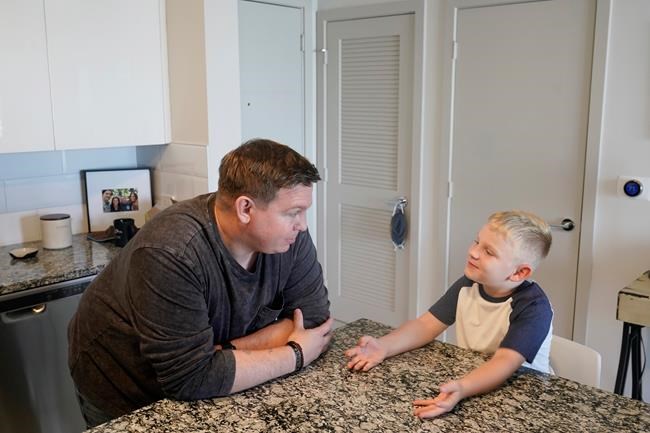
One day not long ago, I watched my soon-to-be 3-year-old son jump up and down to the sound of “ho” and “hey.”
It’s a song by the Lumineers, an American folk-rock band. The lyrics and stomp reverberate throughout the kitchen and into the house. My son jumps on each verse that ends with a shout.
“So show me, family. Hey!” He jumps.
“All the blood that I will bleed. Ho!” He jumps.
“I don’t know where I belong. Hey!” He jumps.
“I don’t know where I went wrong. Ho!”
He jumps. And then, so do I.
___
This is a story about a curious boy with no name — at least, no name that I ever came to know. It was 2013, more than a decade after the 9/11 attacks. I was a Marine then, back in Afghanistan for a second time.
At the time, I was working to stop a Taliban cell that specialized in making improvised explosive devices. In that effort, a video emerged. I watched it.
I remember him. I cannot forget him. I remember watching a minute-long video showing a static video camera aimed down a narrow path between two mud hut walls, common in the small hamlets often surrounded by opium-poppy fields. On the screen, not much was moving.
I remember the wind from the east kicking up the moon-like dust to the west. The tree and its shadow moved across the ground as the branches and leaves broke up the rays of sunlight to make abstract art patterns on the desert floor.
I remember the boy, full of energy and life, running into the frame and then out of it. From left to right.
With little boys like him — with little boys like mine — the curiosities of life can be palpable. And so the curious boy with no name wandered slowly back into the frame. From right to left.
He is an Afghan and, given the province we’re in — Helmand, to be exact — he maybe speaks Pashto. His small size places him somewhere between 3 and 5 years old. Maybe he’s 6, a feat in itself; it’s said one in 10 children in Afghanistan die before they turn 5.
As his curiosity runs rampant, I know what he does not. When he ran into the frame and then out of it, he had stepped on a soft spot in the ground — a patch different from the rest of the hard-packed dirt. He wanted to know why. I did not.
Slowly he walks back to mid-frame, studying the ground closely. Like a newly discovered toy, he starts to stomp on the soft spot in the dirt. Over and over again, he stomps. I wait, knowing what I know.
___
Victim-operated improvised explosive devices, known as VOIEDs, have various switches known as pressure plates. The idea is that the bomb is detonated by an unsuspecting individual by completing the circuit when pressure is applied or removed to the switch.
A power source supplies electricity between the switch and the detonator and by completing the circuit, the main charge explodes. Gas heats up and expands rapidly under pressure sending shock waves and shrapnel outward.
In short: Step on the IED and, if you weigh enough, the bomb goes off.
None of this is known to the curious boy with no name who continues to stomp on the bomb that won’t go off — the bomb that he does not know is a bomb.
The reason for this is perhaps even more insidious than the bomb itself: He is too malnourished and does not weigh enough to set off the bomb that will surely kill him. So he continues to stomp.
I remember all of it. I remember wanting to yell at him through the computer screen to stop being a curious 5-year-old boy, to stop, to PLEASE STOP stomping on that soft spot in the ground. I remember wanting to scream. I remember standing silent and watching the screen. I remember being powerless.
The curious boy with no name jumps one last time. He disappears into a dust cloud of fire and ripped flesh.
The video ends with a simple question: “Replay?”
Inside my head, I have no control over the answer.
___
My mental replays of the video continue, year after year, as if in perfect harmony with the Afghan war itself. In many ways, the war became a monster in my life. Everything was defined by who I was before it and who I was after.
The monster took my friends in gun battles — or later, via their own hands. I could blame it for my anger and depression. My sleepless nights and unhealthy eating habits and weight gain. My failed marriage. The pills from the VA. The ringing in my ear and shortness of breath in my lungs. How long until cancer develops from toxic burn pits, I wonder.
Afghanistan is my sucking chest wound, and always will be because — despite what we’ve seen these recent weeks — wars do not end with a withdrawal or retreat or retrograde or the signing of a peace treaty.
Instead, they ebb and flow within the memories of those who were there and the ones who received an unfortunate knock on the door one day from people in uniforms. On those battlegrounds, there is a permanent shattering. It’s the real “forever war.”
The skepticism about America’s longest running war — and, now, its chaotic and bloody conclusion — is bolstered by recent history. It reminds us that President Trump said he would have the troops home by Christmas, and how that didn’t happen. Less than a year before I would watch the curious boy live through his final moments, President Obama tweeted out then-Vice President Biden’s words: “We are leaving in 2014. Period.” We did not.
After years of statements from Washington about “turning a corner” in Afghanistan, Army Gen. Mark Milley, the chairman of the Joint Chiefs of Staff, said in December that the United States had only achieved a “modicum of success” after nearly two decades of war that have left both American and Afghan families permanently devastated.
I look around me. What do my people know of this war, of its blood spilled and treasure lost, of me?
In 2009, then-Defense Secretary Robert Gates said, “Whatever their fond sentiments for men and women in uniform, for most Americans the wars remain an abstraction, a distant and unpleasant series of news items that do not affect them personally.”
Around me, around you, America’s newest generation of combat veterans transition to civilian life. They look for jobs, and only find them sometimes. They look for healthcare, and find they need more.
They are sometimes noticed, sometimes ignored — combatants still, this time in a deepening divide between the small slice of Americans who bore the brunt of war, and those for whom the wars are only, as Gates said, “an abstraction.”
___
I am in my house again, far from Helmand province, far from my jumbled days in Afghanistan, far from the anguish that is unfolding right now. It is years after the curious boy jumped on the soft patch of Afghan earth one final time. In my house, The Lumineers sing. My son dances.
“All the blood that I will bleed. Ho!” He jumps.

“I don’t know where I belong. Hey!” He jumps.
“I don’t know where I went wrong. Ho!”
He jumps once more. And keeps on dancing.
___
James LaPorta is a reporter on the AP’s Global Investigations Team, covering national security and military affairs. He is a former U.S. Marine infantryman and a veteran of the Afghanistan War. Follow him on Twitter at http://twitter.com/Jimlaporta

Advertisement Advertise With Us
Advertisement Advertise With Us