9/11 artifacts share ‘pieces of truth’ in victims’ stories

Advertisement

Advertise with us

NEW YORK (AP) — For nearly six years, Andrea Haberman’s ashen and damaged wallet lay mostly untouched in a drawer at her parents' Wisconsin home, along with a partly melted cell phone, her driver's license, credit cards, checkbook and house keys. Flecks of rust had formed on the rims of her eyeglasses, their lenses shattered and gone.

Read this article for free:


or

Already have an account? Log in here »

To continue reading, please subscribe:

Subscribe and receive a limited-edition Free Press branded hat or tote.

Digital Subscription

One year of digital access for only $205*

  • Enjoy unlimited reading on winnipegfreepress.com
  • Read the E-Edition, our digital replica newspaper
  • Access News Break, our award-winning app
  • Play interactive puzzles

*First annual payment billed as $205.00 + GST for one year. This annual subscription will automatically renew at $233.00 + GST every 52 weeks (10% off the regular annual price of $259.35). Offer available to new and qualified returning subscribers only. Cancel any time.

To continue reading, please subscribe:

Add Free Press access to your Brandon Sun subscription for only an additional

$1 for the first 4 weeks*

  • Enjoy unlimited reading on winnipegfreepress.com
  • Read the E-Edition, our digital replica newspaper
  • Access News Break, our award-winning app
  • Play interactive puzzles
Start now

*Your next Brandon Sun subscription payment will increase by $1.00 and you will be charged $17.95 plus GST for four weeks. After four weeks, your payment will increase to $24.95 plus GST every four weeks.

Hey there, time traveller!
This article was published 08/09/2021 (1822 days ago), so information in it may no longer be current.

NEW YORK (AP) — For nearly six years, Andrea Haberman’s ashen and damaged wallet lay mostly untouched in a drawer at her parents’ Wisconsin home, along with a partly melted cell phone, her driver’s license, credit cards, checkbook and house keys. Flecks of rust had formed on the rims of her eyeglasses, their lenses shattered and gone.

Those everyday items were the remnants of a young life that ended when a hijacked jetliner struck the north tower of the World Trade Center on Sept. 11, 2001. Haberman was 25 and about to be married when she was killed while on a business trip from Chicago — her first visit to New York City.

Her belongings, still smelling of Ground Zero, evoked mostly sorrow for Haberman’s family. To ease their pain, they donated the artifacts to the 9/11 Memorial & Museum.
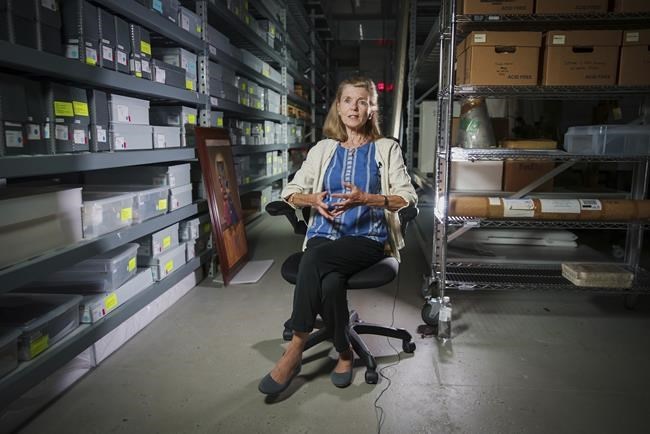
Jan Ramirez, chief curator at the 9/11 Memorial & Museum, sits for an interview inside a warehouse where thousands of artifacts from the 9/11 attacks are archived, July 16, 2021, in Jersey City, N.J. Over the years, the museum has collected some 22,000 personal artifacts to help tell the stories of those who died and those lucky to survive. Many of those personal effects were plucked from the ruins of what was once the Twin Towers. Other items were donated by survivors or by the families of those who perished. (AP Photo/Robert Bumsted)

“These are not the happy things you want to remember someone by,” said Gordon Haberman, her father.

The collection of some 22,000 personal artifacts — some on display at the 9/11 museum, and others on display at other museums around the country — provide a mosaic of lost lives and stories of survival: wallets, passports, baseball gloves, shoes, clothes and rings.

“Each person who makes up part of that tally was an individual who lived a life,” said Jan Ramirez, the museum’s chief curator and director of collections.

“We knew that families — the people that have lost a loved one that day — were going to need to have a place, have a way, to remember the person that never came home from work, that never came home from a flight,” Ramirez said.

Many of those personal effects were plucked from the ruins of what was once the Twin Towers. Other items were donated by survivors or by the families of those who perished.

A woodworking square, screwdriver, pry bar and a toolbelt represent Sean Rooney, a vice president at Aon Corp. who died in the South Tower. Rooney’s essence was that of “a builder,” his sister-in-law Margot Eckert said, making the carpenter’s tools donated to the museum the “perfect antidote to the destruction.”

Rooney had phoned his wife, Beverly Eckert, at their home in Stamford, Connecticut, after being trapped by fire and smoke on the 105th floor. He spent his last breaths recounting happier times, whispering, “I love you,” as he labored for air.

His remains were never found.
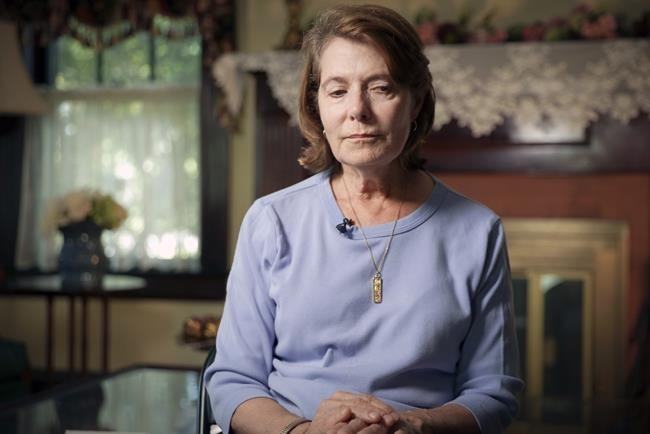
Margot Eckert sits for an interview at her home, Thursday, July 15, 2021, in Springfield, Mass. Her brother-in-law Sean Rooney was killed on 9/11 while working in his office in the South Tower. His wife, Beverly Eckert, Margot's sister, died in a plane crash in 2009. The collection of some 22,000 personal artifacts — some on display at the 9/11 museum, and others on display at other museums around the country — provide a mosaic of lost lives and stories of survival: wallets, passports, baseball gloves, shoes, clothes and rings. (AP Photo/Robert Bumsted)

Beverly died eight years later in a plane crash while traveling to her husband’s high school in Buffalo, New York, to award a scholarship in his honor. Before she died, she had set aside the items she hoped would help tell her husband’s story, that of a weekend carpenter, handyman and volunteer with Habitat for Humanity.

“We have a gravesite for her, we don’t have a gravesite for Sean,” Eckert said. “Artifacts become very important. And artifacts are the facts that someone lived. They are the facts you can touch.”

For Robert Chin’s family, the story was about a love for playing softball. They recounted his first hit — a drive down the third-base line — playing for Fiduciary Trust International. To help savor the moment, his teammates scribbled congratulatory notes on the ball before presenting it to him.

Among the names on the ball were Pedro Francisco Checo and Ruben Esquilin Jr., who also died with Chin that day. That dusty softball Chin had kept at home is included among the trove of keepsakes in the 9/11 museum’s collection.

Not all of the donated artifacts are on behalf of those who died. Some came from those who survived 9/11.

Linda Raisch-Lopez donated her bloodied patent leather heels to represent her will to survive on a day she ran for her life.

As she made her way down a stairwell from the 97th Floor of the South Tower, she slipped out of her heels. and walked through the debris in her bare feet, according to the museum’s account. Somewhere on her way to a Hudson River pier, she had slipped back into her shoes, smearing blood on the tan leather from her cut and blistered feet.
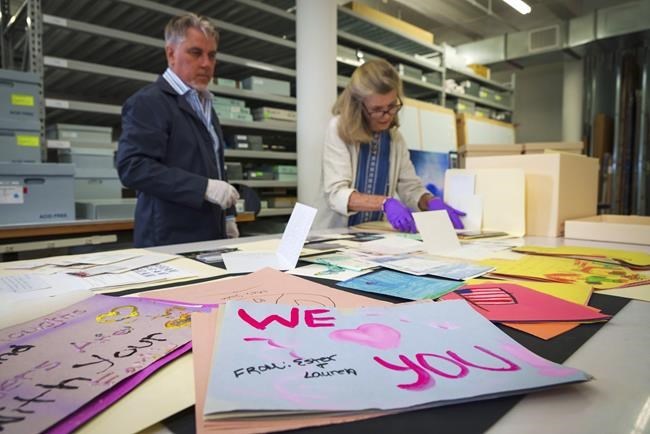
Jan Ramirez, chief curator at the 9/11 Memorial & Museum, right, sifts through a collection of condolence cards for a victim of 9/11 that were donated to the museum's archive, July 16, 2021, in Jersey City, N.J. Over the years, the museum has collected some 22,000 personal artifacts to help tell the stories of those who died and those lucky to survive. Many of those personal effects were plucked from the ruins of what was once the Twin Towers. Other items were donated by survivors or by the families of those who perished. (AP Photo/Robert Bumsted)

Just a small part of the museum’s collection of artifacts is ever on display because there are just too many to show at any one time. When not on display, the artifacts are stored in warehouses, including a hangar at JFK airport and across the Hudson River in New Jersey. Row after row of shelves are stacked with boxes filled with tragedy and remembrance.

“Each piece is a little part of a puzzle,” Ramirez said. “Having those important, little pieces of truth, those palpable pieces of truth — those bridges to allow people to get engaged in the story — is why we do what we do and will continue to do what we do.”

__________

Associated Press journalists Carrie Antlfinger in Milwaukee and Robert Bumsted in New York contributed to this report.

Report Error Submit a Tip

More Stories

Wryly funny essays chronicle rocky road to motherhood, postpartum anxiety

Reviewed by Kathryne Cardwell 4 minute read Preview

Wryly funny essays chronicle rocky road to motherhood, postpartum anxiety

Reviewed by Kathryne Cardwell 4 minute read Saturday, Jul. 11, 2026

‘Motherhood is often oppressively touted as one of the most important things a woman can do, and yet that same oppressive force demands she never speak on the inherent realities of mothering.”

So begins Toronto sportswriter Stacey May Fowles in her touching memoir on becoming a mother after four years of infertility.

Fowles is best-known for her baseball reporting, including 2017’s Baseball Life Advice, a collection of essays celebrating baseball while challenging sexist attitudes towards female sports reporters.

She’s also published two novels, a children’s book and contributed to several literary anthologies, demonstrating gifts for reporting, research and prose.

Read
Saturday, Jul. 11, 2026

The ‘Buy Canadian’ trade war challenge

Editorial 4 minute read Preview

The ‘Buy Canadian’ trade war challenge

Editorial 4 minute read 2:00 AM CDT

“Buy Canadian,” they tell us, as trade tensions escalate between Canada and the United States. “Elbows up,” the pithy slogan advises again and again, in response to the latest daily affront from increasingly unbalanced U.S. President Donald Trump.

And there’s no question Canadians from coast to coast to coast have bought into the patriotic mindset that politicians, from Prime Minister Mark Carney right on down to elected officials at the municipal level, have implored us to adopt.

“We were attacked,” is how Carney described the Aug. 21 unraveling of trade talks, after U.S. negotiators reportedly inserted last-minute demands the Canadian side viewed as both unreasonable and unacceptable. “You’re at war when you get attacked. We got attacked.”

The breakdown led to the immediate imposition by Trump of steep new tariffs on $29 billion worth of Canadian goods headed to south-of-the-border markets. A targeted, dollar-for-dollar Canadian tariff response will take effect after the Labour Day weekend. In the meantime, Canadians are more motivated than ever to stand firm against Trump’s tyrannical tactics.

Read
2:00 AM CDT

MMF threatens legal action over city’s handling of homeless camp

Julia-Simone Rutgers and Joyanne Pursaga 6 minute read Preview

MMF threatens legal action over city’s handling of homeless camp

Julia-Simone Rutgers and Joyanne Pursaga 6 minute read Thursday, Jun. 4, 2020

The Manitoba Metis Federation is threatening the City of Winnipeg with legal action over a homeless encampment next to its Henry Avenue office, which the federation claims poses an immediate danger.

Meanwhile, those at the centre of the conflict say the Point Douglas area is home to them. As nearby shelters fill up, they would like to see the city partner with the community to help keep the space clean rather than kicking people out.

“Where's everybody going to go? If they're comfortable here… and this has been an ongoing situation for how many years now?” said Leslee Cook, who lives at the Disraeli Freeway encampment.

"Being homeless — wouldn't you rather be together where everyone feels safe? If they kick us out, then what? Everyone's going to go scattering everywhere."

Read
Thursday, Jun. 4, 2020

Conflict confusion of interest to Manitobans

Dan Lett 5 minute read Preview

Conflict confusion of interest to Manitobans

Dan Lett 5 minute read Monday, Mar. 1, 2021

Was Paul Beauregard guilty of a conflict of interest?

That is the question left hanging in the air following a remarkable week of disclosures, allegations and counter-allegations.

The Manitoba NDP claims Beauregard, former secretary to the Treasury Board, had improperly interceded in the awarding of a contract to his former employer, Bell MTS.

The party and MLA Adrien Sala devoted a considerable amount of time in 2020 pursuing such allegations against Beauregard who, in turn, filed a complaint against the official Opposition under the legislature's Respectful Workplace Policy.

Read
Monday, Mar. 1, 2021

Explaining Canada’s superior employment rate

Wayne Simpson 5 minute read Preview

Explaining Canada’s superior employment rate

Wayne Simpson 5 minute read 2:00 AM CDT

Donald Trump regularly makes outrageous claims. Fentanyl was pouring across the northern border from Canada and had to be stopped. Canada is nasty to deal with and has the highest tariffs in the world. Canada needs the U.S. but the U.S. doesn’t need Canada. Canadians want to become the 51st state. And so on.

In the latest trade dispute, after Mark Carney walked away from negotiations, Trump made a new claim that Canada’s unemployment rate was 10 per cent and climbing rapidly. Insofar as the unemployment rate is closely monitored, reported monthly, and given similar attention to the rates of inflation and economic growth, the comment was likely intended to signal Canada’s weakness. It fits Trump’s narrative that Canada needs the U.S. for its livelihood and protection and would be better off more directly under U.S. influence as a 51st state, or perhaps a protectorate like the Philippines or Panama in the past.

Fact checkers quickly reported that Canada’s unemployment rate is really 6.4 per cent for July, not 10 per cent, has fallen from 6.9 per cent in April, and is at its lowest rate since May 2024. Some astute observers pointed out that Canada’s method for the calculation of the unemployment rate leads to a higher rate than the U.S. by about one per cent. Under the American methodology, then, our unemployment rate would be 5.4 per cent, not that far off the U.S. July rate of 4.1 per cent.

Detection of unemployment is less straightforward that might appear, as it is sandwiched between the labour force statuses of employment and inactivity at a particular point in time. The internationally established standard for determination of unemployment is the notion of searching for work — you are unemployed if you do not have paid employment and you are looking for work without success. Surveys have been developed to categorize respondents as employed, unemployed or inactive, including the labour force survey (LFS) in Canada and the current population survey (CPS) in the U.S.

Read
2:00 AM CDT

9/11 artifacts share 'pieces of truth' in victims' stories

Bobby Caina Calvan, The Associated Press 6 minute read Preview

9/11 artifacts share 'pieces of truth' in victims' stories

Bobby Caina Calvan, The Associated Press 6 minute read Wednesday, Sep. 8, 2021

The Montrealer wins in a walkover when Spain’s Alcaraz retires in the second set with a leg injury.

Read
Wednesday, Sep. 8, 2021