Faster, higher, nicer
These Olympians deserve a medal for sportsmanship; and one of them -- a Canadian -- did

Advertisement
Read this article for free:
or
Already have an account? Log in here »
To continue reading, please subscribe:
Digital Subscription
One year of digital access for only $1.44 a week*
- Enjoy unlimited reading on winnipegfreepress.com
- Read the E-Edition, our digital replica newspaper
- Access News Break, our award-winning app
- Play interactive puzzles
*Billed as $5.77 plus GST every four weeks. After 52 weeks, price increases to the regular rate of $19.95 plus GST every four weeks. Offer available to new and qualified returning subscribers only. Cancel any time.
To continue reading, please subscribe:
Add Free Press access to your Brandon Sun subscription for only an additional
$1 for the first 4 weeks*
- Enjoy unlimited reading on winnipegfreepress.com
- Read the E-Edition, our digital replica newspaper
- Access News Break, our award-winning app
- Play interactive puzzles
*Your next Brandon Sun subscription payment will increase by $1.00 and you will be charged $17.95 plus GST for four weeks. After four weeks, your payment will increase to $24.95 plus GST every four weeks.
Read unlimited articles for free today:
or
Already have an account? Log in here »
Hey there, time traveller!
This article was published 07/08/2021 (1904 days ago), so information in it may no longer be current.
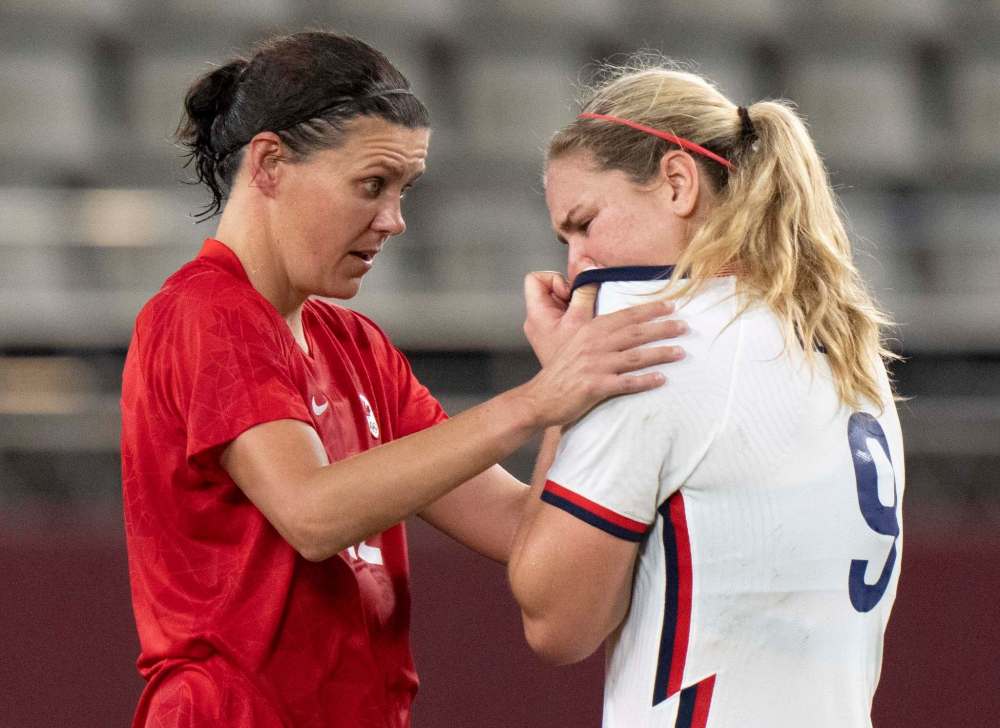
Soccer legend Christine Sinclair, captain of the Canadian women’s national team, had every reason to celebrate.
She had just helped her team pull off one of the biggest upsets in its history at the Tokyo Summer Olympics on Monday, beating the U.S. Women’s National Team for the first time in 20 years and earning a spot in the gold-medal game.
But at the end of the semifinal match, Sinclair didn’t immediately begin celebrating with her squad. Instead, the all-time leading goal scorer (man or woman) in the history of international soccer made her way across the field to despondent American midfielder Lindsey Horan and wrapped her in a tight hug.
The two are teammates on the Portland Thorns, and Sinclair knew she needed to comfort the younger player. As the cameras looked on, the Canadian legend, 38, who serves as the Thorns captain, gave an animated pep talk to a visibly distraught Horan, 27, who has fallen short of the gold at two consecutive Olympics.
For Brittany Timko Baxter, who also played for Canada in 2012 at the London Games, Sinclair’s selflessness was a perfect example of what the Olympics are really about.
“She’s always been the most humble leader,” Timko Baxter told the Vancouver Sun. “(Consoling her opponent) just goes to show you that she is first and foremost a great human being.”
That act of kindness places Sinclair in excellent company, as we see from today’s medal-winning list of Five Famously Selfless Acts of Olympic Sportsmanship:
5) The good sport: American runner Isaiah Jewett
The selfless act: Speaking of the Tokyo Games, Canada’s Christine Sinclair is not the only athlete who has made headlines for doing the right thing.
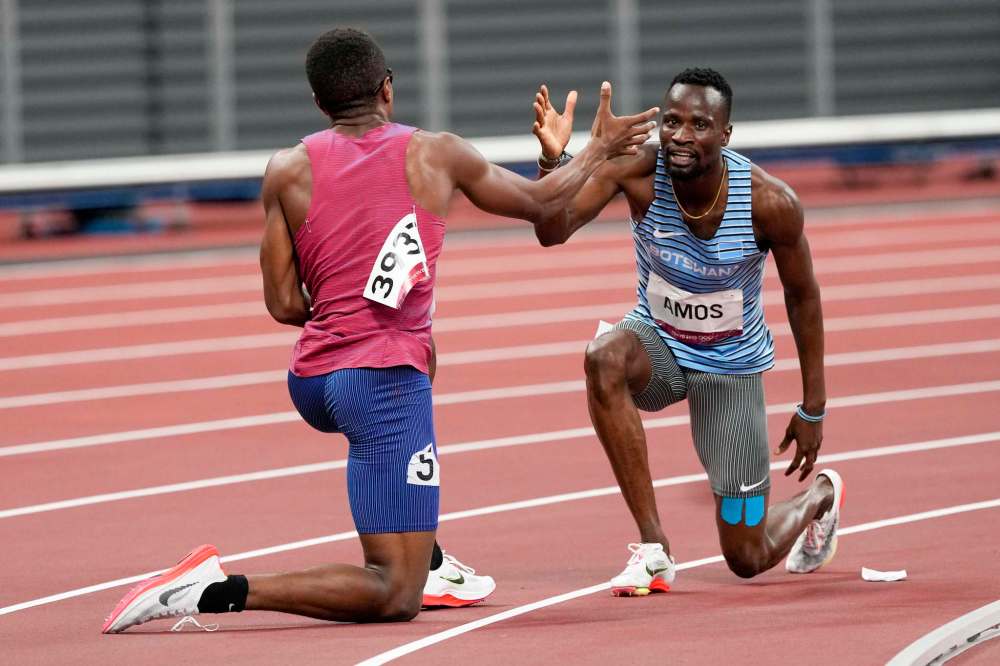
In last Sunday’s men’s 800-metre semifinal, U.S. runner Isaiah Jewett didn’t have the race he expected, but he still ended up a winner in the eyes of sports fans around the world. Running the final curve in the semifinal, Jewett was in prime position to finish in the top two in his heat when an unintentional disaster struck. Botswana’s Nijel Amos inadvertently tripped Jewett from behind and the two collapsed on the track.
“I just felt like when I was starting to lift, somebody hit the back of my heel and that caused me to fall,” Jewett told USA Today. “It was devastating. I’m not going to lie.” It was what happened next, however, that transformed the moment from tragedy to an example of true Olympism. As the pair began to pick themselves up, they extended a hand to one another, pulling each other back up onto their feet. They then put their arms around each other, jogging together to the finish line.
Amos let Jewett finish one step a head of him, in second last. “But where they finished was secondary. What mattered is that they finished the race and they showed everyone witnessing around the world an example of sportsmanship and forgiveness,” according to USA Today.
After the race, Jewett explained: “I always have to finish a race. I got Nijel (Amos) up as well. I could see that he was devastated. He apologized to me. I told him, ‘Let’s just finish the race, man.’ Regardless of how mad you are, you have to be a hero at the end of the day. That was my version of trying to be a hero … because that’s what heroes do. They show their humanity through who they are. They show that they are good people.”
4) The good sport(s): Cross-country ski coaches Justin Wadsworth and Bjoernar Haakensmoen
The selfless act(S): Yes, these are two separate stories of Olympic sportsmanship, but they’re linked by two men with huge hearts who refused to stand idle when someone needed their help.
At the 2014 Winter Games in Sochi, Russia, Canadian cross-country coach Justin Wadsworth didn’t hesitate when Russia’s Anton Gafarov crashed and broke a ski during a semifinal heat in the men’s cross-country sprint. Gafarov was way behind, but desperately wanted to finish in front of his hometown crowd.
He was struggling miserably, trying to drag himself to the end of the course, which is when Wadsworth grabbed a spare ski he’d brought for a Canadian racer and ran to the rescue. Kneeling beside the Russian, Wadsworth fastened the spare ski to Gafarov’s boot as the crowd cheered.
“It’s kind of like seeing an animal in a trap,” the Canadian coach said at the time. “I just couldn’t let him sit there… I wanted him to have dignity as he crossed the finish line.”
His generous act mirrors the kindness of Norwegian cross-country coach Bjoernar Haakensmoen who, during the Nordic ski sprint relay final at the Turin Winter Olympics in 2006, handed Sara Renner a spare ski pole after the Canadian broke one in her sprint for the finish.
It may have been a bit too long for her, but it allowed Renner to finish her leg of the race. The Canadian duo won silver, while Norway’s cross-country team just missed the podium in fourth place, meaning Håkensmoen’s display of sportsmanship may have cost his own team a medal.
Grateful Canadians donated 5.2 tons of maple syrup (7,400 cans) and sent them to Haakensmoen as a thank you. The Norwegian coach could not have been more humble about proving that winning is not everything.
“I was just standing there, and this skier had broken her pole,” he famously said. “So I gave her one. That is the whole story.”
3) The good sport(s): Japanese pole vaulters Shuhei Nishida and Sueo Oe
The selfless act(S): Italy’s Gianmarco Tamberi and Qatar’s Mutaz Essa Barshim shared the gold medal during the men’s high jump final at the Tokyo Games, refusing a jump-off.
When it comes to sharing medals, however, it’s impossible to top the story behind what came to be known as the “Medals of Friendship.” At the 1936 Olympics in Berlin, 25,000 spectators watched American Earle Meadows clear the impressive height of 4.35m in the pole vault to claim the gold medal.
Three athletes competed for second place: Bill Sefton from the United States along with Japan’s Shuhei Nishida and Sueo Oe. Sefton failed to clear the jump-off height while the two Japanese men succeeded. But the final standings were yet to be decided as Nishida and Oe achieved the exact same result, then refused to jump again for the silver.
Along with being world-class athletes, they were best friends and wanted to share the silver. Their request was rejected, and the Japanese team was told to make its own decision about who should claim second place and who third. It was finally agreed that Nishida, who had vaulted 4.25 at his first attempt, should take precedence over Oe, who had needed two attempts at that height.
But the athletes were still not happy. Upon their return to Japan, Nishida and Oe went to a jeweller and asked him to cut both medals in half. Then they had the silver and bronze halves welded together to create two prizes that they felt better reflected their real accomplishments — a hybrid silver-bronze medal for each athlete.
According to Britain’s The Independent newspaper: “Oe died in 1941, in the war; Nishida died in 1997. Oe’s medal remains in private hands but Nishida’s is kept by Waseda University. In each case, the peculiar half-and-half medals serve as permanent reminders that, even in the hate-filled atmosphere of Hitler’s Germany, the Olympic Games allowed young people to display something more lasting, and ultimately more thrilling, than mere athletic excellence.”
2) The good sport: American sprinter Shawn Crawford
The selfless act: At the 2008 Summer Games in Beijing, sprinting legend Usain Bolt set a world record of 19.30 seconds to win gold in the 200m and capture all the headlines. It was what happened behind Bolt that really tugs on the heart-strings.
U.S. sprinter Shawn Crawford finished fourth, only to move up two spots when Netherlands Antilles sprinter Churandy Martina and American Wallace Spearmon were disqualified for running outside their lanes. The silver medal was his, but that’s not the way Crawford saw it. Instead, the medal felt like a weight around his neck.
So he decided to give it back to Martina, who in his opinion beat him fair and square. “In my heart, I felt he deserved it,” Crawford later told reporters. “Some people say, ‘It’s big of you to do that — it shows a true athlete. Some say, ‘How could you give it up? You step on the line, you’re disqualified. You should be happy to accept it.’ I didn’t expect to finish in fourth and walk away with silver. I never felt like it was rightfully mine.”
After Beijing, Crawford set out to return the medal to the person he felt it rightfully belonged to — Martina. Eventually, at a meet in Zurich, Crawford brought the box with the medal to the front desk of the hotel where Martina was staying, asking the staff to give it to him. He also wrote a short note on hotel stationary that simply read: “You ran a silver medal race and deserve this medal.”
Martina invited Crawford to his room so he could say thanks. “He couldn’t believe that I did that,” the sprinter recounted. “He was almost speechless. He was very moved.” In the end, his act of sportsmanship turned out to be little more than a gesture. The Court of Arbitration for Sport rejected Martina’s claim that he should be listed as runner-up behind Bolt. Crawford’s name still appears as the silver medallist.
1) The good sport: Canadian sailor Lawrence Lemieux
The selfless act: Lawrence Lemieux was competing in the fifth of his seven races in the Finn class at the 1988 Seoul Olympics and was in second position with a medal in his sights. That’s when he spotted two Singaporean sailors in the water next to their capsized boat.
With the winds blowing at 35 knots, the churning waves were threatening to carry the injured men out to sea. One of them had made it to the boat but the other was drifting away due to the force of the waves. Lemieux had to decide — finish his race and remain in medal contention, or save two unknown sailors competing in an entirely different class.
For the Canadian, it was no choice at all. “The distance between him and his boat was quite a way and the boat was drifting faster than he could swim. And if I couldn’t see those big orange markers, who was going to see a little head bobbing in the water? He’d have been lost at sea,” Lemieux was quoted as saying at the time. “I had to make a decision and once I realized the dynamics of the problem there was no question.”
The Canadian sailor abandoned his race, throwing away his medal chances as he veered off course and pulled the injured sailors — Joseph Chan and Shaw Her Siew — from the water. He couldn’t rejoin the race until a patrol boat arrived to take the sailors back to the shore.
He was later credited with a second-place finish en route to finishing 11th overall. He has been immortalized in Olympics history books as the man who sacrificed something he’d worked towards most of his life to save the lives of two Singaporean sailors.
His act of selfless courage was rewarded as he became the fifth recipient of the Pierre de Coubertin Medal for sportsmanship. “By your sportsmanship, self-sacrifice and courage, you embody all that is right with the Olympic ideal,” Juan Antonio Samaranch, president of the International Olympic Committee, said at the time. Lemieux insists he simply did what anyone would have done in that moment.
doug.speirs@freepress.mb.ca
Doug has held almost every job at the newspaper — reporter, city editor, night editor, tour guide, hand model — and his colleagues are confident he’ll eventually find something he is good at.
Our newsroom depends on a growing audience of readers to power our journalism. If you are not a paid reader, please consider becoming a subscriber.
Our newsroom depends on its audience of readers to power our journalism. Thank you for your support.
Doug has held almost every job at the newspaper — reporter, city editor, night editor, tour guide, hand model — and his colleagues are confident he’ll eventually find something he is good at.
Our newsroom depends on a growing audience of readers to power our journalism. If you are not a paid reader, please consider becoming a subscriber.
Our newsroom depends on its audience of readers to power our journalism. Thank you for your support.
Related Articles
Gold medal greatest gift for greatest female soccer player ever





Advertisement Advertise With Us
Advertisement Advertise With Us