How does Canada’s COVID-19 vaccine rollout compare to other countries?
Advertisement
Read this article for free:
or
Already have an account? Log in here »
To continue reading, please subscribe:

Digital Subscription
One year of digital access for only $205*
- Enjoy unlimited reading on winnipegfreepress.com
- Read the E-Edition, our digital replica newspaper
- Access News Break, our award-winning app
- Play interactive puzzles
*First annual payment billed as $205.00 + GST for one year. This annual subscription will automatically renew at $233.00 + GST every 52 weeks (10% off the regular annual price of $259.35). Offer available to new and qualified returning subscribers only. Cancel any time.
To continue reading, please subscribe:
Add Free Press access to your Brandon Sun subscription for only an additional
$1 for the first 4 weeks*
- Enjoy unlimited reading on winnipegfreepress.com
- Read the E-Edition, our digital replica newspaper
- Access News Break, our award-winning app
- Play interactive puzzles
*Your next Brandon Sun subscription payment will increase by $1.00 and you will be charged $17.95 plus GST for four weeks. After four weeks, your payment will increase to $24.95 plus GST every four weeks.
Read unlimited articles for free today:
or
Already have an account? Log in here »
Hey there, time traveller!
This article was published 07/01/2021 (2068 days ago), so information in it may no longer be current.
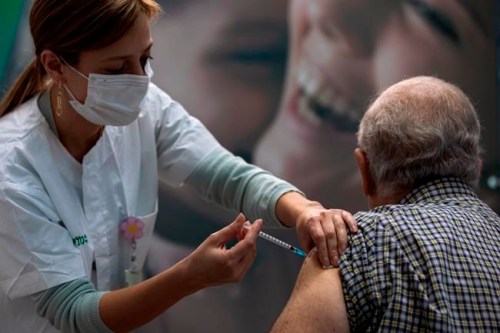
Canada’s COVID-19 vaccine rollout has been slow to gather momentum since it began weeks ago, causing some to wonder how other countries have shown such promising progress with their own immunization efforts in a shorter amount of time.
Expert say it may be tempting to compare numbers and time frames from international examples, but they warn that direct country comparisons are usually “fraught with error.”
Dr. Sumon Chakrabarti, an infectious diseases physician in Mississauga, Ont., says Canada’s vaccination efforts — somewhere around 10th in the world in doses given per population after Wednesday — “absolutely needs to improve.”

“But it’s barely fair to even compare between provinces let alone other countries,” he said.
Still, Chakrabarti and other experts agree there may be lessons from how other countries have approached their vaccination rollouts.
Here’s a look at some of their strategies:
ISRAEL’S IMPRESSIVE PACE
Israel leads the world in vaccines administered per population, giving at least one dose to 17 per cent of its 9 million people in less than three weeks.
A Canadian vaccine tracker says Canada has given at least one shot to more than 193,000 people, or 0.52 per cent of the population as of Wednesday night, despite starting a week earlier than Israel.
Dr. Isaac Bogoch, an infectious disease expert with the University of Toronto, attributes Israel’s success to massive vaccine supply and an efficiency in delivering them.
Israel, which reportedly paid a premium to secure a larger supply of Pfizer-BioNTech’s vaccine, has been operating clinics nearly around the clock. But Israel’s smaller and more centralized population, and its smaller geographical area, also works in its favour, Bogoch says.
“You think about Canada, the second largest country in the world, you’ve got cold-chain issues, you’ve got rural, remote, underserviced areas. It’s a very big challenge to do this here,” he said. “That’s not to (excuse) our tardy startup. But it explains that we will have some logistical challenges that are very real.”
There have been concerns raised by human rights groups over Israel’s rollout, which does not include vaccinating Palestinians in the Israeli-occupied West Bank and Gaza Strip. An Israeli Health Ministry official said last month the approach is in line with past agreements. The 1990s Oslo accords require the Palestinian Authority to maintain international vaccination standards and for the sides to cooperate in combating epidemics.
Bogoch says the lesson Canada can learn from Israel is “speed matters.” Bogoch, who’s also on Ontario’s COVID vaccine task force, expects Canada’s rollout to start ramping up soon, as people continue to “demand more” from the program and provinces work out initial kinks in their logistics.
“This is crisis management,” he said. “We have to get vaccines as fast as humanly possible from the freezer into arms.”
BRITAIN’S DEFERRED DOSES
The United Kingdom says it will experiment with delaying second doses of vaccines from Pfizer-BioNTech, Moderna and AstraZeneca, all of which require two doses for full protection, in an effort to inoculate more individuals up front.
Other countries, and even some Canadian provinces, say they may go that route as well, but experts warn not to stray too far from the recommended timelines.
In clinical trials, second doses of Pfizer-BioNTech were administered 21 days after the first, while Moderna participants had their second jab 28 days later.
Horacio Bach, an adjunct professor of infectious diseases at UBC, says there’s risk in delaying second doses because unforeseen problems in pharmaceutical manufacturing or shipping could mean further delays of vaccines down the line.
And since health officials only have data from the trials to go on, Bach says it’s hard to know how our immunity is impacted with one dose for a prolonged period.
“Maybe the antibodies you start to produce there disappear (while waiting for the second dose),” he said. “There’s a lot of questions to answer, but we know for sure what happened in the clinical trials…. And I would stick with that.”
Chakrabarti says there’s an argument to be made for delaying second doses — 100 people walking around with some level of COVID immunity would be advantageous to 50 with full immunity.
He adds, however, that the time frame between doses shouldn’t stretch past “a few weeks.”
“I think it’s the best public health approach to get as many people the first dose of vaccine as you can,” he said.
ITALY’S PRETTY POP-UPS
In an effort to make the inoculation process more appealing, Italian architect Stefano Boeri has designed vaccine pavilions — gazebo-shaped structures built from wood and biodegradable fabric, with airflow and light-filled waiting rooms — that will be placed in piazzas across the country.
The structures will have a primrose logo painted on them as a symbol of rebirth and offer people a more inviting alternative to being vaccinated in a hospital or clinic setting.
Chakrabarti says it’s an interesting idea, and one that may be worthwhile.
“Addressing the human side of things is definitely helpful,” he said. “If you’re worried about the vaccine and you see something like this, it makes it a little bit fun, makes it an occasion. As long as people are distanced, wearing masks, all public health protocols are met, I think it’s a great idea.”
Italy expects to reach herd immunity by vaccinating at least 40 million residents over the next 18 months. As of Wednesday, the country had vaccinated 0.51 per cent of its population since its rollout started Dec. 27.
INDONESIA’S INVERTED STRATEGY
Indonesia is set to begin its mass vaccination rollout next week, prioritizing working-class adults before seniors in an effort to reach herd immunity while reviving its economy.
While it seems like a backwards approach, Chakrabarti says it does have merit in theory. By inoculating those more likely to spread the virus, you can prevent it from reaching those more vulnerable.
One explanation for Indonesia’s approach may be the vaccine they’re using — made by Chinese drug company Sinovac Biotech — which wasn’t tested on people over 59 in clinical trials.

Chakrabarti says fear of economic collapse may be playing a bigger role in the vaccine strategies of certain countries.
“For (Indonesia), it might make sense to concentrate on that middle part of the pyramid age,” he said. “But I think with Canada it’s very different.”
Bogoch agrees Indonesia’s approach wouldn’t make sense here, where long-term care has proven the most pressing vulnerability.
“Long-term care homes are on fire, and we can extinguish that with a massive push to vaccinate everyone who lives and works there,” he said. “In the Canadian setting, I like our plan of vaccinating the most vulnerable first.”
This report by The Canadian Press was first published Jan. 7, 2021.
Related Articles
Can I socialize once I'm vaccinated?








Advertisement Advertise With Us
Advertisement Advertise With Us