Key events in development of Pfizer’s COVID-19 vaccine

Advertisement

Advertise with us

Key events in the development of a COVID-19 vaccine by partners Pfizer Inc. and Germany's BioNTech:

Read this article for free:


or

Already have an account? Log in here »

To continue reading, please subscribe:

Subscribe and receive a limited-edition Free Press branded hat or tote.

Digital Subscription

One year of digital access for only $205*

  • Enjoy unlimited reading on winnipegfreepress.com
  • Read the E-Edition, our digital replica newspaper
  • Access News Break, our award-winning app
  • Play interactive puzzles

*First annual payment billed as $205.00 + GST for one year. This annual subscription will automatically renew at $233.00 + GST every 52 weeks (10% off the regular annual price of $259.35). Offer available to new and qualified returning subscribers only. Cancel any time.

To continue reading, please subscribe:

Add Free Press access to your Brandon Sun subscription for only an additional

$1 for the first 4 weeks*

  • Enjoy unlimited reading on winnipegfreepress.com
  • Read the E-Edition, our digital replica newspaper
  • Access News Break, our award-winning app
  • Play interactive puzzles
Start now

*Your next Brandon Sun subscription payment will increase by $1.00 and you will be charged $17.95 plus GST for four weeks. After four weeks, your payment will increase to $24.95 plus GST every four weeks.

Hey there, time traveller!
This article was published 09/11/2020 (2134 days ago), so information in it may no longer be current.

Key events in the development of a COVID-19 vaccine by partners Pfizer Inc. and Germany’s BioNTech:

March 17 — Pfizer and BioNTech announce plans to jointly develop a COVID-19 vaccine using BioNTech’s technology.

April 29 — Testing of four vaccine candidates begins with volunteers in Germany, one of six countries in the testing plan.
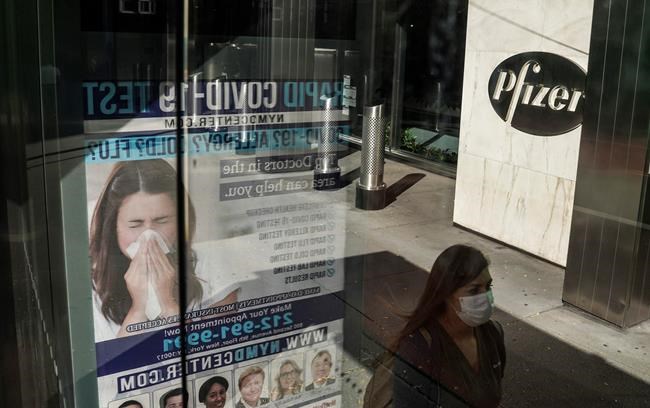
An ad for COVID-19 testing reflects on glass at a bus stop, as pedestrians walk past Pfizer world headquarters in New York on Monday Nov. 9, 2020. Pfizer says an early peek at its vaccine data suggests the shots may be 90% effective at preventing COVID-19, but it doesn't mean a vaccine is imminent. (AP Photo/Bebeto Matthews)

May 5 — Testing expands to the United States.

July 1 — Preliminary data shows one of four candidates appears to stimulate the immune system, is well tolerated.

July 22 — U.S. government agrees to buy 100 million vaccine doses for $1.95 billion, with an option for 500 million more. Several other countries also sign agreements for vaccines.

July 27 — Late-stage tests begin for 30,000 volunteers; companies could seek U.S. regulatory approval as early as October if all goes well.

Aug. 20 — The partners announce promising early data from testing of their lead vaccine candidate.

Sept. 8 — With pressure mounting for a vaccine before the U.S. election, CEOs of Pfizer, BioNTech and seven other major drugmakers pledge to stand with the science and not be rushed.

Sept. 12 — Proposal made to expand study enrolment to 44,000 volunteers to include teenagers and people with certain chronic illnesses; regulators later agree.

Oct. 16 — Pfizer says it can’t request emergency use of vaccine before the third week of November, when safety information due.

Nov. 8 — Independent board analyzes test results so far and notifies Pfizer.

Nov. 9 — Pfizer announces the vaccine appears to be about 90% effective, based on 94 infections so far in study volunteers.

Late November — Pfizer expects to have more data on effectiveness, along with information on safety and manufacturing quality. Soon after that, Pfizer expects to apply for emergency use authorization in the U.S.

End of year: Pfizer expects to have up to 50 million doses available.

___

The Associated Press Health and Science Department receives support from the Howard Hughes Medical Institute’s Department of Science Education. The AP is solely responsible for all content.

Report Error Submit a Tip

More Stories

On the Night Table: Sean Burns

2 minute read Preview

On the Night Table: Sean Burns

2 minute read Yesterday at 2:00 AM CDT

Sean Burns

Musician, songwriter and host of Boots and Saddle on CKUW 95.9 FM

I’m reading Jimmy McDonough’s Gary Stewart: I Am From the Honky-Tonks again. Any chance I can talk about this book, I’ll take it. (Stewart) should be in the Country Music Hall of Fame; he sort of rejected the machine so hard that they kind of let him sink himself. But he was a fantastic performer. He was just so passionate about playing, he didn’t care about the other stuff — to his detriment. It’s sad. The fellow who wrote the book was a superfan who chased (Stewart) down and just showed up at his place and really got to know him. The context, from when Gary was a young child to the very end, and the details are incredible. You get a really good sense of who he was as a person. I learned some stuff about how the music business operated that I never knew.

Sean Burns & Lost Country release their album Better Off In Time & Other Songs For the Dance Floor on Friday at Sidestage (700 Osborne St.). For an interview with Burns, see Friday’s Free Press.

Read
Yesterday at 2:00 AM CDT

Tory health critic livid after being rebuffed by health officials

Carol Sanders 4 minute read Preview

Tory health critic livid after being rebuffed by health officials

Carol Sanders 4 minute read Yesterday at 11:53 AM CDT

The health critic for the Progressive Conservative party says her ability to get information about the accelerated reopening of Dauphin’s emergency department was stymied by Prairie Mountain Health officials because they refused to meet with her.

“I wanted to meet with PMH staff to discuss the status of the facility and the challenges they’re facing and getting services back online,” Kathleen Cook said Friday.

“I was very disappointed that Prairie Mountain Health declined me that opportunity.”

Cook said she asked for a meeting a few days after the Sept. 7 reopening of a temporary ER at the hospital, that was severely damaged by flooding.

Read
Yesterday at 11:53 AM CDT

Evaluating the athletic complaint process

Mac Horsburgh 4 minute read Yesterday at 2:00 AM CDT

Be careful what you wish for.

The fervent desire of our Canadian sports communities to attain objectivity in processing complaints has led to the creation of a completely unregulated industry for complaint investigations.

As it stands, professional self-regulation has been criticized for operating in its own self-interest rather than the public interest.

But now we have a new Independent Third Party (ITP) industry which operates without licensing or oversight in carrying out its duties relating to reviewing and conducting investigations into athletic complaints.

What do we elect a school trustee to do?

Laura Reimer 5 minute read Yesterday at 2:00 AM CDT

On Oct. 28, Manitobans will once again elect the people who serve on our local school boards. School trustee races rarely attract the attention given to other elections. Yet school boards are among our most immediate forms of representative democracy.

Before asking who should be a school trustee, perhaps we should ask a more basic question:

What, exactly, are we electing a school trustee to do?

Trustees are elected to govern a school division. They are not elected to run it.

Citizen reports help highlight connectivity issues across southwest Manitoba

Nicole Buffie 5 minute read Preview

Citizen reports help highlight connectivity issues across southwest Manitoba

Nicole Buffie 5 minute read Updated: Yesterday at 10:43 AM CDT

A southwestern Manitoba man has created a map to document cell service blackout spots in an effort to push for better access in rural areas.

Mark Custance compiled more than 300 citizen reports over the last few months to document where service in southwest Manitoba is strong, spotty or doesn’t exist at all.

“I’ve heard people complain and say, ‘cell service sucks’ or ‘this is not working.’ But what does the data actually say?” Custance said from his office in Melita, where he has installed a cell-service booster to maintain connectivity with the rest of the world.

Analyzing where service is good and poor, he cross-references it with the location of cellphone towers across the region.

Read
Updated: Yesterday at 10:43 AM CDT

Double climate whammy hits home

Editorial 4 minute read Preview

Double climate whammy hits home

Editorial 4 minute read Wednesday, Sep. 9, 2026

It’s a bit of a one-two punch.

First, the show-and-tell of what global warming could be bringing us.

Then, the fact we’ve already failed our best chance of halting climate change.

On Sept. 3, the World Meteorological Organization released its forecast of the potential effects of the rapidly-developing super El Niño phenomenon.

Read
Wednesday, Sep. 9, 2026