Scientists urge WHO to acknowledge virus can spread in air

Advertisement

Advertise with us

LONDON - More than 200 scientists have called for the World Health Organization and others to acknowledge that the coronavirus can spread in the air — a change that could alter some of the current measures being taken to stop the pandemic.

Read this article for free:


or

Already have an account? Log in here »

To continue reading, please subscribe:

Subscribe and receive a limited-edition Free Press branded hat or tote.

Digital Subscription

One year of digital access for only $205*

  • Enjoy unlimited reading on winnipegfreepress.com
  • Read the E-Edition, our digital replica newspaper
  • Access News Break, our award-winning app
  • Play interactive puzzles

*First annual payment billed as $205.00 + GST for one year. This annual subscription will automatically renew at $233.00 + GST every 52 weeks (10% off the regular annual price of $259.35). Offer available to new and qualified returning subscribers only. Cancel any time.

To continue reading, please subscribe:

Add Free Press access to your Brandon Sun subscription for only an additional

$1 for the first 4 weeks*

  • Enjoy unlimited reading on winnipegfreepress.com
  • Read the E-Edition, our digital replica newspaper
  • Access News Break, our award-winning app
  • Play interactive puzzles
Start now

*Your next Brandon Sun subscription payment will increase by $1.00 and you will be charged $17.95 plus GST for four weeks. After four weeks, your payment will increase to $24.95 plus GST every four weeks.

Hey there, time traveller!
This article was published 06/07/2020 (2269 days ago), so information in it may no longer be current.

LONDON – More than 200 scientists have called for the World Health Organization and others to acknowledge that the coronavirus can spread in the air — a change that could alter some of the current measures being taken to stop the pandemic.

In a letter published this week in the journal Clinical Infectious Diseases, two scientists from Australia and the U.S. wrote that studies have shown “beyond any reasonable doubt that viruses are released during exhalation, talking and coughing in microdroplets small enough to remain aloft in the air.” That means people in certain indoor conditions could be at greater risk of being infected than was previously thought.

The WHO has long maintained that COVID-19 is spread via larger respiratory droplets, most often when people cough or sneeze, that fall to the ground. It has dismissed the possibility of airborne transmission, except for certain high-risk medical procedures, like when patients are first put on breathing machines.
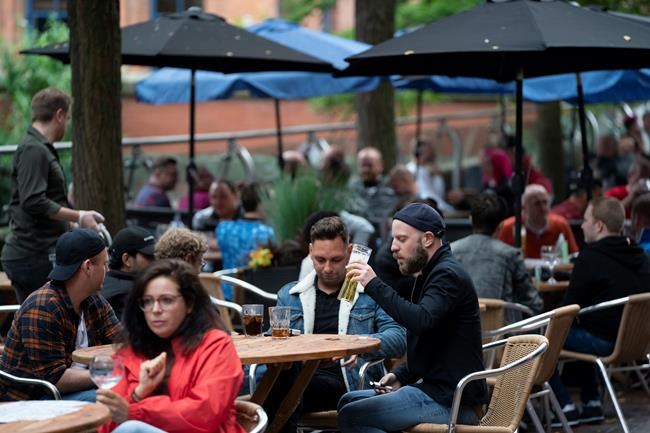
Members of the public are seen at a bar on Canal Street in Manchester's gay village, England, Saturday July 4, 2020. England is embarking on perhaps its biggest lockdown easing yet as pubs and restaurants have the right to reopen for the first time in more than three months. In addition to the reopening of much of the hospitality sector, couples can tie the knot once again, while many of those who have had enough of their lockdown hair can finally get a trim. (AP Photo/Jon Super)

In a statement on Monday, the U.N. health agency said it was aware of the article and was reviewing it with technical experts.

WHO has been criticized in recent weeks and months for its seeming divergence from the scientific community. The organization for months declined to recommend mask-wearing, partly out of supply concerns and has also continued to describe the transmission of COVID-19 from people without symptoms as “rare.”

The letter was endorsed by 239 scientists from a variety of fields. It stated that the issue of whether or not COVID-19 was airborne was of “heightened significance” as many countries stop restrictive lockdown measures.

The authors cited previous studies suggesting that germs closely related to the new virus were spread via airborne transmission. They said “there is every reason to expect” that the coronavirus behaves similarly. They also cited a Washington state choir practice and research about a poorly ventilated restaurant in Guangzhou, China, each of which raised the possibility of infections from airborne droplets.

“We are concerned that the lack of recognition of the risk of airborne transmission of COVID-19 and the lack of clear recommendations on the control measures against the airborne virus will have significant consequences,” the scientists wrote. “People may think they are fully protected by adhering to the current recommendations but in fact, additional airborne interventions are needed.”

Scientists around the world have been working furiously to understand the new virus. The U.S. Centers for Disease Control and Prevention says it is thought to mainly jump from person to person through close contact, but adds: “We are still learning about how the virus spreads.”

Martin McKee, a professor of European Public Health at the London School of Hygiene and Tropical Medicine who was not linked to the letter, said the scientists’ arguments sounded “entirely reasonable.”

“Part of the problem is that everybody at WHO was moving with the paradigm of influenza, even though we know there are lots of differences between influenza and coronaviruses,” he said.

McKee noted that with Britain’s recent reopening of its pubs, restaurants and salons, the possibility of airborne coronavirus transmission might mean stricter interventions are needed indoors, including more mask-wearing and continued physical distancing.

“We’re getting accumulating evidence about super-spreading events happening in indoor spaces where there are large numbers of people in confined spaces,” he said. “Many of these are in exactly the circumstances that governments now want to open up.”

___

The Associated Press Health and Science Department receives support from the Howard Hughes Medical Institute’s Department of Science Education. The AP is solely responsible for all content.

Report Error Submit a Tip

More Stories

Province announces free daycare for low-income families

Nicole Buffie 3 minute read Preview

Province announces free daycare for low-income families

Nicole Buffie 3 minute read Wednesday, Sep. 2, 2026

Eligible parents will have their child-care fees waived come Sept. 13.

The province announced Wednesday child care would be free for about 4,100 children from 3,000 families as part of a budget commitment to eliminate the $2-per-day fee for low-income families.

“This announcement that we’re making here today is going to be hugely, hugely impactful for the families that rely on this important, important service of child care,” Education and Early Childhood Learning Minister Tracy Schmidt said at a news conference at Panda Bear Day Care.

She said the program would save families between $520 and $2,600 per child per year.

Read
Wednesday, Sep. 2, 2026

Who does Manitoba’s police watchdog represent?

Christopher J. Schneider and Stacey Hannem 4 minute read Yesterday at 2:00 AM CDT

Cassity Delvenne, a 24-year-old Indigenous woman, was arrested by the Brandon Police Service (BPS) and charged with impaired driving and resisting arrest on June 12.

A 45-second bystander video of Delvenne’s arrest shows officers on top of her, repeatedly striking her. Brandon Police acknowledge that the officers did hit Delvenne.

Allegations of excessive force have been levied against the arresting officers. Delvenne’s mother maintains that she has photos showing extensive injuries to her daughter that include bloodied ears, bruising, and a chipped tooth.

Delvenne reportedly made a complaint to the BPS following her arrest. She died nine days later. The exact cause of her death is under investigation.

Bisons look to bounce back against Dinos at Murray Field

Joshua Frey-Sam 6 minute read Preview

Bisons look to bounce back against Dinos at Murray Field

Joshua Frey-Sam 6 minute read Wednesday, Sep. 16, 2026

Nathan Udoh has been around long enough to know how quickly things can change in the Canada West conference.

The fifth-year Manitoba Bisons receiver is one of the oldest players in a youthful locker room that is experiencing the ebbs and flows of a U Sports season for the first time, and to say his experience if being leaned on would be an understatement.

“I try to lean on that and help guys who haven’t been in these situations just to keep their heads and how hard you have to play,” Udoh said Wednesday. “I think that’s the biggest thing that there is no snap that you take off, and playing with that intensity is really where it starts.”

The Bisons have already endured a roller-coaster two games into the season. After shocking the country by steamrolling the reigning conference champion Saskatchewan Huskies 40-22 in their season-opener, the Bisons fell back to earth in a 22-8 road loss to the Regina Rams last weekend.

Read
Wednesday, Sep. 16, 2026

From footnote to martyr: execution altered Scott’s place in history

Tom Brodbeck 5 minute read Preview

From footnote to martyr: execution altered Scott’s place in history

Tom Brodbeck 5 minute read Friday, Feb. 14, 2020

When Thomas Scott was marched outside the walls of Upper Fort Garry and executed by firing squad, it forever changed how history would treat Louis Riel and the Red River Resistance. The killing of Scott, whether a misguided error by Riel or an unavoidable step to prevent further bloodshed, would turn out to be one of the most pivotal events of the resistance.

Only a month after the Irish-born Canadian was condemned to death in March 1870, Riel opponents in Ontario used Scott’s execution to whip up anti-Métis sentiment in an effort to sabotage negotiations between Ottawa and the Red River Settlement. It nearly worked. Two of three Red River delegates sent to Ottawa to negotiate the terms of Manitoba’s entry into confederation were arrested on arrival (but later released) for Scott’s death. At the same time, Prime Minister John A. Macdonald was under increasing political pressure to send military troops to quell the resistance in Red River, rather than engage in peaceful negotiations.

Scott’s death didn’t just complicate matters for the Red River delegates. It undermined their efforts to bargain with Ottawa.

Scott was tried and convicted by a “military council” on March 3 for rebelling against the provisional government and attacking a Métis guard at Upper Fort Garry, where he and other political prisoners were held. The trial wasn’t conducted under normal court rules, even by 1870 Red River standards. Scott had no defence counsel and wasn’t present for much of the proceedings, which were conducted in French (a language he didn’t understand). Riel, one of the chief witnesses in the case, had to act as translator. The military council was not unanimous in its decision to sentence Scott to death. Some felt the penalty was too harsh.

Read
Friday, Feb. 14, 2020

Hellebuyck determined to turn numbers around

Jason Bell 6 minute read Preview

Hellebuyck determined to turn numbers around

Jason Bell 6 minute read Tuesday, Oct. 30, 2018

HELSINKI — Connor Hellebuyck is enjoying a visit to the Finnish capital city and has wandered some of the twisting cobblestone paths in search of its many sights — a well-timed distraction from the outcomes of his most recent NHL starts and the mediocre stats that accompany them.

By his own admission, the Winnipeg netminder — who emerged last season as one of the top goaltenders in the NHL — hasn't had a banner beginning to the 2018-19 campaign. In nine opportunities to guard the Jets net, Hellebuyck has posted a 4-4-1 record, a 3.00 goals-against average and .907 save percentage.

Those aren't numbers that warrant a 911 response, but they're not what Jets fans were accustomed to seeing from the 25 year old during a breakout 2017-18 season.

Most importantly, they don't resemble the body of work the Michigan-born goaltender, who dropped his last two starts, demands of himself.

Read
Tuesday, Oct. 30, 2018

Assiniboine Park has long provided visitors the chance to commune with nature

Alison Gillmor 8 minute read Preview

Assiniboine Park has long provided visitors the chance to commune with nature

Alison Gillmor 8 minute read Monday, Apr. 12, 2021

Here’s what I observed on a perfect spring day in Assiniboine Park last week: I saw people biking, jogging and walking their dogs (so many good dogs).

I saw the Assiniboine River at low ebb and perennial plantings in the English Garden pushing up toward the April sun.

I saw birdwatchers with binoculars, a group of 20-somethings playing cards, a man tossing bread to some chipper little ground squirrels, and a guy on a tricked-out three-wheeled cycle with a speaker blasting Don’t Stop Believing. This being Winnipeg, I also ran into my husband’s aunt’s best friend.

During the last year of COVID-19, as so many indoor places where Winnipeggers would normally gather were shut down, outdoor public spaces became crucial for mental and physical health. When time seems to have stopped, it helps to see the natural world continue its cycles. When life feels isolated, it’s reassuring to realize you’re still part of a larger community.

Read
Monday, Apr. 12, 2021