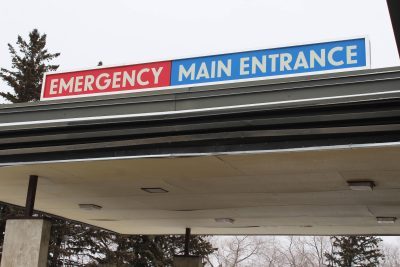
COVID-19 clinics to open as doctors call for cases to be kept out of hospitals
Advertisement
Read this article for free:
or
Already have an account? Log in here »
To continue reading, please subscribe:
Digital Subscription
One year of digital access for only $1.44 a week*
- Enjoy unlimited reading on winnipegfreepress.com
- Read the E-Edition, our digital replica newspaper
- Access News Break, our award-winning app
- Play interactive puzzles
*Billed as $5.77 plus GST every four weeks. After 52 weeks, price increases to the regular rate of $19.95 plus GST every four weeks. Offer available to new and qualified returning subscribers only. Cancel any time.
To continue reading, please subscribe:
Add Free Press access to your Brandon Sun subscription for only an additional
$1 for the first 4 weeks*
- Enjoy unlimited reading on winnipegfreepress.com
- Read the E-Edition, our digital replica newspaper
- Access News Break, our award-winning app
- Play interactive puzzles
*Your next Brandon Sun subscription payment will increase by $1.00 and you will be charged $17.95 plus GST for four weeks. After four weeks, your payment will increase to $24.95 plus GST every four weeks.
Read unlimited articles for free today:
or
Already have an account? Log in here »
Hey there, time traveller!
This article was published 06/03/2020 (2430 days ago), so information in it may no longer be current.
Doctors are warning that Canada needs to build capacity to screen for the new coronavirus outside hospitals or risk overwhelming emergency rooms and having the infection spread within their facilities.
Physicians from eight Toronto hospitals published a paper in the Canadian Medical Association Journal on Friday calling for potential COVID-19 cases to be tested at specialized clinics or at home as several communities work to set up such initiatives.
“Canada’s preparedness for COVID-19 must extend beyond hospitals, as a surge of cases appears inevitable,” writes co-author Dr. Jerome Leis, medical director of infection prevention and control at Sunnybrook Health Sciences Centre.

The doctors work at hospitals that collectively tested 135 people for the virus between Jan. 20 and Feb. 19. They found the majority of patients were young and not very ill. Only one case came back positive.
The authors note that there are several barriers to community testing, including limited access to diagnostics and Ontario guidelines that require health-care workers use protective equipment that is hard to find outside hospitals.
They say these restrictions need to be addressed before emergency rooms are flooded with suspected COVID-19 cases, leading to side-effects such as overcrowding, the infection of health-care workers and putting critically ill patients at risk.
Efforts are underway to prevent such a scenario as health-care authorities and providers in several areas try to shift their screening efforts away from hospitals, so emergency doctors can focus on treating those who need it most.
Quebec’s health minister told reporters earlier this week the province plans to designate medical clinics to assess potential COVID-19 cases, starting with sites in Montreal and Quebec City.
On Friday, Alberta asked returning travellers experiencing flu-related symptoms to stay away from emergency rooms and call the provincial health line, 811, to arrange testing with a paramedic or a public-health nurse.
The Ontario government is also working with Toronto authorities to set up COVID-19 assessment centres, a health ministry spokesman said in an email.
In east Toronto, Michael Garron Hospital is preparing to open a screening clinic later this month to be jointly run out of a nearby family medical centre.
Stephen Beckwith, executive director of the South East Toronto Family Health Team, said the clinic has 14 rooms to isolate patients before a doctor arrives to check their symptoms and collect a nose or throat swab for testing.
If demand rises, Beckwith said they’re exploring ways to expand capacity with “drive-through” testing, which will allow patients to be assessed without leaving their cars.
In Renfrew County, about an hour-drive west of Ottawa, health officials have proposed protocols to enlist the help of paramedics to test and monitor patients at home.
Dr. Robert Cushman, acting medical officer of health at the Renfrew County and District Health Unit, said he expects the program will be easy to implement, because the majority of COVID-19 patients likely won’t require hospitalization.
But when someone comes in with possible symptoms, Cushman said it can create a “tempest” in the waiting room, even if the person turns out to have a cold or the flu.
“It creates a lot of anxiety,” he said. “That’s the last place you want infection running around.”

During 2003’s SARS outbreak, hospitals became “amplification centres” for infection among front-line medical personnel, who accounted for a significant share of Toronto’s cases, said Alyson Kelvin, an assistant professor of infectious diseases at Dalhousie University.
Dr. Zain Chagla, co-medical director of infection control at St. Joseph’s Healthcare in Hamilton, Ont., said health-care workers can protect both themselves and their patients through telemedicine, an emerging medical approach that harnesses the power of technology to provide treatment.
Chagla said doctors can use secure text messaging and video to not only monitor COVID-19 patients, but also people concerned about contracting the virus in health-care settings.
The total of confirmed and presumptive cases of COVID-19 in Canada reached more than 50 on Friday. Health officials have said the risk posed by COVID-19 in this country remains low, but they are preparing for a possible outbreak similar to the ones seen in Iran, South Korea, Italy and China.
This report by The Canadian Press was first published March 6, 2020.
Related Articles
Feds to support those under virus quarantine
Advertisement Advertise With Us
Advertisement Advertise With Us