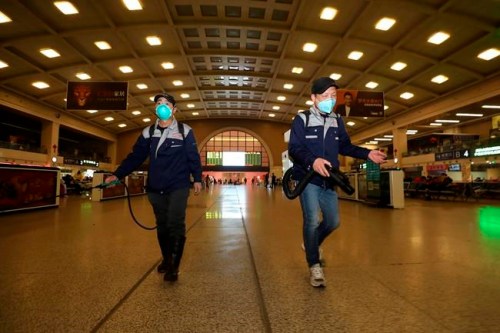
Officials question report of virus spreading before symptoms

Advertisement

Advertise with us

German health officials have raised questions about a report that suggested the new virus from China could be spread by people who are not yet showing symptoms.

Read this article for free:


or

Already have an account? Log in here »

To continue reading, please subscribe:

Subscribe and receive a limited-edition Free Press branded hat or tote.

Digital Subscription

One year of digital access for only $205*

  • Enjoy unlimited reading on winnipegfreepress.com
  • Read the E-Edition, our digital replica newspaper
  • Access News Break, our award-winning app
  • Play interactive puzzles

*First annual payment billed as $205.00 + GST for one year. This annual subscription will automatically renew at $233.00 + GST every 52 weeks (10% off the regular annual price of $259.35). Offer available to new and qualified returning subscribers only. Cancel any time.

To continue reading, please subscribe:

Add Free Press access to your Brandon Sun subscription for only an additional

$1 for the first 4 weeks*

  • Enjoy unlimited reading on winnipegfreepress.com
  • Read the E-Edition, our digital replica newspaper
  • Access News Break, our award-winning app
  • Play interactive puzzles
Start now

*Your next Brandon Sun subscription payment will increase by $1.00 and you will be charged $17.95 plus GST for four weeks. After four weeks, your payment will increase to $24.95 plus GST every four weeks.

Hey there, time traveller!
This article was published 04/02/2020 (2390 days ago), so information in it may no longer be current.

German health officials have raised questions about a report that suggested the new virus from China could be spread by people who are not yet showing symptoms.

The report, published last week in the New England Journal of Medicine, raised concerns that controlling the virus will be more daunting if it turns out it is spreading before people know they are sick.

But officials at the Robert Koch Institute, Germany’s public health agency, said Tuesday the woman who set off a cluster of cases was taking anti-fever medicine. Recent interviews with her revealed she “might have had mild unspecific symptoms including back pain,” the institute’s Marieke Degen wrote in an email to The Associated Press.

The paper’s authors hadn’t spoken to the woman, and instead relied on information from other patients, according to the news site ScienceInsider, which first reported the German officials’ comments.

The study was not the only evidence that the virus can spread before a person feels sick. Two other reports from China also have suggested it, said Marc Lipsitch, an epidemiologist at Harvard’s public health school.

“This is still a point of great uncertainty and it’s an important uncertainty,” Lipsitch said.

The mild symptoms described by German health authorities are “about as close to no symptoms as you can get without calling it no symptoms,” he added.

The new virus causes fever, cough and shortness of breath. Some people have had only mild illness. In serious cases, the virus can cause pneumonia. Some patients have needed oxygen.

The medical journal, which published the report Thursday, confirmed it is aware of the new information. “We’re working on it but we’re not yet in a position to make a statement or answer additional questions,” said journal spokeswoman Jennifer Zeis.

The report had been cited by U.S. health authorities as they announced the first quarantine of healthy travellers. But U.S. health authorities had other reasons for ordering quarantines, such as the rapid increase in new cases reported by China.

The U.S. Centers for Disease Control and Prevention has said travellers returning from Hubei Province will be quarantined, and travellers from other parts of China will be actively monitored with help from state health departments.

___

The Associated Press Health and Science Department receives support from the Howard Hughes Medical Institute’s Department of Science Education. The AP is solely responsible for all content.

Report Error Submit a Tip

More Stories

Officials question report of virus spreading before symptoms

Carla K. Johnson, The Associated Press 3 minute read Tuesday, Feb. 4, 2020

German health officials have raised questions about a report that suggested the new virus from China could be spread by people who are not yet showing symptoms.

The report, published last week in the New England Journal of Medicine, raised concerns that controlling the virus will be more daunting if it turns out it is spreading before people know they are sick.

But officials at the Robert Koch Institute, Germany's public health agency, said Tuesday the woman who set off a cluster of cases was taking anti-fever medicine. Recent interviews with her revealed she “might have had mild unspecific symptoms including back pain,” the institute's Marieke Degen wrote in an email to The Associated Press.

The paper's authors hadn't spoken to the woman, and instead relied on information from other patients, according to the news site ScienceInsider, which first reported the German officials' comments.

Sisters among 137 to begin doctor journey at U of M

Nicole Buffie 4 minute read Preview

Sisters among 137 to begin doctor journey at U of M

Nicole Buffie 4 minute read Wednesday, Aug. 19, 2026

Not everyone enters medical school with a built-in study buddy.

Sisters Maya and Dana Jalal joined 135 of their classmates to don white coats and mark the beginning of their journey through the University of Manitoba’s Max Rady College of Medicine Wednesday morning.

Maya, 22, and Dana, 21, were accepted into medical school at the same time.

“Thankfully, we both got accepted in the same area, same time. So we decided we’d rather go together than apart,” Maya said. “It’ll be nice seeing different perspectives during our studies. We are siblings, but we each have our own perspectives, our own lived experiences.”

Read
Wednesday, Aug. 19, 2026

Zoo caring for orphaned polar bear cub

Tiago Resko 2 minute read Preview

Zoo caring for orphaned polar bear cub

Tiago Resko 2 minute read 1:57 PM CDT

The Assiniboine Park Zoo is caring for an orphaned polar bear cub that arrived from Churchill Thursday after conservation officers determined it was incapable of surviving on its own.

The officers found the bear’s dead mother.

Orphaned cubs have a high mortality rate, and a medical team was quickly sent to Churchill to support the cub’s initial needs, the zoo said in a media release.

The team arrived in Winnipeg late Thursday night.

Read
1:57 PM CDT

Private governance or public good

David Nutbean 5 minute read 2:00 AM CDT

The Manitoba government recently held public forums to discuss regulations for Bill 51, the Public Sector Artificial Intelligence and Cybersecurity Governance Act. I was able to participate in the meeting in Brandon and there was also a session in Winnipeg.

I was a bit fired up, ready to rail about data centres and phone terms and conditions and generally give it to big tech. The discussion, however, was focused on what the public sector responses should be regarding cybersecurity, data and privacy protections, and AI usage in government.

With all the recent attention on social media bans, the harms of AI, misinformation and the like, I was somewhat disappointed that these would not be tackled directly in this meeting. Those issues may be discussed at future forums.

At this event, as focus groups developed responses, the discussion between private companies and public governance kept getting mixed in, pointing out the reliance of government services on private companies in running their digital operations. As government operations become more dependent on digital infrastructure and towards AI agency and control, rethinking how technology is implemented may be crucial to our democracy.

Educated people vote

John R. Wiens 4 minute read 2:00 AM CDT

I add my voice to Erna Buffie’s Think Tank piece “Democracy is a civic election issue” (Aug. 13) by asserting that democracy is a public education issue. Put another way, this fall’s municipal and school board elections are a test of public education — educating democratic citizens who appreciate our democratic inheritance enough to take responsibility for renewing it.

Voter turnouts for elections in Canada are abysmal. Where there should be 100 per cent participation, it often approaches 50 per cent federally and provincially, 25 per cent in local elections. The explanations given seem insufficient and unsatisfying, as are the reasons given by those who decide not to bother.

Some say they feel disempowered and alienated from the political process, feeling they have no say in governmental decisions which rule their lives.

Others appear resigned to the fact that, if they were to speak, they would simply be passed over or ignored, choosing not to vote because their votes, like their voices, make no difference and count for nothing. Still others say they’re too busy or just don’t care.

Doctor speaks out, raises alarm over gas plant expansion plans

Rylee Gerrard 4 minute read Preview

Doctor speaks out, raises alarm over gas plant expansion plans

Rylee Gerrard 4 minute read 2:00 AM CDT

BRANDON — A retired doctor is raising red flags on Manitoba Hydro’s proposed gas plant expansion in Brandon and the health-related consequences of climate change.

Dr. Scott Blyth, a former family physician who practised medicine for more than 40 years, said there are health risks associated with long-term exposure to gas.

“A simple answer, the plant should not be built because of the potential health risks,” Blyth said Thursday.

Blyth is a member of the Canadian Association of Physicians for the Environment — a doctor-led organization with 80 members in Manitoba that works on the intersection between health and the environment.

Read
2:00 AM CDT