Ont. school board warns that coronavirus concerns veer into anti-Chinese racism

Advertisement

Advertise with us

Community organizations are applauding an Ontario school board for taking a stand against racial profiling as the new coronavirus raises concerns about discrimination against Chinese-Canadians.

Read this article for free:


or

Already have an account? Log in here »

To continue reading, please subscribe:

Subscribe and receive a limited-edition Free Press branded hat or tote.

Digital Subscription

One year of digital access for only $205*

  • Enjoy unlimited reading on winnipegfreepress.com
  • Read the E-Edition, our digital replica newspaper
  • Access News Break, our award-winning app
  • Play interactive puzzles

*First annual payment billed as $205.00 + GST for one year. This annual subscription will automatically renew at $233.00 + GST every 52 weeks (10% off the regular annual price of $259.35). Offer available to new and qualified returning subscribers only. Cancel any time.

To continue reading, please subscribe:

Add Free Press access to your Brandon Sun subscription for only an additional

$1 for the first 4 weeks*

  • Enjoy unlimited reading on winnipegfreepress.com
  • Read the E-Edition, our digital replica newspaper
  • Access News Break, our award-winning app
  • Play interactive puzzles
Start now

*Your next Brandon Sun subscription payment will increase by $1.00 and you will be charged $17.95 plus GST for four weeks. After four weeks, your payment will increase to $24.95 plus GST every four weeks.

Hey there, time traveller!
This article was published 28/01/2020 (2433 days ago), so information in it may no longer be current.

Community organizations are applauding an Ontario school board for taking a stand against racial profiling as the new coronavirus raises concerns about discrimination against Chinese-Canadians.

Officials with the York Region District School Board issued a letter Monday urging parents to not speculate about the risk of students and staff members spreading the virus based on their race or travel history.

An online petition by parents in the region north of Toronto, which has a large Chinese population, calls on the school board to ask students whose families have recently returned from China to stay home for 17 days to “self-quarantine.”
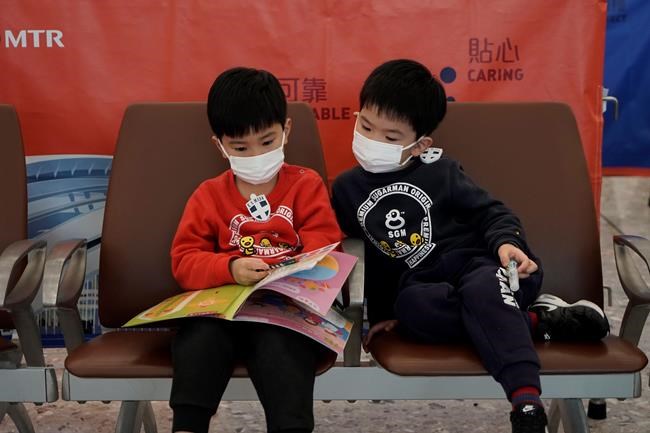
Passengers wear masks to prevent an outbreak of a new coronavirus in the high speed train station, in Hong Kong, Wednesday, Jan. 22, 2020. THE CANADIAN PRESS/AP/Kin Cheung

Board chair Juanita Nathan and education director Louise Sirisko wrote that such requests run the risk of “demonstrating bias and racism,” even when made in the name of safety.

“At times such as this, we must come together as Canadians and avoid any hint of xenophobia, which in this case can victimize our East Asian Chinese community,” the letter said. “Situations such as these can regrettably give rise to discrimination based on perceptions, stereotypes and hate.”

More than a dozen community groups that advocate for marginalized communities issued a joint statement Tuesday commending the school board for taking swift action to prevent racial profiling.

“Racism has no place in our society or in our classrooms,” said the statement, which was endorsed by the Chinese Canadian National Council for Social Justice, the Ontario Council of Agencies Serving Immigrants, the Urban Alliance on Race Relations among other organizations.

On Tuesday, health officials found a presumed case of the virus in British Columbia, in addition to the two others that have been identified in Toronto.

Speaking in Ottawa, Health Minister Patty Hajdu cautioned people against letting fear of the illness drive them to act out against others.

Organizers are set to hold a press conference outside Toronto City Hall on Wednesday to address the stigmatization of Chinese-Canadian communities amid growing public panic about the new coronavirus.

Speaker Avvy Go, the director of the Chinese and Southeast Asian Legal Clinic, said the climate of fear brings back painful memories about the discrimination Chinese-Canadians suffered during 2003’s SARS outbreak.

Go said she represented clients facing landlords looking to evict them, employers who cut their wages or their jobs and immigration officials who wore face masks while hearing refugee claims.

Go testified about these experiences during Ontario’s inquiry into the SARS outbreak, but said the commission’s more than 1,200-page report didn’t address the role anti-Chinese racism played in the crisis.

While health authorities say they’re better prepared to handle an outbreak than 17 years ago, Go said the lack of progress in responding to racial profiling presents a public-health concern.

“(The) government should start getting ready to prepare for the very foreseeable outbreak of racism during this crisis,” Go said. “Don’t wait till the matter gets worse.”

Tonny Louie, chair of the Toronto Chinatown Business Improvement Area, helped kick off Lunar New Year celebrations this weekend by joking to the crowd that his sore throat was caused by a cold, not the new coronavirus.

But by the second day of the festivities, Louie said the event saw a considerable dropoff in attendance. He believes businesses in the city’s bustling Chinatown have also suffered a loss of patrons due to fears about contracting the virus.

According to a 2004 report by the Chinese Canadian National Council, Chinese-owned businesses across Toronto were hit by the SARS outbreak, leading to between a 40 per cent and 80 per cent loss of income by some estimates.

The economic blow was so pronounced that then-prime minister Jean Chretien dined in Chinatown in a bid to show it was safe to patronize Chinese establishments.

Justin Kong, executive director of the Chinese Canadian National Council’s Toronto chapter, said it will take more than a photo-op to assuage community members’ concerns about a resurgence in anti-Chinese racism.

Kong said social media has accelerated the spread of misinformation that could not only fuel the stigmatization of Chinese-Canadian communities, but also distract from the evidence-based health information Canadians need.

“This is a crisis for all Canadians, and Chinese-Canadians are bearing the brunt of it,” Kong said. “We need to make sure that we not only prevent the spread of this virus, but that we don’t harm people and communities in the process.”

This report by The Canadian Press was first published Jan. 28, 2020.

Report Error Submit a Tip

More Stories

Thinking outside the boxwood

Colleen Zacharias 7 minute read Preview

Thinking outside the boxwood

Colleen Zacharias 7 minute read Saturday, Sep. 12, 2020

With fall barrelling towards us at record wind speeds and winter not far behind, now is the time to decide how you will protect your tender plants. Boxwood is a good example. My experience with growing boxwood in my Zone 3b garden has gone something like this: buy in spring, plant, dig up the following spring, repeat. It’s like one of those videos that plays on a continuous loop.

Digging a trench and burying my boxwood for the winter months beneath a layer of soil and shredded leaves has proven (mostly) successful. When the boxwood is lifted in spring, every speck of debris needs to be cleared from the centre of the plants to prevent fungal disease. I relocate the overwintered boxwood temporarily to a deep shade location to protect the foliage from burning which can occur in the cold temperatures of early spring. Once the root ball has fully thawed, boxwood can be safely replanted into containers and window boxes where it can live on happily for another summer.

But what makes boxwood worth all this trouble and aren’t the boxwood varieties sold at local garden centres supposed to be hardy (or relatively hardy) to our area?

Boxwood is one of the world’s most popular shrubs. It has the distinction of being one of those few plants so widely recognized and beloved for its inimitable structure and style that it can be found growing in landscapes around the world from Europe to Africa, Asia, the Mediterranean, and North America. In addition to the appeal of its small, glossy green, elliptically shaped evergreen foliage, boxwood can be shaped into almost anything. Boxwood is equally beautiful in the landscape or in container arrangements. Its architectural shape and glossy emerald green texture dresses up window boxes and adds pizazz to planters. Boxwood can be purchased in quart size containers, which are less costly, and used as a stand-alone plant or in a linear arrangement of three or more or as the thriller in a container arrangement.

Read
Saturday, Sep. 12, 2020

Explaining Canada’s superior employment rate

Wayne Simpson 5 minute read Preview

Explaining Canada’s superior employment rate

Wayne Simpson 5 minute read Friday, Sep. 4, 2026

Donald Trump regularly makes outrageous claims. Fentanyl was pouring across the northern border from Canada and had to be stopped. Canada is nasty to deal with and has the highest tariffs in the world. Canada needs the U.S. but the U.S. doesn’t need Canada. Canadians want to become the 51st state. And so on.

In the latest trade dispute, after Mark Carney walked away from negotiations, Trump made a new claim that Canada’s unemployment rate was 10 per cent and climbing rapidly. Insofar as the unemployment rate is closely monitored, reported monthly, and given similar attention to the rates of inflation and economic growth, the comment was likely intended to signal Canada’s weakness. It fits Trump’s narrative that Canada needs the U.S. for its livelihood and protection and would be better off more directly under U.S. influence as a 51st state, or perhaps a protectorate like the Philippines or Panama in the past.

Fact checkers quickly reported that Canada’s unemployment rate is really 6.4 per cent for July, not 10 per cent, has fallen from 6.9 per cent in April, and is at its lowest rate since May 2024. Some astute observers pointed out that Canada’s method for the calculation of the unemployment rate leads to a higher rate than the U.S. by about one per cent. Under the American methodology, then, our unemployment rate would be 5.4 per cent, not that far off the U.S. July rate of 4.1 per cent.

Detection of unemployment is less straightforward that might appear, as it is sandwiched between the labour force statuses of employment and inactivity at a particular point in time. The internationally established standard for determination of unemployment is the notion of searching for work — you are unemployed if you do not have paid employment and you are looking for work without success. Surveys have been developed to categorize respondents as employed, unemployed or inactive, including the labour force survey (LFS) in Canada and the current population survey (CPS) in the U.S.

Read
Friday, Sep. 4, 2026

Flop wedge needed at Phantom Lake Golf Club

Ryan Desjarlais 5 minute read Preview

Flop wedge needed at Phantom Lake Golf Club

Ryan Desjarlais 5 minute read 5:57 PM CDT

In a remote land of spruce, ptarmigan and rock, Flintabbatey Flonatin — an adventurer exploring the depths of Phantom Lake with his little submarine — discovered an underwater treasure trove of minerals. Once word spread among the prospecting community, the miners came, and the head frame of Flin Flon was born.

Now, that’s not exactly how The Sunless City novel reads, and Phantom Lake is actually in Saskatchewan, but my re-interpretation connects the dots enough to introducing Flin Flon’s links.

Phantom Lake Golf Club does not technically reside in Flin Flon, but rather in its twin community, Creighton, Sask. Indeed, as soon as you cross the border, you immediately turn south for a couple of clicks to the shores of Phantom Lake.

The very old river-stone clubhouse is up the hill from the parking lot. Folks with movement challenges might want to send the young bucks ahead to get the rental cart and bring it back to the parking lot to collect you and your sticks.

Read
5:57 PM CDT

East St. Paul product’s next wheelchair basketball chapter in Spain’s best men’s division

Joshua Frey-Sam 5 minute read Preview

East St. Paul product’s next wheelchair basketball chapter in Spain’s best men’s division

Joshua Frey-Sam 5 minute read Yesterday at 4:48 PM CDT

Every time Joshua Brown takes the court, the line between dreams and reality blurs.

You see, Brown, born and raised in East St. Paul, was diagnosed with cerebral palsy early in life. Understanding his condition, he came to terms with the challenge it would be to play stand-up sports competitively.

That didn’t stop him from dreaming, though.

Brown remembers watching Canada’s best in wheelchair basketball at the Paralympic Games on television as a youngster, and vividly recalls what went through his mind at the time.

Read
Yesterday at 4:48 PM CDT

City, province, Ottawa strike task force to battle meth

Jessica Botelho-Urbanski 5 minute read Preview

City, province, Ottawa strike task force to battle meth

Jessica Botelho-Urbanski 5 minute read Tuesday, Dec. 18, 2018

The city, province and federal governments are teaming up to create a tri-level task force that will fight distribution of illicit drugs and address the root causes of the province's meth crisis.

"As far as we know, this is the first collaborative initiative like this in the country and it’s something that I’m very proud to be a part of," said Winnipeg Mayor Brian Bowman, who had been calling for such a task force (with unanimous council support) since September. 

In interviews last week, officials from the three levels of government told the Free Press they hadn't yet met in the same room to discuss the surge in meth-related problems.

By Tuesday, it seems they managed to clear their schedules.

Read
Tuesday, Dec. 18, 2018

Ledohowski among new entrants to Manitoba Business Hall of Fame

Gabrielle Piché 3 minute read Preview

Ledohowski among new entrants to Manitoba Business Hall of Fame

Gabrielle Piché 3 minute read 6:00 PM CDT

The late Canad Inns founder will join the ranks of Manitoba Business Hall of Fame members next year.

Leo Ledohowski is one of three honourees to receive the prestigious title. Mark Evans, the executive chair of Conquest Planning, and Michael Pyle, Exchange Income Corporation’s chief executive, are also slated to be inducted next year.

“Each of their stories is very unique,” said Greg Leipsic, president of JA Manitoba.

The non-profit oversees the hall of fame; its board chooses new faces annually. The incoming businessmen will be honoured at an April 6 gala at the Victoria Inn Hotel.

Read
6:00 PM CDT