Deaths rise as Nepal issues more permits for Mount Everest
Advertisement
Read this article for free:
or
Already have an account? Log in here »
To continue reading, please subscribe:

Digital Subscription
One year of digital access for only $205*
- Enjoy unlimited reading on winnipegfreepress.com
- Read the E-Edition, our digital replica newspaper
- Access News Break, our award-winning app
- Play interactive puzzles
*First annual payment billed as $205.00 + GST for one year. This annual subscription will automatically renew at $233.00 + GST every 52 weeks (10% off the regular annual price of $259.35). Offer available to new and qualified returning subscribers only. Cancel any time.
To continue reading, please subscribe:
Add Free Press access to your Brandon Sun subscription for only an additional
$1 for the first 4 weeks*
- Enjoy unlimited reading on winnipegfreepress.com
- Read the E-Edition, our digital replica newspaper
- Access News Break, our award-winning app
- Play interactive puzzles
*Your next Brandon Sun subscription payment will increase by $1.00 and you will be charged $17.95 plus GST for four weeks. After four weeks, your payment will increase to $24.95 plus GST every four weeks.
Read unlimited articles for free today:
or
Already have an account? Log in here »
Hey there, time traveller!
This article was published 28/05/2019 (2692 days ago), so information in it may no longer be current.
NAMCHE, Nepal – Scaling Mount Everest was a dream few realized before Nepal opened its side of the mountain to commercial climbing a half-century ago. This year the government issued a record number of permits, leading to traffic jams on the world’s highest peak that likely contributed to the greatest death toll in four years.
As the allure of Everest grows, so have the crowds, with inexperienced climbers faltering on the narrow passageway to the peak and causing deadly delays, veteran climbers said.
After 11 people died this year, Nepal tourism officials have no intention of restricting the number of permits issued, instead encouraging even more tourists and climbers to come “for both pleasure and fame,” said Mohan Krishna Sapkota, secretary at the Ministry of Tourism and Civil Aviation.
Nepal, one of the world’s poorest countries, relies on the climbing industry to bring in $300 million each year. It doesn’t cap the number of permits it issues or control the pace or timing of the expeditions, leaving that to tour operators and guides who take advantage of brief clear weather conditions whenever they come, leading to pileups near the peak.
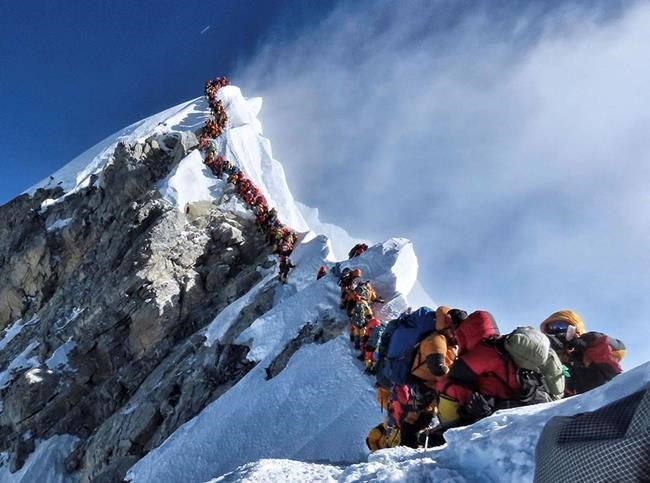
On May 22, a climber snapped a photo from a line with dozens of hikers in colorful winter gear that snaked into the sky.
Climbers were crammed crampon-to-crampon along a sharp-edged ridge above South Col, with a 7,000-foot (2,000-meter) drop on either side, all clipped onto a single line of rope, trudging toward the top of the world and risking death as each minute ticked by.
“There were more people on Everest than there should be,” said Kul Bahadur Gurung, general secretary of the Nepal Mountaineering Association, an umbrella group of all expedition operators in Nepal. “We lack the rules and regulations that say how many people can actually go up and when.”
The death toll this season is the highest since 2015. Most of those who died are believed to have suffered from altitude sickness, which is caused by low amounts of oxygen at high elevation and can cause headaches, vomiting, shortness of breath and mental confusion.
Once only accessible to well-heeled elite mountaineers, Nepal’s booming climbing market has driven down the cost of an expedition, opening Everest up to hobbyists and adventure-seekers. Nepal requires climbers to have a doctors’ note deeming them physically fit, but not to prove their stamina at such extreme heights.
Because of the altitude, climbers have just hours to reach the top before they are at risk of a pulmonary edema, when the lungs fill with liquid. From Camp Four at 8,000 metres (26,240 feet) to the 8,850-meter (29,035-foot) peak, the final push on Everest is known as the “death zone.”
The conditions are so intense at such times that when a person dies, no one can afford to expend energy on carrying the body down from the mountain.
“Every minute counts there,” said Eric Murphy, a mountain guide from Bellingham, Washington, who climbed Everest for a third time on May 23. He said what should have taken 12 hours took 17 hours because of struggling climbers who were clearly exhausted but had no one to guide or help them.
Just a handful of inexperienced climbers, he said, is “enough to have a profound effect.”
The deaths this year on Nepal’s side of the mountain included Don Cash, a sales executive from Utah, and Christopher Kulish, an attorney from Colorado, who both died on their way down from the peak.
Kulish, 62, had just reached the top with a small group after crowds of climbers congested the peak last week, according to his brother, Mark Kulish.
He described his brother as an attorney who was an “inveterate climber of peaks in Colorado, the West and the world over.”
Just before he died, Kulish made it into the so-called “Seven Summit Club” of mountaineers who have reached the highest peaks on every continent, his brother said.
Cash, 55, collapsed at the summit and was given CPR and massages by his two Sherpa guides. He got up only to fall again in the same way at Hillary Step, the first cliff face down from the summit. His body was left near there.
Cash had said on his LinkedIn page that he left his job as a sales executive to try to join the seven summits club.
Nepal doesn’t have any regulations to determine how many permits should be issued, so anyone with a doctor’s note can obtain one for an $11,000 fee, Sapkota said.
This year, permits were issued to 381 people in 44 teams, the highest number ever, according to the government. They were accompanied by an equal number of guides from Nepal’s ethnic Sherpa community. Some climbers were originally issued permits in 2014 that were revoked mid-season when 16 Sherpa guides died in an avalanche and other Sherpas, whose support as guides and porters is essential, effectively went on strike.
Another factor was China’s limit on the number of permits it issued this year for routes in its territory on the north side of Everest for a clean-up. Both the north and south sides of the mountain are littered with empty oxygen canisters, food packaging and other debris.
Instead of the overcrowding, Sapkota blamed the weather, equipment and inadequate supplemental oxygen for this year’s deaths.
“There has been concern about the number of climbers on Mount Everest but it is not because of the traffic jam that there were casualties,” Sapkota said in Namche, the town that serves as the staging area for Everest trips.
Still, he said, “In the next season we will work to have double rope in the area below the summit so there is better management of the flow of climbers.”
Mirza Ali, a Pakistani mountaineer and tour company owner who reached Everest’s peak for the first time this month, on his fourth attempt, said such an approach was flawed.
“Everybody wants to stand on top of the world,” but tourists unprepared for the extremes of Everest endanger the entire industry, he said.
“There is not a sufficient check on issuing the permits,” Ali said. “The more people come, the more permits, more business. But on the other side it is a lot of risk because it is costing lives.”
Indian climber Ameesha Chauhan, soaking her frostbitten toes in medicine at a hospital in Kathmandu, described the agony of turning away from the peak when she realized her supplemental oxygen supply was low.
Two of her team members died on the May 16 ascent.
She returned and scaled the peak a week later.

“If you look at it, the inexperienced climbers do not even know how to tie on the oxygen masks around their face,” she said. “Many climbers are too focused on reaching the summit.”
___
Associated Press researcher Chonchui Ngashangva in New Delhi contributed to this report.
___
Gurubacharya reported from Kathmandu, Nepal, and Schmall reported from New Delhi.
Related Articles
Winnipeg teacher on top of the world after scaling Everest
Advertisement Advertise With Us
Advertisement Advertise With Us