Experts offer coping tips as fear of flying takes off in wake of plane crash

Advertisement

Advertise with us

TORONTO - For many people with a fear of flying, Sunday's deadly Ethiopian Airlines crash may have triggered fresh bouts of anxiety about taking to the skies in the future, especially as the tragedy came less than five months after the same model of aircraft plunged into the ocean off Indonesia, also killing all on board.

Read this article for free:


By clicking the button above, an account will be created and you will begin to receive some of our recommended newsletters. You may opt out of any newsletter by visiting your Email and Communication Preferences page or by clicking "unsubscribe" at the bottom of any email.

or

Already have an account? Log in here »

To continue reading, please subscribe:

Digital Subscription

One year of digital access for only $1.44 a week*

  • Enjoy unlimited reading on winnipegfreepress.com
  • Read the E-Edition, our digital replica newspaper
  • Access News Break, our award-winning app
  • Play interactive puzzles

*Billed as $5.77 plus GST every four weeks. After 52 weeks, price increases to the regular rate of $19.95 plus GST every four weeks. Offer available to new and qualified returning subscribers only. Cancel any time.

To continue reading, please subscribe:

Add Free Press access to your Brandon Sun subscription for only an additional

$1 for the first 4 weeks*

  • Enjoy unlimited reading on winnipegfreepress.com
  • Read the E-Edition, our digital replica newspaper
  • Access News Break, our award-winning app
  • Play interactive puzzles
Start now

*Your next Brandon Sun subscription payment will increase by $1.00 and you will be charged $17.95 plus GST for four weeks. After four weeks, your payment will increase to $24.95 plus GST every four weeks.

Hey there, time traveller!
This article was published 12/03/2019 (2791 days ago), so information in it may no longer be current.

TORONTO – For many people with a fear of flying, Sunday’s deadly Ethiopian Airlines crash may have triggered fresh bouts of anxiety about taking to the skies in the future, especially as the tragedy came less than five months after the same model of aircraft plunged into the ocean off Indonesia, also killing all on board.

TV and newspaper images of the African crash site, coupled with an outpouring of comments on social media, can exacerbate those fears for both children and adults, say experts.

In fact, some airlines have been dealing with nervous passengers booked for flights on the same model — Boeing’s 737 Max 8 — seeking to switch their tickets to another type of aircraft. That comes amidst a growing number of countries ordering that the aircraft be grounded while the Ethiopian Airlines crash that killed all 157 passengers and crew is investigated.
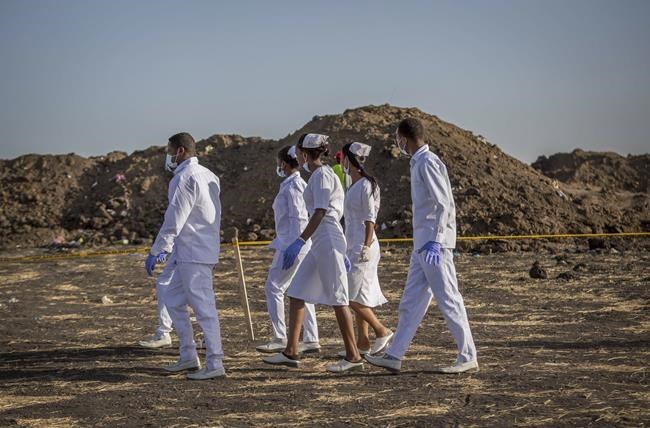
Nurses walk to collect materials, under the instruction of investigators, at the scene where the Ethiopian Airlines Boeing 737 Max 8 crashed shortly after takeoff on Sunday killing all 157 on board, near Bishoftu, or Debre Zeit, south of Addis Ababa, in Ethiopia Tuesday, March 12, 2019. THE CANADIAN PRESS/AP-Mulugeta Ayene

“If you see that an airplane has crashed recently and you’re going on an airplane in a few days from now, your brain does the math and it basically says ‘Oh, if it happened to them, it can happen to me,'” said Dr. Ian Shulman, a psychologist who specializes in phobias, including fear of flying.

“It just amplifies the appearance that it’s happening all the time,” he said, despite the fact that flying is considered among the safest forms of travel. In 2017, for instance, there were no fatal passenger airline accidents worldwide.

Anxiety about flying is often related to feelings of loss of control, and for some the claustrophobic discomfort of being trapped inside an object hurtling through the atmosphere with no way to escape.

While travelling in a vehicle on a highway is statistically far more perilous than flying in a commercial aircraft, people know they can roll down the window for air or pull off at the next exit if they feel nervous, Shulman said Tuesday from Oakville, Ont., where he practises.

“When we fly, we’re not able to have those same opportunities … So it takes us out of that place where we believe that we are in control,” he said. “I think that’s a huge element to the fear.”

But pointing out that “the real fear happens in the head,” Shulman said coping strategies can be learned to help people overcome their anxiety.

“One of them is to really pay attention to your own thinking: what are you telling yourself about this? Are you over-generalizing and saying because those two planes had problems, then all planes will have problems? Because that’s probably not accurate.”

Shulman advises people to pull back from that kind of thinking and to realize that “because we think something might happen, it doesn’t mean that it will happen.”

Of course, adults aren’t the only ones susceptible to a fear of flying. Children and teens exposed to grisly images of the plane crash sites and hearing that some of those lost were young people like themselves may also develop nervousness about taking to the air.

“When children hear things on the news that are frightening, they can certainly become worried about them,” said Madison Aitken, a clinical psychologist at the Centre for Addiction and Mental Health in Toronto.

“And I think it’s really important they feel comfortable talking with their parents, so they can discuss those fears openly and perhaps be reassured about them or just understand them a little more together.”

Parents can reassure their child or teen that aircraft crashes are extremely rare events, she said, adding that they might encourage their young travellers to focus on the destination and the fun activities they can engage in once they’ve arrived.

“One thing is being really prepared and minimizing stress on and around the actual travel and walking your children through what they can expect, and going early (to the airport), so you’re not feeling stressed about getting through security and those kinds of other situations around flying that can raise stress levels in general.”

And if parents themselves feel anxious about flying, Aitken recommends that parents talk about their own emotions with their children, “as long as they can do it in a way that they’re able to model their successful” coping skills.

“So if you’re going to talk about feeling worried yourself, that’s OK, and then adding … that ‘even though I’m really feeling nervous, I can get through it and here are the things that I do.'”

There are a number of programs in Canada that provide help to people who are nervous or phobic about air travel, including a weekend course in the spring and fall offered by Shulman, called Afraid to Fly.

The two-day course helps participants better understand their fears, discusses coping strategies, and includes having a commercial pilot come to the Oakville clinic to answer their questions about aircraft and flight. On the second day, the group heads to a nearby airfield for a flight in a small plane in which the class practises their newly learned coping skills under Shulman’s guidance.

___

Online:

www.shiftct.com

— Follow @SherylUbelacker on Twitter

Report Error Submit a Tip

More Stories

Winnipeg novelist's latest offering a riveting fictional account of missionaries' plight

Reviewed by Julienne Isaacs 5 minute read Preview

Winnipeg novelist's latest offering a riveting fictional account of missionaries' plight

Reviewed by Julienne Isaacs 5 minute read Saturday, Sep. 7, 2019

In 1955, five American missionary couples set out to evangelize the Waorani, an Indigenous people group of the Ecuadorian rainforest that had never had contact with the outside world. They dubbed their mission “Operation Auca.”

After a few months of airdropping gifts, the five men — Jim Elliot, Peter Fleming, Nate Saint, Ed McCully and Roger Youderian — opted to set up camp on a beach near a Waorani settlement. Just a few days later, they were all speared to death. Thanks to the swift arrival of a Life magazine photographer, the brutal conclusion to Operation Auca became global news.

In her new novel, Five Wives, Winnipeg writer Joan Thomas tells this story again.

“In the missionaries’ memoirs, ‘God’s leading’ explains almost every impulse,” Thomas writes in a postscript. “I set out to peer behind that, to explore in human terms actions that astonished me.”

Read
Saturday, Sep. 7, 2019

Province’s first female dentist took skill, insight wherever needed

David Sanderson    25 minute read Preview

Province’s first female dentist took skill, insight wherever needed

David Sanderson    25 minute read Saturday, Apr. 3, 2021

Some stories take longer to get around to than others.

In the fall of 2011 I hooked up with Fiona Odlum at an Academy Road Starbucks for a lighthearted feature about people who report on traffic for a living. Odlum, currently a contributor at CBC Saskatchewan, was working for 680 CJOB at the time, clueing rush-hour commuters in on stalls, lane closures and fender-benders they’d be wise to avoid.

Odlum turned the tables at one point by asking a few questions of her own including, “So, what’s your main beat?”

I don’t really have one, I told her, but if pressed, I would probably go with human-interest pieces.

Read
Saturday, Apr. 3, 2021

Imperialist crusades: 21st-century style

John R. Wiens 5 minute read Preview

Imperialist crusades: 21st-century style

John R. Wiens 5 minute read Wednesday, Jul. 8, 2026

In the 11th century and lasting into the 13th, the papacy launched a series of at least eight military campaigns we now refer to as the Crusades, or Holy Wars. They were an imperialistic call to arms for Christians to retake Jerusalem, which was at the time under Muslim rule.

Spiritual rewards for participation were implied, and other incentives offered, to dull the extra taxation demanded to fund the campaigns. Over time, the “crusades” morphed to become massacres of not only Muslims but also Jews and Christian dissidents — in other words, any enemies of the papacy. If today’s news sounds like déjà vu all over again, it probably should.

The stories keep repeating themselves in many forms. We now know that two 20th century world wars, global in scope, were caused by imperialistic ambitions, changes in the balance of international powers and corresponding arms races. The first was attributed to the assassination of the heir to the Austro-Hungarian throne by a Bosnian Serb, a kind of “regime change” initiative. The second resulted from rising tensions between Allied and Axis powers, triggered by the rise of European fascism and Japanese militarism. The human toll of both was unimaginable.

In the First World War, 15 to 22 million people, including soldiers and civilians, were killed and another 23 million were wounded. These numbers do not account for those otherwise affected — victims of chemical warfare whose compromised health shortened their lives; of the subsequent Spanish flu epidemic amplified by the displacement of peoples; others who died from other diseases caused by war conditions; and those who were malnourished or starved. Nor do they account for the ongoing trauma and resentments passed on intergenerationally to this day.

Read
Wednesday, Jul. 8, 2026

Fact Check

1 minute read Thursday, Nov. 30, 2023

Fact Check

Having problems with the form?Contact Us Directly |

Province changes Thompson ‘Vaxport’ plan

Carol Sanders 5 minute read Preview

Province changes Thompson ‘Vaxport’ plan

Carol Sanders 5 minute read Thursday, Jan. 14, 2021

The Manitoba government has changed its plans for a vaccination "super site" for the North — just days after it was announced — after local officials argued the original proposal was unworkable.

Some northern residents will still get their COVID-19 shots at Thompson's airport, but "Vaxport" will be less super than originally planned, providing injections only to residents of fly-in communities.

Most northern residents will get their shots at the Thompson Community Recreation Centre, which is centrally located in the city of about 13,000.

"This makes much more sense logistically, and for the citizens of Thompson," Mayor Colleen Smook said Thursday after touring the airport site, which is located 10 kilometres from the city and isn't serviced by public transportation.

Read
Thursday, Jan. 14, 2021

The new normal in Canadian politics

David McLaughlin 5 minute read Preview

The new normal in Canadian politics

David McLaughlin 5 minute read Yesterday at 2:01 AM CDT

“Nothing happening, all at once.”

Welcome to the new normal of Canadian politics, where normality is the new normal. Routine and stable are in; disruptive and excessive are out. Exhibits A and B are the Alberta referendum and the British Columbia election. Voters opted for stability over volatility.

The opposite of being normal is being different from the norm. In politics that means different from where we’ve been and what we’ve come to expect. Two competing trends have dominated our politics for the past decade and a half — progressivism and populism. Think Justin Trudeau and liberal, progressive identity politics in Canada, and Donald Trump and conservative, populist MAGA politics in America. We are now experiencing a swing away from both those trends.

Representing this “new normal” are Prime Minister Mark Carney, for one, and newly elected British Columbia premier, Lorne Doerksen, for another. Both are considered normal because they talk and act like adults in a childish political world. Their political flair is to not have any political flair. They stand out for not standing out.

Read
Yesterday at 2:01 AM CDT