Business groups appeal for support amid surging COVID-19 cases and new restrictions

Advertisement

Advertise with us

Two of Canada's largest business groups are calling on provincial governments to provide financial support for restaurants, retailers and small businesses grappling with renewed public health restrictions.

Read this article for free:


or

Already have an account? Log in here »

To continue reading, please subscribe:

Subscribe and receive a limited-edition Free Press branded hat or tote.

Digital Subscription

One year of digital access for only $205*

  • Enjoy unlimited reading on winnipegfreepress.com
  • Read the E-Edition, our digital replica newspaper
  • Access News Break, our award-winning app
  • Play interactive puzzles

*First annual payment billed as $205.00 + GST for one year. This annual subscription will automatically renew at $233.00 + GST every 52 weeks (10% off the regular annual price of $259.35). Offer available to new and qualified returning subscribers only. Cancel any time.

To continue reading, please subscribe:

Add Free Press access to your Brandon Sun subscription for only an additional

$1 for the first 4 weeks*

  • Enjoy unlimited reading on winnipegfreepress.com
  • Read the E-Edition, our digital replica newspaper
  • Access News Break, our award-winning app
  • Play interactive puzzles
Start now

*Your next Brandon Sun subscription payment will increase by $1.00 and you will be charged $17.95 plus GST for four weeks. After four weeks, your payment will increase to $24.95 plus GST every four weeks.

Hey there, time traveller!
This article was published 21/12/2021 (1745 days ago), so information in it may no longer be current.

Two of Canada’s largest business groups are calling on provincial governments to provide financial support for restaurants, retailers and small businesses grappling with renewed public health restrictions.

In an open letter to premiers, Restaurants Canada and the Canadian Federation of Independent Business said Tuesday that many provinces have introduced a fresh round of restrictions on top of existing measures, putting their businesses at risk.

They say those new rules, coupled with widespread fears of the spiking Omicron variant of COVID-19, have prompted many Canadians to cancel holidays plans and shop online.
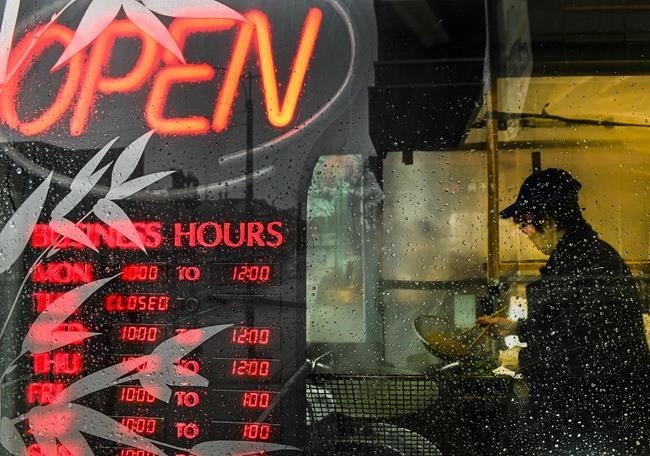
A chef cooks on a rainy fall day as a restaurant is open for curbside pickup during the COVID-19 pandemic in Toronto on Monday, November 30, 2020. THE CANADIAN PRESS/Nathan Denette

But many businesses still don’t qualify for federal government support as their operations aren’t fully locked down.

“Put frankly, tens of thousands of small firms across Canada will receive no support from governments while government restrictions dramatically reduce their ability to serve customers and public health warnings frighten many consumers into staying home,” the organizations wrote.

They asked the premiers to announce a new round of provincial small business grants and to pressure the federal government into bringing back wage and rent subsidies with the same eligibility requirements those relief programs had in spring.

The groups also want the Canada Emergency Business Account program reopened with a larger loan, a larger forgivable portion and delayed repayment requirements.

The groups want the government to make any new relief programs more accessible, so new firms can benefit and companies don’t have to meet the onerous terms once required.

Past terms kept businesses like Anita Agrawal’s from getting support.

The chief executive of Toronto jewelry manufacturer Jewels4Ever applied for rent relief, but didn’t qualify because her company saw a 66 per cent drop in business, just shy of the 70 per cent the government required.

Despite the lack of support, she kept her business running, but admits Omicron now has her staff afraid to come to work and has already hampered her reservations.

“On a regular day, we maybe have eight to 10 appointments, but because of COVID, we’ll have like two or three,” Agrawal said. “And now with Omicron, it’s even less, so it is a bit of a struggle.”

While Agrawal sees the need for small business owners to receive more support, she called on the provincial and federal governments to think about long-term solutions too.

High on her wish list is making commercial rent affordable because it is a massive portion of the business expenses companies have.

“We don’t have any caps in this province on how much your rent can increase,” she said, referencing Ontario.

She fears companies will have to consider cuts or closures once more if there is no sustainable rent relief and many won’t have anything left in their coffers to survive after previous waves of restrictions.

“I’m very worried about the next three months and what that means,” she said. “Stores are going to be closed again, possibly, or will have less traffic as a result of the Omicron variant and… that’s going to have an impact on all of us, because most people’s big priority won’t be to go out and spend money.”

This report by The Canadian Press was first published Dec. 21, 2021.

Report Error Submit a Tip

More Stories

Hydro reports $446-M loss in 2025-26, points to fourth drought year in past five

Scott Billeck 3 minute read Preview

Hydro reports $446-M loss in 2025-26, points to fourth drought year in past five

Scott Billeck 3 minute read Yesterday at 6:38 PM CDT

Manitoba Hydro posted a $446-million loss in 2025-26, as drought conditions slashed hydroelectric generation, forcing the Crown corporation to buy more power while leaving it with less electricity to sell outside the province.

The loss was $666 million worse than the $220-million profit Hydro had budgeted. The utility posted a $63-million loss the previous year, according to the utility’s annual report released Tuesday.

Hydro said the 2025-26 fiscal year, which ended on March 31, marked its fourth low-water year in the past five years, among the worst stretches of water-flow conditions in its recorded history.

Hydroelectric generation fell 23 per cent to 24 billion kilowatt-hours from 31 billion the previous year, leaving Hydro a net importer of electricity.

Read
Yesterday at 6:38 PM CDT

No dog? No problem Local program offers offices pup for a day

AV Kitching 4 minute read Preview

No dog? No problem Local program offers offices pup for a day

AV Kitching 4 minute read Saturday, Nov. 1, 2025

Brandt and Paisley are raring to start their new jobs.

They’ve passed their assessment tests, aced their personality evaluations, received all the relevant vaccinations and are getting ready to greet their colleagues at their respective places of employment.

But instead of hellos and handshakes, they’ll most likely be giving their co-workers tail wags and face licks. Not that anyone in the office will mind.

The doggie duo are part of Business Buddies, a new program from the city’s Animal Services Agency which sees canines in the facility spending the afternoon with local businesses.

Read
Saturday, Nov. 1, 2025

Night terrors

AV Kitching 7 minute read Preview

Night terrors

AV Kitching 7 minute read Monday, Oct. 20, 2025

Before we go any further, let me just unequivocally state: Six Pines is not for the weak.

I was so terrified my mind has effectively erased the entire experience.

I shall do my best to give you a comprehensive, cohesive review of the night my friend and I visited, but please forgive the lack of detail.

What you are about to read are snatches of memories, dragged kicking and screaming from the depths of my fear-addled brain, which is, even as I type, trying to block all attempts of retrieval.

Read
Monday, Oct. 20, 2025

Expert urges food, drink makers to look to foreign markets

Gabrielle Piché 5 minute read Preview

Expert urges food, drink makers to look to foreign markets

Gabrielle Piché 5 minute read Yesterday at 5:04 PM CDT

Canada’s slowing population growth could restrict business expansion, a top economist for Farm Credit Canada warned Manitoba manufacturers.

Craig Johnston, the federal Crown corporation’s chief economist, addressed Prairie businesses at Farm Credit Canada’s Food and Beverage Summit Tuesday.

“There could be some modest growth in Canadian consumption of food and beverage,” Johnston said, relaying population numbers inside a Victoria Inn Hotel conference room.

Still, per-person spending on food is “stagnant, if not somewhat rising,” Johnson later told reporters.

Read
Yesterday at 5:04 PM CDT

State of the Nations event to highlight Indigenous mining plans

Gabrielle Piché 3 minute read Preview

State of the Nations event to highlight Indigenous mining plans

Gabrielle Piché 3 minute read Monday, Sep. 28, 2026

A first-ever conference aims to connect Indigenous leaders with businesses as local mining ambitions grow.

The Manitoba Prospectors and Developers Association expects to rally a half-dozen chiefs to present on their communities’ mineral development projects.

The Nov. 16 event — called the State of the Nations — comes as the province promises to triple critical mineral production.

“We want to see those minerals being developed and being able to be exported,” said Renée Greyeyes, the prospectors association’s chief executive.

Read
Monday, Sep. 28, 2026

Plenty of losses all around

Gwynne Dyer 4 minute read Wednesday, Jul. 15, 2026

The last time oil-tankers were being shot up in the Persian Gulf, back in the 1980s, it was Saddam Hussein’s brutal tyranny in Iraq versus Ayatollah Khomeini’s revolutionary Islamist regime in Iran.

The United States backed Saddam because he was just another murderous thug, whereas the new regime in Tehran was an actual threat to American interests. It had overthrown Iran’s American-backed puppet king and wanted to spread its Islamist ideology across the region.

So, of course, Ronald Reagan’s administration chose Saddam’s side. It sent Iraq arms by clandestine means (because Congress wouldn’t authorize it) and even provided targeting information for Iraqi poison gas attacks on Iran. The Americans chose the “lesser evil,” but at least they knew it was evil.

Once in a while they would even say it out loud, quoting U.S. diplomat Henry Kissinger: “It’s a shame that both sides can’t lose.” But they never did anything about it, and after eight years of slaughter, the war ended in a no-score draw.