Industry warns of empty shelves as CN rail blockade reaches ninth day
Advertisement
Read this article for free:
or
Already have an account? Log in here »
To continue reading, please subscribe:
Digital Subscription
One year of digital access for only $1.44 a week*
- Enjoy unlimited reading on winnipegfreepress.com
- Read the E-Edition, our digital replica newspaper
- Access News Break, our award-winning app
- Play interactive puzzles
*Billed as $5.77 plus GST every four weeks. After 52 weeks, price increases to the regular rate of $19.95 plus GST every four weeks. Offer available to new and qualified returning subscribers only. Cancel any time.
To continue reading, please subscribe:
Add Free Press access to your Brandon Sun subscription for only an additional
$1 for the first 4 weeks*
- Enjoy unlimited reading on winnipegfreepress.com
- Read the E-Edition, our digital replica newspaper
- Access News Break, our award-winning app
- Play interactive puzzles
*Your next Brandon Sun subscription payment will increase by $1.00 and you will be charged $17.95 plus GST for four weeks. After four weeks, your payment will increase to $24.95 plus GST every four weeks.
Read unlimited articles for free today:
or
Already have an account? Log in here »
Hey there, time traveller!
This article was published 14/02/2020 (2453 days ago), so information in it may no longer be current.
MONTREAL – Industry players are warning governments that shortages of groceries, propane, drinking water and other goods are on the horizon as a rail blockade by anti-pipeline protesters enters its ninth day.
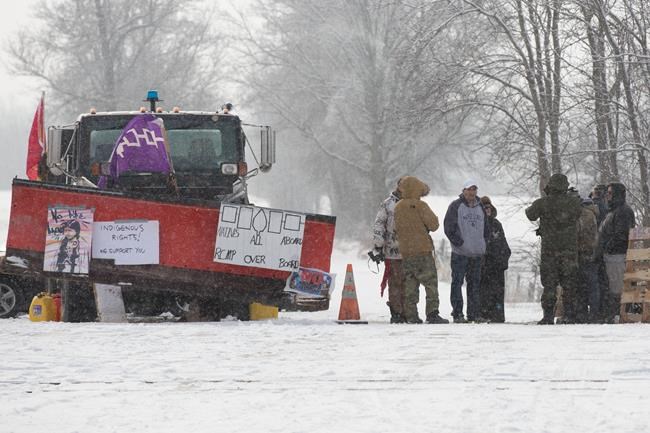
Demonstrators set up a blockade on Canadian National Rail Co. tracks near Belleville, Ont., on Feb. 6 after RCMP officers enforced an injunction against opponents of the Coastal GasLink pipeline project that crosses the traditional territory of the Wet’suwet’en First Nation in northwestern B.C.
Fresh food, personal hygiene products and baby formula are among the goods that could soon run out as halted railcars in the eastern half of the country clog CN’s network from coast to coast.
“It’s not like there’s 10,000 idled trucks sitting in some subterranean basement somewhere that can just be dusted off if there’s a rail stoppage. There’s just too much volume for that,” said Retail Council of Canada spokesman Karl Littler.
Canadian Propane Association CEO Nathalie St-Pierre says wholesalers in the Maritimes have already begun to ration distribution while truck line-ups for the fuel in Sarnia, Ont., are now up to 10 hours long as water treatment plants, hospitals, farmers and rural residents await more shipments.
Drinking water could also fall into short supply if chlorine for water treatment stays off the tracks, according to chemicals trade group Responsible Distribution Canada.
“If something doesn’t happen now, we’re going to start seeing municipalities in Ontario beginning to have boil-water advisories going out,” said president Cathy Campbell.
“This week it’s going to get very scary.”
Hand sanitizer, de-icing fluid for aircraft and chemicals used to coat cars and clean food processing equipment could prompt production line shutdowns, she said.
“It’s a little bit of everything,” said Avery Shenfeld, chief economist of CIBC Capital Markets.
He cautioned that layoffs could be imminent, with the broader impact bound to dent the economy unless a resolution is found soon. “If goods start piling up at ports and factories, we’re going to see production halts that would affect employment.”
Industries from manufacturing to fertilizer say they respect the right to peaceful protest but argue it’s time for federal and provincial governments to bridge the impasse or enforce injunctions obtained by CN.
“We do feel like we’re sort of getting sideswiped by a protest that pertains more to natural resources products than rail,” said the retail council’s Karl Littler.
Via Rail has cancelled all service on CN tracks in Canada, leaving only two northern routes open — between Sudbury and White River in Ontario and between Churchill and The Pas in Manitoba.
Prime Minister Justin Trudeau said Friday he has no plans to order the RCMP to end blockades of vital rail links across the country.
“We are not the kind of country where politicians get to tell the police what to do in operational matters,” Trudeau said Friday in Munich, where he was attending a global security conference.
Conservative Leader Andrew Scheer called on Trudeau Friday to order Public Safety Minister Bill Blair to use his authority under the RCMP Act to end what he called the “illegal blockades” by Indigenous Peoples at the centre of a dispute over a British Columbia pipeline project.
Early Friday morning, demonstrators lifted a rail blockade that was set up four days earlier on the line into Prince Rupert, B.C. reopening a key port.
First Nations leaders had suggested that would happen if federal and provincial politicians agreed to meet to discuss solutions to the ongoing dispute over construction of a natural gas pipeline through Wet’suwet’en traditional land.
The ongoing eastern network shutdown impedes mills’ ability to ship pulp, two-by-fours and wood panelling to the U.S. and beyond, said Forest Products Association of Canada CEO Derek Nighbor, who called the CN line a “critical artery.”
“For every train car that we use for pulp, it would take four trucks to move that same carload. For lumber it’s two trucks for every one train car,” Nighbor said.
Some mills are on the verge of suspending operations due to a lack of chemicals or fuel, while others are paying out of pocket for extra warehousing and truck transport, he said.
“You can’t just turn the tap on and things are back to normal again. If everything got resolved to day…we probably wouldn’t get empty railcars to our mills till mid- to late-week next week.”
Jean Simard, CEO of the Aluminium Association of Canada, said plants from Saguenay, Que., to Kitimat, B.C., are scrambling to find makeshift solutions for incoming and outgoing shipments.
“You have work out the delays and adapt your production, whether it’s tar, pitch or other types of products that normally come in on a regular basis,” he said.
The Association of Canadian Port Authorities says ports are beginning to turn away ships, with cargo rerouted to docks in the U.S. or less efficient truck transport at the risk of “long-lasting reputational damage.”
Canadian Federation of Agriculture president Mary Robinson says the backed-up rail lines are hampering producers’ ability to export commodities, warning of “huge financial consequences” as farmers do not get paid until products get to market.

“Rail service disruptions can also have negative impacts on animal welfare issues, as propane shipments are crucial to keeping barns heated during the winter months,” she said.
While the repercussions of the rail shutdown are negative for the vast majority of stakeholders, the closure of Via’s Ottawa-Toronto and Montreal-Toronto routes has proven to be a bonus for Porter Airlines, which said more passengers have booked flights between those cities over the past week as a result.
This report by The Canadian Press was first published Feb. 14, 2020.
Companies in this story: (TSX:CNR)
Note to readers: This is a corrected story. A previous version stated that the Ontario blockade began Feb. 9.
Related Articles
Ontario blockade stays put as police watch




Advertisement Advertise With Us
Advertisement Advertise With Us