Tim Hortons seeks to reclaim Canadian brand identity amid lukewarm sales

Advertisement

Advertise with us

Tim Hortons franchisees gathered in Calgary earlier this week and erupted into applause after corporate executives promised to help reframe the public's understanding that the chain is a Canadian company.

Read this article for free:


By clicking the button above, an account will be created and you will begin to receive some of our recommended newsletters. You may opt out of any newsletter by visiting your Email and Communication Preferences page or by clicking "unsubscribe" at the bottom of any email.

or

Already have an account? Log in here »

To continue reading, please subscribe:

Digital Subscription

One year of digital access for only $1.44 a week*

  • Enjoy unlimited reading on winnipegfreepress.com
  • Read the E-Edition, our digital replica newspaper
  • Access News Break, our award-winning app
  • Play interactive puzzles

*Billed as $5.77 plus GST every four weeks. After 52 weeks, price increases to the regular rate of $19.95 plus GST every four weeks. Offer available to new and qualified returning subscribers only. Cancel any time.

To continue reading, please subscribe:

Add Free Press access to your Brandon Sun subscription for only an additional

$1 for the first 4 weeks*

  • Enjoy unlimited reading on winnipegfreepress.com
  • Read the E-Edition, our digital replica newspaper
  • Access News Break, our award-winning app
  • Play interactive puzzles
Start now

*Your next Brandon Sun subscription payment will increase by $1.00 and you will be charged $17.95 plus GST for four weeks. After four weeks, your payment will increase to $24.95 plus GST every four weeks.

Hey there, time traveller!
This article was published 31/01/2020 (2464 days ago), so information in it may no longer be current.

Tim Hortons franchisees gathered in Calgary earlier this week and erupted into applause after corporate executives promised to help reframe the public’s understanding that the chain is a Canadian company.

Executives travelling the country to discuss its strategy for the new year have promised franchisees a directional shift that will see the chain reclaim its Canadian, coffee and doughnut roots, following years of sluggish sales, a frenzy of new products and multiple lawsuits between franchisees and their parent company.

“We’re as Canadian as you get,” said Tanya Doucette, a 42-year-old who owns eight Tim Hortons restaurants in Alberta with her husband and parents. She also serves on the company’s franchisee-elected advisory board.

People walk past the newly renovated Tim Hortons in Toronto on Thursday, July 25, 2019. THE CANADIAN PRESS/Nathan Denette

While Tim Hortons was born out of Canada, its history since then has crossed the 49th parallel.

Two Canadians, Ron Joyce and hockey pro Tim Horton, founded the chain in the 1960s and it opened its 1,000th restaurant in 1995.

Wendy’s International Inc. acquired it that year, and in 2014 U.S.- and Brazil-based 3G Capital merged it with Burger King under a new parent company, Restaurant Brands International. These changes sowed accusations from some that the company was no longer Canadian.

Prime Minister Justin Trudeau recently fuelled this fire when he visited Oh Doughnuts, a Winnipeg bakery, to pick up treats for some meetings. He shared the purchase on his Twitter account with the hashtag ShopLocal.

While some social media users reproached the federal leader for choosing a pricey shop over a Tim Hortons, others praised Trudeau for avoiding an internationally owned chain to support a small business.

“That makes me crazy,” said Doucette of suggestions her shops are not a local, Canadian business. That’s the sort of commentary she wants to rebuff and is happy to see executives eager to tackle.

Chief corporate officer Duncan Fulton acknowledges that franchisees aren’t happy that some consumers no longer view Tim Hortons as a Canadian company.

“We intend to start swinging back very hard everywhere that someone says that we’re not Canadian,” he said in an interview.

Restaurant Brands International is registered in Canada with a global head office in Toronto.

Three-quarters of the Tim Hortons leadership team is Canadian, as are its roughly 1,500 franchisees and some 100,000 employees.

“Everything about this company is Canadian,” said Fulton — even the ownership.

3G’s ownership share has fallen to 32 per cent recently, down from 51 per cent in 2014. Several Canadian owners fall within its top 20 shareholders, including Fidelity Investment Canada, the Royal Bank of Canada and Jarislowsky Fraser Ltd. But several large U.S. firms are also shareholders, including T.Rowe Price Associates Inc, Pershing Square Capital Management and Warren Buffett’s Berkshire Hathaway Inc.

The push to be seen as Canadian comes as the fast-food chain works to boost sales.

For its most recent quarter, Tim Hortons saw the key retail metric of comparable-store sales in Canada slip 1.2 per cent. The company is set to release its fourth-quarter and full-year results next month.

Tim Hortons plans to focus on elevating its staples: coffee, breakfast, baked goods and doughnuts, said Fulton.

It’ll continue to innovate, but in these core categories rather than the recent bevy of launches that included failures like plant-based protein burgers. In 2019, Tim Hortons launched nearly 60 new products, compared to its more traditional figure of half that. The limited-time offers created operational complexity and moved the company farther from its core offerings.

This report by The Canadian Press was first published Jan. 31, 2020.

Companies in this story: (TSX:QSR)

Report Error Submit a Tip

More Stories

World Indigenous Business Forum comes home to Winnipeg for first time, ponders questions for future prosperity

Aaron Epp 5 minute read Preview

World Indigenous Business Forum comes home to Winnipeg for first time, ponders questions for future prosperity

Aaron Epp 5 minute read Tuesday, Oct. 27, 2026

When Nicola Shirley-Phillips imagines what the Indigenous economy in her country might look like 100 years from now, she doesn’t mention social media or artificial intelligence. Instead, she envisions a holistic way of life where people work alongside each other in a way that cares for the planet.

“I see community (and) I see us being more respectful of all the energies around us — our water energy, our climate (and) the soil,” she said. “In all of that, there are opportunities for us to create businesses and opportunities to provide our services.”

Shirley-Phillips, a serial entrepreneur, organic farmer and community economic development specialist from Jamaica, shared her vision Tuesday morning during a panel discussion focused on Indigenous women and prosperity.

The discussion was one of the first items on the schedule during the first full day of the World Indigenous Business Forum at the RBC Convention Centre in Winnipeg.

Read
Tuesday, Oct. 27, 2026

Indigenous-, newcomer-focused job fair puts opportunity in spotlight

Gabrielle Piché 3 minute read Tuesday, Oct. 27, 2026

Canadian Armed Forces pamphlets grazed the side of Serena Valiquette’s ribbon skirt, as the Grade 9 student clutched the handouts tight.

“When I get to age, I’ll probably apply,” said Serena, 14, joining pockets of students hopping from booth to booth — City of Winnipeg here, Manitoba Public Insurance there — at a job fair in Winnipeg on Tuesday.

The job seekers, present and future, were largely Indigenous and newcomers. It was the demographic organizer Clayton Sandy aimed to attract.

“We have the ability to open doors for young people,” Sandy said. “This is one of the ways we use.”

Carrying a torch for tiki

Eva Wasney 5 minute read Preview

Carrying a torch for tiki

Eva Wasney 5 minute read Monday, Nov. 15, 2021

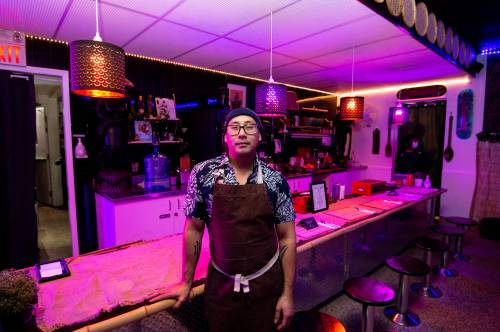
A paper tiki mask is the only indication that the door it’s affixed to leads somewhere other than a dive bar. Ring the doorbell and walk through the kitchen, however, and you’ll be transported to an island-themed lounge that’s equal parts kitschy and comfortable.

“This is just from people’s houses, like my mom’s,” says Allan Pineda, pointing to the wood carvings, water-buffalo horns and rattan furniture decorating the room. “A lot of the stuff you see in here, you’d see in a Filipino’s house back in the day — like second-wave immigrants in the ‘60s and ‘70s, they’d bring this stuff home (from the Philippines).”

Pineda is a local chef and part of the team behind the Bahay Kubo Tiki Bar, a pop-up Filipino drinking and dining experience hosted weekly at an undisclosed Winnipeg establishment.

The details are hush-hush because the temporary eatery is meant to operate like a speakeasy. The dinners are an offshoot of Baon Manila Nights, which Pineda started as a way to highlight Winnipeg’s Filipino culinary scene.

Read
Monday, Nov. 15, 2021

Hellebuyck’s numbers down, but problems go beyond crease

Andrew Berkshire 6 minute read Preview

Hellebuyck’s numbers down, but problems go beyond crease

Andrew Berkshire 6 minute read Friday, Dec. 7, 2018

After hitting a bit of a skid in the last couple weeks of November when they lost four of six games, the Jets have turned it around to win four straight heading into Friday’s matchup against the St. Louis Blues, averaging over four goals per game in the process.

They’ve needed that goal support because, outside of Tuesday’s win over the Islanders, they have allowed three or more against in seven of their last nine games. As it is any time a team allows a lot of goals over a short stretch, many are looking straight at Connor Hellebuyck and expecting him to shut the door, going forward.

Goaltending isn’t that simple, and as I mentioned in mid-November, there were signs this season that Hellebuyck’s performance so far this season was as good and in some ways superior to last season, despite the drop in save percentage.

Things change as time goes on though, and because Hellebuyck’s save percentage since then is an unimpressive 87.8 per cent, it’s probably worthwhile to look at his overall numbers to see what’s going on.

Read
Friday, Dec. 7, 2018

Transit driver killed in knife attack on U of M campus

8 minute read Preview

Transit driver killed in knife attack on U of M campus

8 minute read Tuesday, Feb. 14, 2017

A Winnipeg Transit driver was killed early this morning after he was stabbed by the only passenger on his bus at the University of Manitoba campus.

Irvine Jubal Fraser, 58, was rushed to hospital in critical condition but later died, police said.

The attack occurred at about 2 a.m. in the area of Dafoe Road West and Gillson Street.

Witnesses pointed officers led by the canine unit in the direction of the Red River, where a 22-year-old suspect trying to cross to the St. Vital side was arrested and taken into custody.

Read
Tuesday, Feb. 14, 2017

Moving past the Indian Act will take time and trust

Niigaan Sinclair 5 minute read Preview

Moving past the Indian Act will take time and trust

Niigaan Sinclair 5 minute read 4:52 PM CDT

If I had a dime for every time a politician has called for the “abolishment”of the Indian Act, I’d be a rich man.

OK, maybe I’d have enough coins to jingle loudly in my pocket.

My point: a Canadian leader calling for the end of the race-based law passed in 1867 that is designed to give the federal government broad and brutal control over First Nations governments, membership, and reserve land is nothing new.

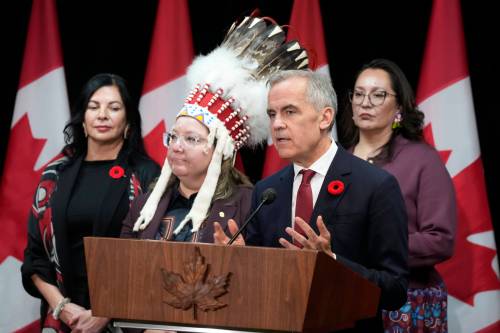
Premier Wab Kinew became the latest to advocate for this, during the First Nations-first ministers meeting in Ottawa this week.

Read
4:52 PM CDT