His Irish eyes are smiling

Winnipeg doctor, musician serious about promoting cultural traditions of his ancestral homeland

Advertisement

Advertise with us

"Never get one of those cheap tin whistles. It leads to much harder drugs like pipes and flutes."

Read this article for free:


By clicking the button above, an account will be created and you will begin to receive some of our recommended newsletters. You may opt out of any newsletter by visiting your Email and Communication Preferences page or by clicking "unsubscribe" at the bottom of any email.

or

Already have an account? Log in here »

To continue reading, please subscribe:

Digital Subscription

One year of digital access for only $1.44 a week*

  • Enjoy unlimited reading on winnipegfreepress.com
  • Read the E-Edition, our digital replica newspaper
  • Access News Break, our award-winning app
  • Play interactive puzzles

*Billed as $5.77 plus GST every four weeks. After 52 weeks, price increases to the regular rate of $19.95 plus GST every four weeks. Offer available to new and qualified returning subscribers only. Cancel any time.

To continue reading, please subscribe:

Add Free Press access to your Brandon Sun subscription for only an additional

$1 for the first 4 weeks*

  • Enjoy unlimited reading on winnipegfreepress.com
  • Read the E-Edition, our digital replica newspaper
  • Access News Break, our award-winning app
  • Play interactive puzzles
Start now

*Your next Brandon Sun subscription payment will increase by $1.00 and you will be charged $17.95 plus GST for four weeks. After four weeks, your payment will increase to $24.95 plus GST every four weeks.

Opinion

Hey there, time traveller!
This article was published 28/04/2012 (5308 days ago), so information in it may no longer be current.

“Never get one of those cheap tin whistles. It leads to much harder drugs like pipes and flutes.”

— Unknown

TREVOR HAGAN / WINNIPEG FREE PRESS 
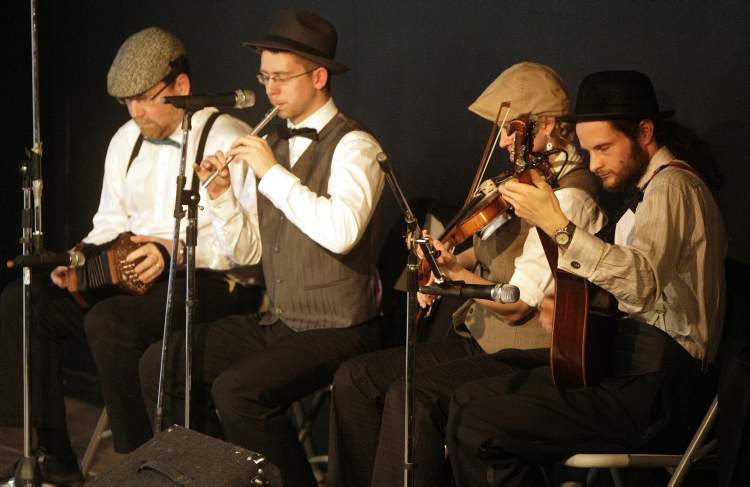
David Strang (from left), Kyle Borley, Cathy Rayner and D'Arcy Stearns of The Barefoot Ceili Band:
TREVOR HAGAN / WINNIPEG FREE PRESS David Strang (from left), Kyle Borley, Cathy Rayner and D'Arcy Stearns of The Barefoot Ceili Band: "It's happy music. It's hard not to tap your foot along."

David Strang is glad he never took the advice from that famous anonymous quote, although it’s partly true in his case.

The whistle was a musical gateway drug, of sorts, for the president of the Winnipeg chapter of Comhaltas (pronounced coal-tis), one that led down a path to the concertina, a hand-held, bellows-driven instrument similar to a button accordion.

He plays the instrument in two different traditional Irish ceili bands — the Flatland Ceili Band and the Barefoot Ceili Band — that play regularly around town at different events, jams and sessions with people hooked on other instruments such as the Uilleann pipes, bodhran, guitar and fiddle.

“I’ve just always loved all sorts of music. I don’t know what it is; that’s how I’m wired,” Strang says.

“I’ve always liked the traditional music. The folk festival was my exposure to it. I’m told my maternal grandfather played the fiddle as well, so there’s probably something genetic about it.”

The 50-year-old doctor’s love of traditional music from the Emerald Isle led to his involvement in the local chapter of Comhaltas, which aims to promote Irish culture in the areas of music, dance and language.

The organization was founded in Ireland in 1951 and now boasts 400 branches and 75,000 members around the world. The Winnipeg group was founded 25 years ago by Irish expats. These days, most members of the volunteer non-profit organization were born here but share a love of the culture, from the music to Guinness beer.

“People get enthusiastic about it. They want to share the word and spread it to people to keep the traditions alive. The people that are in Comhaltas all love this kind of music. We like to play it and find other people that like to play it. It’s happy music. Jigs and reels are all pretty catchy. It’s hard not to tap your foot along. It’s all dance music,” Strang says.

The bands sometimes, but not always, perform with dance groups, including the McConnell School of Dance and local set-dancing groups, which differs from the more famous step-dancing (Riverdance) by being more like square dancing, with four couples dancing together, performing different figures and sets.

Comhaltas organizes regular set-dancing nights at Riverview Elementary School and a drop-in music night at Sam’s Place bookstore and café on Henderson Highway the last Friday of every month.

They tried to organize Gaelic lessons but couldn’t get enough members to hold a regular quorum, Strang says.

Comhaltas’ most well-known event is the annual Irish Fest, which takes place every October and includes concerts at the Irish Club and the West End Cultural Centre, along with workshops at Gordon Bell High School.

This year, the parent Comhaltas chapter in Dublin will send its touring music group to Winnipeg for the Oct. 12 and 13 festivities, which will be a boon for lovers of authentic traditional music, Strang says.

“I think all these traditional cultures are valuable. They do go in cycles or waves. If you don’t watch out, in a downturn you lose it, and once it’s gone, it’s gone. Traditionally, it was by aural tradition — people learned tunes by ear. It’s only in the last century people have started writing it down,” he says.

To help get Irish Fest off the ground, Comhaltas started a fundraiser called Reels on Wheels, featuring three bands playing at three different houses. The bands play three sets a night and the crowd moves from house to house during the course of the evening, catching music everywhere they go. By the end of the night, every participant has seen a set from each of the bands. “It’s like a progressive dinner party,” Strang says.

Information about the event will be posted online at the group’s website, comhaltaswinnipeg.ca

rob.williams@freepress.mb.ca

Report Error Submit a Tip

More Stories

Students report inappropriate behaviour by The King’s School teacher

Maggie Macintosh 6 minute read Preview

Students report inappropriate behaviour by The King’s School teacher

Maggie Macintosh 6 minute read Thursday, Jun. 2, 2022

Current and former students at The King’s School say a male teacher, who has been put on leave amid an investigation, overstepped boundaries by massaging them, disclosing intimate secrets to teenagers, and asking deeply personal questions in return — including the status of their relationships with their fathers.

One Grade 12 student at the independent Winnipeg school, which is run in partnership with Gateway Church and partially funded by the provincial government, said she immediately noticed the educator’s inappropriate behaviour when she enrolled.

“It just didn’t sit right with me,” she told the Free Press.

The student described the educator’s conduct as “intimate.” He offered what he called “fatherly hugs” and asked teenage girls, herself included, about what their relationship with their fathers was like, she said.

Read
Thursday, Jun. 2, 2022

It’s not about bikes, it’s about openness

Russ Wyatt 5 minute read Preview

It’s not about bikes, it’s about openness

Russ Wyatt 5 minute read Tuesday, Jul. 14, 2015

Contrary to what's been written, I am a big fan of active transport (AT) (Give cycling, walking plan green light, June 11). I have worked with my community over the last 10 years to build a dedicated AT network that is now more than 15 kilometres and hopefully growing. It is therefore disappointing not being able to support the existing proposed policy.

Following the last election, the first time non-executive policy committee members heard about the report was on Jan. 23, when we received an email from Bike Winnipeg asking us to vote for the report. This was very interesting, because we had not received any report, yet clearly the bike lobby had, or at least was aware of its contents. Following this, I contacted the mayor's chief of staff who assured me no report was complete.

On Feb. 19, a council seminar was held and no report recommendations were provided. Around this time, I made a point of meeting with the director of public works who assured me I would have input into the report, especially when it came to the Transcona ward.

This never occurred.

Read
Tuesday, Jul. 14, 2015

Canadians right to be leery of AI data centres

Simon Enoch 4 minute read Yesterday at 2:01 AM EST

At the beginning of this year, like most Canadians, I would have been unable to explain what a hyperscale AI data centre is — a sprawling, energy-guzzling facility used for AI training and operations.

That changed in March, when Bell announced its plan to construct the largest AI data centre of its kind just outside of Regina, where I live. Public reaction was a mixture of confusion and concern.

But while most Canadians were still wondering how to respond, those in the know were pointing to protests in the United States, where the data-centre building boom was provoking a countrywide community backlash.

Down south, fears that soaring electricity rates, water scarcity and constant noise would leave communities bearing the cost, mixed with a general anxiety about AI and its impacts, were turning communities against data centres.

One year after EF4-scale tornado, Alonsa is still picking up pieces

Jessica Botelho-Urbanski 7 minute read Preview

One year after EF4-scale tornado, Alonsa is still picking up pieces

Jessica Botelho-Urbanski 7 minute read Friday, Jul. 19, 2019

ALONSA – Jimmy Bruce crouches to scoop up a hunk of rusty tin from the beach. It’s one of hundreds, if not thousands, of pieces of the community that washed ashore on Margaret Bruce Beach in the past year.

The roughly quarter-mile stretch of sand along Lake Manitoba was named after Bruce’s grandmother.

Since a tornado ripped through on Aug. 3, 2018, his family’s campground and beach were left in pieces. He and wife Christel are trying to rebuild.

The trouble is, they’ve already sunk at least $100,000 into the property, rerouting hydro lines to every campsite, replanting trees and setting up sheds.

Read
Friday, Jul. 19, 2019

A real Christmas present — no gifts

Jen Zoratti 9 minute read Preview

A real Christmas present — no gifts

Jen Zoratti 9 minute read Friday, Nov. 29, 2019

The holidays are supposed to be a time of eat, drink and be merry. So why do they often feel like a time to eat, cry, and be stressed?

There’s a lot of expectation around this time of year, especially when it comes to gift-giving. Whether you’re working as a secret Santa or actual Santa, there’s real pressure to give the perfect gift — and get into credit card debt doing it. And for those who can’t put a pile of presents under a twinkling tree, the pressure is even more painful.

And then there’s the matter of waste. The endless Amazon packages that are then wrapped up in shiny, unrecyclable paper. The appreciated but unwanted knick-knacks and tchotchkes that end up in closets. The plastic toys that are eschewed by toddlers for the boxes they came in.

The whole process can end up being a joy-suck, which is why many people are rethinking their approach to gift-giving — or opting out of it entirely.

Read
Friday, Nov. 29, 2019

Throne speech offers glimpse of PCs’ priorities

Shannon Sampert 5 minute read Preview

Throne speech offers glimpse of PCs’ priorities

Shannon Sampert 5 minute read Thursday, Nov. 22, 2018

Throne speeches are more than just pomp and circumstance and the opportunity for selfies between political rivals on the beautiful marble floors of the Manitoba legislature building on Broadway. They set the agenda for the legislative session and set the tone for the government as it moves into its new session. Looked at carefully, they also reveal the priorities of the government by what is said, and also what is not said.

But they are also highly symbolic. They are delivered by the lieutenant-governor of the province, who acts as the symbol of the head of state, the Queen, but they are written by speechwriters for the government of the day.

Political scientists have studied the throne speeches delivered at the federal level to understand the thematic commonalities and what they say about nationalism over the past 30 years. Janine Brodie of the University of Alberta, for example, determined that Canadian throne speeches delivered before the 2000s embraced a more neo-liberal tone that was tied to the global economy.

After 2000, an analysis by Tim Nieguth (Laurentian University) and Tracey Raney (Ryerson University) found that Conservative throne speeches tended to focus on neo-conservative themes — emphasizing the family, the military and threats to security — while Liberals’ speeches talked about health care and Indigenous issues.

Read
Thursday, Nov. 22, 2018