Child hunger a major concern as Canadians hit by soaring food prices

Advertisement

Advertise with us

TORONTO - Skipping the occasional meal has become the norm for Tara Andrews, who says soaring grocery prices have made it too hard to adequately feed herself and her two teens.

Read this article for free:


or

Already have an account? Log in here »

To continue reading, please subscribe:

Subscribe and receive a limited-edition Free Press branded hat or tote.

Digital Subscription

One year of digital access for only $205*

  • Enjoy unlimited reading on winnipegfreepress.com
  • Read the E-Edition, our digital replica newspaper
  • Access News Break, our award-winning app
  • Play interactive puzzles

*First annual payment billed as $205.00 + GST for one year. This annual subscription will automatically renew at $233.00 + GST every 52 weeks (10% off the regular annual price of $259.35). Offer available to new and qualified returning subscribers only. Cancel any time.

To continue reading, please subscribe:

Add Free Press access to your Brandon Sun subscription for only an additional

$1 for the first 4 weeks*

  • Enjoy unlimited reading on winnipegfreepress.com
  • Read the E-Edition, our digital replica newspaper
  • Access News Break, our award-winning app
  • Play interactive puzzles
Start now

*Your next Brandon Sun subscription payment will increase by $1.00 and you will be charged $17.95 plus GST for four weeks. After four weeks, your payment will increase to $24.95 plus GST every four weeks.

Hey there, time traveller!
This article was published 23/06/2022 (1565 days ago), so information in it may no longer be current.

TORONTO – Skipping the occasional meal has become the norm for Tara Andrews, who says soaring grocery prices have made it too hard to adequately feed herself and her two teens.

Even with help from food donations and her retired parents, the 49-year-old single mom says the skyrocketing cost of living is more than she can handle on her monthly income of $1,200. She’s already one month in arrears for May’s rent and expects the same for June.

“My grocery bill has almost doubled and I get maybe half of what I used to be able to get. It’s a direct relationship that the more expensive things get, the less I can afford to buy,” Andrews says from her home in Coquitlam, B.C.

Tara Andrews of Coquitlam, B.C., is shown in this undated handout image provided June 23, 2022. Skipping the occasional meal has become the norm for Tara Andrews, who says soaring grocery prices have made it too hard to adequately feed herself and her two teens. Even with help from food donations and a charity, the 49-year-old single mom says the skyrocketing cost of living is more than she can handle. THE CANADIAN PRESS/HO-Tara Andrews **MANDATORY CREDIT**

It’s a familiar story for various agencies dedicated to addressing food insecurity, with the head of Food Banks Canada saying many families with children are especially precarious as school-based food programs wind down.

Kirstin Beardsley says about a third of people who rely on Canadian food banks are children — as many as up to 400,000 each month. The agency says food bank use is rising among single-parent families.

“These are kids who are not getting a chance to thrive. And that has long-term impact on the country,” says Beardsley.

“You can’t lose sight of the fact that kids don’t get another childhood, they can’t do this over. This is their one chance and you need to make sure that we’re giving everyone the opportunity they need to build the life that they want.”

This summer, Food Banks Canada hopes to bump up the summer food packs it offers kids to 175,000 — up 25,000 from last year and many times over the 700 inaugural packs of 2015.

In Toronto, the head of the Daily Bread Food Bank also says requests for aid have spiked as inflation reached a nearly four-decade high.

Neil Hetherington says his agency is seeing roughly 160,000 client visits per month — up from about 120,000 per month in January. He says modelling the organization has done with CIBC predicts that to rise to 200,000 client visits per month in December.

He says counterparts across the country tell him of similar spikes, with many reporting a 20 to 30 per cent jump in demand.

While many of these visitors have been on the margins for years, Hetherington says he’s also seeing new faces who otherwise have never turned to food charities, pegging the surge to a confluence of soaring food prices, gas prices, housing costs and ongoing labour uncertainty in some sectors.

“We are seeing individuals who are working but their paycheque is not keeping pace with the cost of being able to drive to their place of employment, or be able to feed their children. They are increasingly worried about what they are seeing and (about) being able to put food on the table,” says Hetherington.

Back in British Columbia, Andrews says things would be much worse for her without the subsidy for her three-bedroom apartment, which brings rent down to $540 per month.

But she says pre-existing financial woes deepened during the pandemic and have only gotten worse in 2022 as inflation also drove up the cost of gas and utilities.

She’s also saddled with $150,000 in school loans but can only cover the interest.

“I’m luckier than some because I live in housing so it’s subsidized but still you’ve got all the bills that go with it to keep the house running. Then there’s the food on top of it,” she says.

“I’m making enough to cover my bills and really not to afford food. That’s really what it comes down to.”

Among the organizations Andrews relies on is the North Vancouver-based Backpack Buddies, which supplies weekend meals to kids who need help getting fed between the time school ends Friday afternoon and resumes Monday morning.

The program expanded to summer months during the pandemic and will grow even more this summer, says co-executive director Emily-anne King.
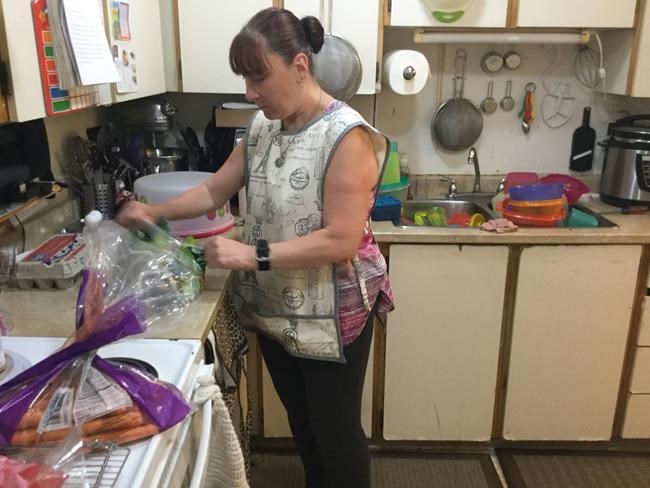
Tara Andrews is seen at her home in Coquitlam, B.C., in this handout image provided June 23, 2022. Skipping the occasional meal has become the norm for Tara Andrews, who says soaring grocery prices have made it too hard to adequately feed herself and her two teens. Even with help from food donations and a charity, the 49-year-old single mom says the skyrocketing cost of living is more than she can handle. THE CANADIAN PRESS/HO-Tara Andrews  **MANDATORY CREDIT**
Tara Andrews is seen at her home in Coquitlam, B.C., in this handout image provided June 23, 2022. Skipping the occasional meal has become the norm for Tara Andrews, who says soaring grocery prices have made it too hard to adequately feed herself and her two teens. Even with help from food donations and a charity, the 49-year-old single mom says the skyrocketing cost of living is more than she can handle. THE CANADIAN PRESS/HO-Tara Andrews **MANDATORY CREDIT**

“We kind of were hoping that the beginning of COVID in March of 2020 and those following six months would be the height of demand for services like ours but we are seeing more demand today than we ever have,” says King.

She says they’ve recently added 500 more recipients in communities including lower Similkameen, Saltspring Island, and the village of Lytton, devastated by last year’s wildfire. They expect to help about 2,100 kids a week this summer.

Demand surges as the annual inflation rate rises faster than it has since 1983, with Statistics Canada announcing Wednesday that the consumer price index in May was up 7.7 per cent compared to a year ago.

That has many bracing for more interest rate hikes to control inflation. The Bank of Canada already raised its key target three times this year.

Statistics Canada said in May the price of groceries rose nearly 10 per cent from the previous year, matching the April jump. The cost of fresh vegetables rose 10 per cent, while the largest increase on record involved edible fats and oils at 30 per cent.

As prices continue to rise, food policy expert Valerie Tarasuk of the University of Toronto says things will only get worse for 5.8 million Canadians believed to be food insecure, among them about 1.4 million children.

While that pool may grow larger this year, she’s most concerned about already suffering Canadians who will sink further unless income support programs increase in tandem with rising costs.

“Things are going to get a lot worse before they get better. And I think with each one of these reports, I hope that our political leaders are feeling more and more pressure to rethink what they’re doing at the bottom end,” says Tarasuk.

“We don’t need little one-off cheques. They’re not going to be enough to make this go away. We need policies that are actually enduring and that means things like indexation.”

The Bank of Canada has said it’s prepared to “act more forcefully” to reel in inflation, leading some economists to suspect rates could increase by three-quarters of a percentage point next month, matching the U.S. Federal Reserve move last week.

For Canadians who are already overextended, Hetherington says a one or two per cent increase on monthly mortgage or loan repayments could be significant.

“I see on a daily basis children excited to be at the food bank, shopping for the food that they need,” says Hetherington.

“They’re thrilled to be with their parents shopping at a food bank and it breaks your heart. It is absolutely wrong that that is happening in our country.”

This report by The Canadian Press was first published June 23, 2022.

Report Error Submit a Tip

More Stories

Alex Jones concedes Sandy Hook attack was ‘100% real’

Jim Vertuno, The Associated Press 6 minute read Preview

Alex Jones concedes Sandy Hook attack was ‘100% real’

Jim Vertuno, The Associated Press 6 minute read Wednesday, Aug. 3, 2022

AUSTIN, Texas (AP) — For years, bombastic far-right conspiracy theorist Alex Jones ranted to his millions of followers that the 2012 Sandy Hook Elementary School shooting was a hoax, that children weren’t killed and that parents were crisis actors in an elaborate ruse to force gun control.

Under oath and facing a jury that could hit him with $150 million or more in damages for his false claims, Jones said Wednesday he now realizes that was irresponsible and believes that what happened in the deadliest school shooting in American history was “100% real.”

Jones’ public contrition came on the final day of testimony in a two-week defamation lawsuit against him and his Austin-based media company, Free Speech Systems, brought by Neil Heslin and Scarlett Lewis, the parents of 6-year-old Jesse Lewis. Their son was a first grader who was among the 20 students and six teachers killed at the school in Newtown, Connecticut, on Dec. 14, 2012.

“I unintentionally took part in things that did hurt these people’s feelings,” said Jones, who also acknowledged raising conspiracy claims about other mass tragedies, from the Oklahoma City and Boston Marathon bombings to the mass shootings in Las Vegas and Parkland, Florida, “and I’m sorry for that.”

Read
Wednesday, Aug. 3, 2022

The freedom to create can be a balm for the soul

Deborah Schnitzer 5 minute read 2:01 AM CDT

My mother-in-law, Malka, came to Toronto in 1958 from postwar Poland. She came with unbearable losses authored by the Third Reich fascist fantasies that had destroyed her world.

She suffered the murder of her husband and second child, a newborn. She endured a hatred of her very being that defies reason and reckoning, yet she came, nonetheless, with profound wits about her and a courage groomed by the black market in Siberia where she somehow kept her first-born toddler alive by placing her in an unlit closet where the child would be safe while Malka bartered for food.

After the war, she married a survivor whose wife and children and been exterminated. Together, they had a son; I married that son, his story and the longest hatred it embodied.

Even given the profound and forbidding ugliness of the world Malka fled, she somehow created, in her third act, a single piece of art she found beautiful.

City, province, Ottawa strike task force to battle meth

Jessica Botelho-Urbanski 5 minute read Preview

City, province, Ottawa strike task force to battle meth

Jessica Botelho-Urbanski 5 minute read Tuesday, Dec. 18, 2018

The city, province and federal governments are teaming up to create a tri-level task force that will fight distribution of illicit drugs and address the root causes of the province's meth crisis.

"As far as we know, this is the first collaborative initiative like this in the country and it’s something that I’m very proud to be a part of," said Winnipeg Mayor Brian Bowman, who had been calling for such a task force (with unanimous council support) since September. 

In interviews last week, officials from the three levels of government told the Free Press they hadn't yet met in the same room to discuss the surge in meth-related problems.

By Tuesday, it seems they managed to clear their schedules.

Read
Tuesday, Dec. 18, 2018

Canadian labour market still tight as economy sees slight bump in employment

Nojoud Al Mallees, The Canadian Press 5 minute read Preview

Canadian labour market still tight as economy sees slight bump in employment

Nojoud Al Mallees, The Canadian Press 5 minute read Friday, Oct. 7, 2022

OTTAWA - After sustaining three consecutive months of job losses and propelling fears of an economic slowdown, the Canadian economy posted a modest bump in employment in September, suggesting the labour market is still exceptionally tight.

The unemployment rate for the month fell to 5.2 per cent as fewer people looked for work, down from 5.4 per cent in August, Statistics Canada reported in its labour force survey released on Friday. Meanwhile,the economy added 21,000 jobs.

Economists say the latest jobs report shows employers are still eager to hire, and wages are growing accordingly.

The report showed wages were up by 5.2 per cent in September compared with a year ago, with the average hourly wage at $31.67. It marked the fourth straight month of five per cent or higher wage growth, but still falls short of the rate of inflation.

Read
Friday, Oct. 7, 2022

Letters, Oct. 5

7 minute read 2:01 AM CDT

Fighting the good fight

Re: Transit, roads and city council’s priorities (Oct. 2)

Many thanks to Erna Buffie for once again speaking up for transit.

When will Winnipeg finally make the shift from a car-dependent culture to a greener and more efficient way?

Thank Manitoba’s teachers by investing in students

Lillian Klausen 5 minute read 2:00 AM CDT

Manitoba’s students are settling into a new school year. Whether you graduated in 1986 or 2006, today’s classrooms look very different from the ones you remember.

Students reflect the changing makeup of our communities — differences in social, emotional, physical and cognitive abilities and socioeconomic stresses are all increasingly present and adding to the complexity of our classrooms.

Meeting these differing individual needs is no easy feat. It requires manageable class sizes, school counsellors, social workers, specialized resource teachers and investment in the systems that can help students thrive. But when those supports aren’t available, students’ needs don’t disappear. Increasingly, it falls to classroom teachers to try to fill the gaps.

When I started working as a teacher more than 30 years ago, we had budgets for resources when we needed them. Today, the needs of students have diversified and increased, but the funding for our public schools is failing to meet them.