Soviet Union’s downfall chronicled in vivid narrative
Advertisement
Read this article for free:
or
Already have an account? Log in here »
To continue reading, please subscribe:
Digital Subscription
One year of digital access for only $1.44 a week*
- Enjoy unlimited reading on winnipegfreepress.com
- Read the E-Edition, our digital replica newspaper
- Access News Break, our award-winning app
- Play interactive puzzles
*Billed as $5.77 plus GST every four weeks. After 52 weeks, price increases to the regular rate of $19.95 plus GST every four weeks. Offer available to new and qualified returning subscribers only. Cancel any time.
To continue reading, please subscribe:
Add Free Press access to your Brandon Sun subscription for only an additional
$1 for the first 4 weeks*
- Enjoy unlimited reading on winnipegfreepress.com
- Read the E-Edition, our digital replica newspaper
- Access News Break, our award-winning app
- Play interactive puzzles
*Your next Brandon Sun subscription payment will increase by $1.00 and you will be charged $17.95 plus GST for four weeks. After four weeks, your payment will increase to $24.95 plus GST every four weeks.
Read unlimited articles for free today:
or
Already have an account? Log in here »
The tumultuous politics of the final years of the Soviet Union, 1985 to 1991, are recounted by British academic historian Robert Service in a vivid, intense narrative.
Central to Service’s depiction of this period is the botched coup of August 1991. A coterie of plotters, dissatisfied with the rule of Soviet president Mikhail Gorbachev, sought to oust him from power. But the attempted coup was ill-advised and only accelerated the demise of the Soviet Union — the opposite of what the plotters wanted.
The most interesting aspect of The August Coup is Service’s account of the personality and policies of Gorbachev and his nemesis, Russian leader Boris Yeltsin (Russia was the largest of the constituent republics of the former Soviet Union).
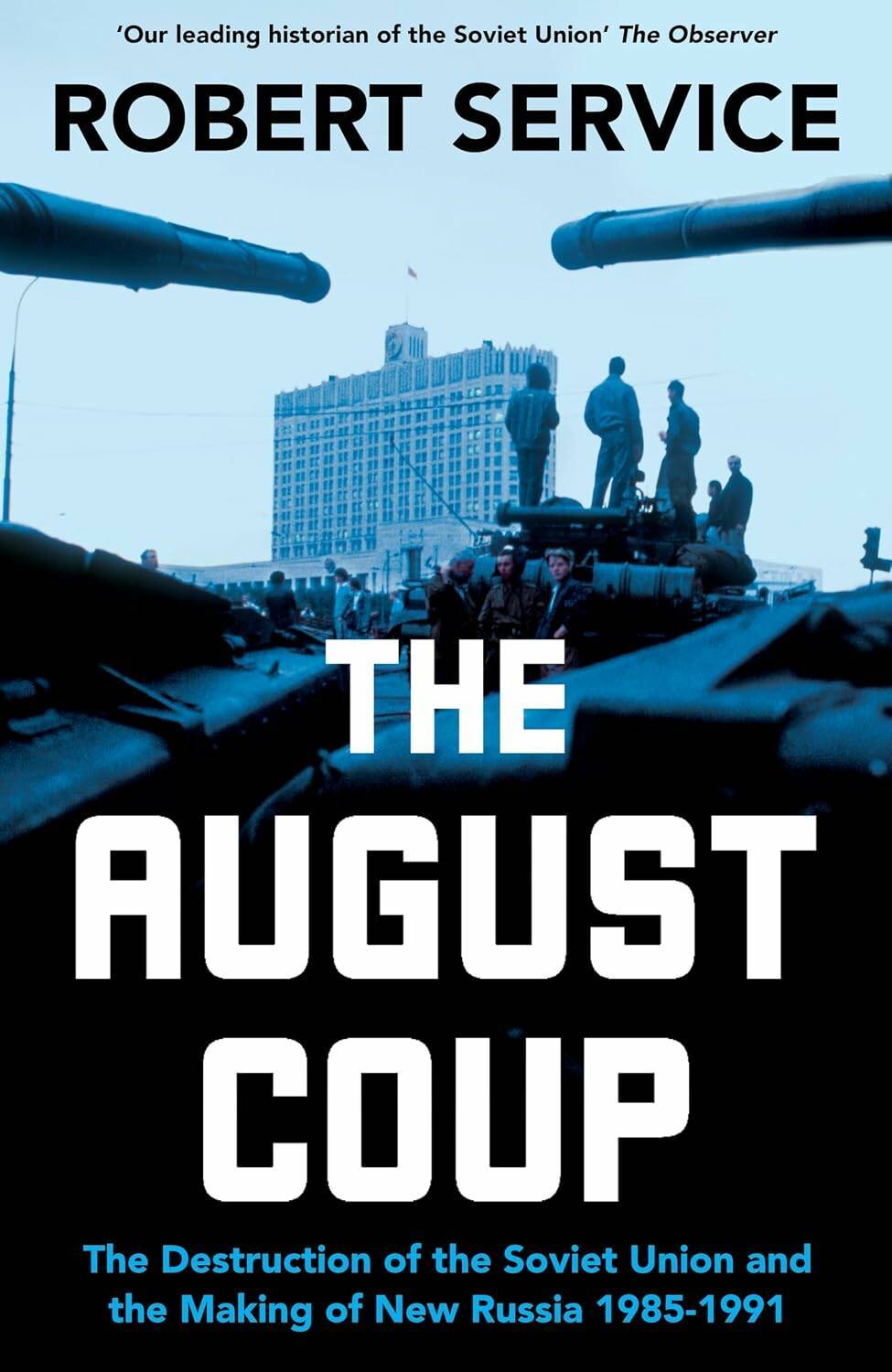
The August Coup
When he assumed power as general secretary of the Communist Party of the Soviet Union in 1985, Gorbachev sought to remake what had become an ossified political and economic system.
He embarked on a massive project of reform, epitomized by the slogans “glasnost” (media openness) and “perestroika” (reconstruction).
Overturning decades of communism, Gorbachev ended one-party rule, allowed dissent and released political prisoners. Religious liberties were introduced. And steps were taken to effect a gradual liberalization of the economy.
Yet Gorbachev, Service writes, was a paradox. Despite his project of reform, he never abandoned his commitment to Marxist-Leninist ideology. He believed that he was building “communism with a human face.” And he was certain his brand of communism would triumph over capitalism and liberal democracy.
Perhaps most anomalously, his political hero was Vladimir Lenin, the Russian revolutionary leader whose rule was characterized by terror and dictatorship.
Gorbachev’s economic reforms were unsuccessful. As Service says, “the government’s priorities resulted in a little economic improvement followed by much deterioration.” He failed to deliver better living conditions for the ordinary person; instead there was inflation and food shortages. The Soviet people became disenchanted with Gorbachev.
Exploiting this discontent was Boris Yeltsin, a major figure in Russian politics.

Yeltsin was often seen as an unintelligent oaf and bumbling drunk. But Service has a more sympathetic view of the former Russian president.
Yeltsin, Service writes, showed courage in rejecting Marxism-Leninism when it was still the official ideology. He read widely and denounced totalitarianism.
However, Yeltsin’s economic reforms, like Gorbachev’s, only enriched a few, and exacerbated material inequalities.
Service has written a magnificent narrative detailing the dissolution of the Soviet Union, focusing on the roles of Gorbachev and Yeltsin in these historic events.
Graeme Voyer is a Winnipeg writer.