WEATHER ALERT

Banff bison brought back from the brink of extinction

Advertisement

Advertise with us

There were some in Winnipeg who swear they saw buffalo roaming their city streets during the memorable 1966 blizzard in March that smothered both cars and commuters and brought everything to a snow-filled standstill.

Read this article for free:


or

Already have an account? Log in here »

To continue reading, please subscribe:

Subscribe and receive a limited-edition Free Press branded hat or tote.

Digital Subscription

One year of digital access for only $205*

  • Enjoy unlimited reading on winnipegfreepress.com
  • Read the E-Edition, our digital replica newspaper
  • Access News Break, our award-winning app
  • Play interactive puzzles

*First annual payment billed as $205.00 + GST for one year. This annual subscription will automatically renew at $233.00 + GST every 52 weeks (10% off the regular annual price of $259.35). Offer available to new and qualified returning subscribers only. Cancel any time.

To continue reading, please subscribe:

Add Free Press access to your Brandon Sun subscription for only an additional

$1 for the first 4 weeks*

  • Enjoy unlimited reading on winnipegfreepress.com
  • Read the E-Edition, our digital replica newspaper
  • Access News Break, our award-winning app
  • Play interactive puzzles
Start now

*Your next Brandon Sun subscription payment will increase by $1.00 and you will be charged $17.95 plus GST for four weeks. After four weeks, your payment will increase to $24.95 plus GST every four weeks.

There were some in Winnipeg who swear they saw buffalo roaming their city streets during the memorable 1966 blizzard in March that smothered both cars and commuters and brought everything to a snow-filled standstill.

What they really saw in the blizzard were police officers in their marvellous 11-kilogram buffalo coats helping people survive. (If police were chasing someone on foot, they’d throw off the coat and let somebody return it for a finder’s fee. Winnipeg Police stopped using buffalo coats in the early 1970s.)

This anecdote isn’t in Karsten Heuer’s Buffalo Lessons, but it helps illustrate our kinship with a wild animal that used to carpet the Canadian Prairies, as lovingly described by Heuer in the saga of an animal that covered much of North America, like wall-to-wall shag carpet, until early settlers from Europe just about wiped all of them out. They were as close to extinction as the carrier pigeon.
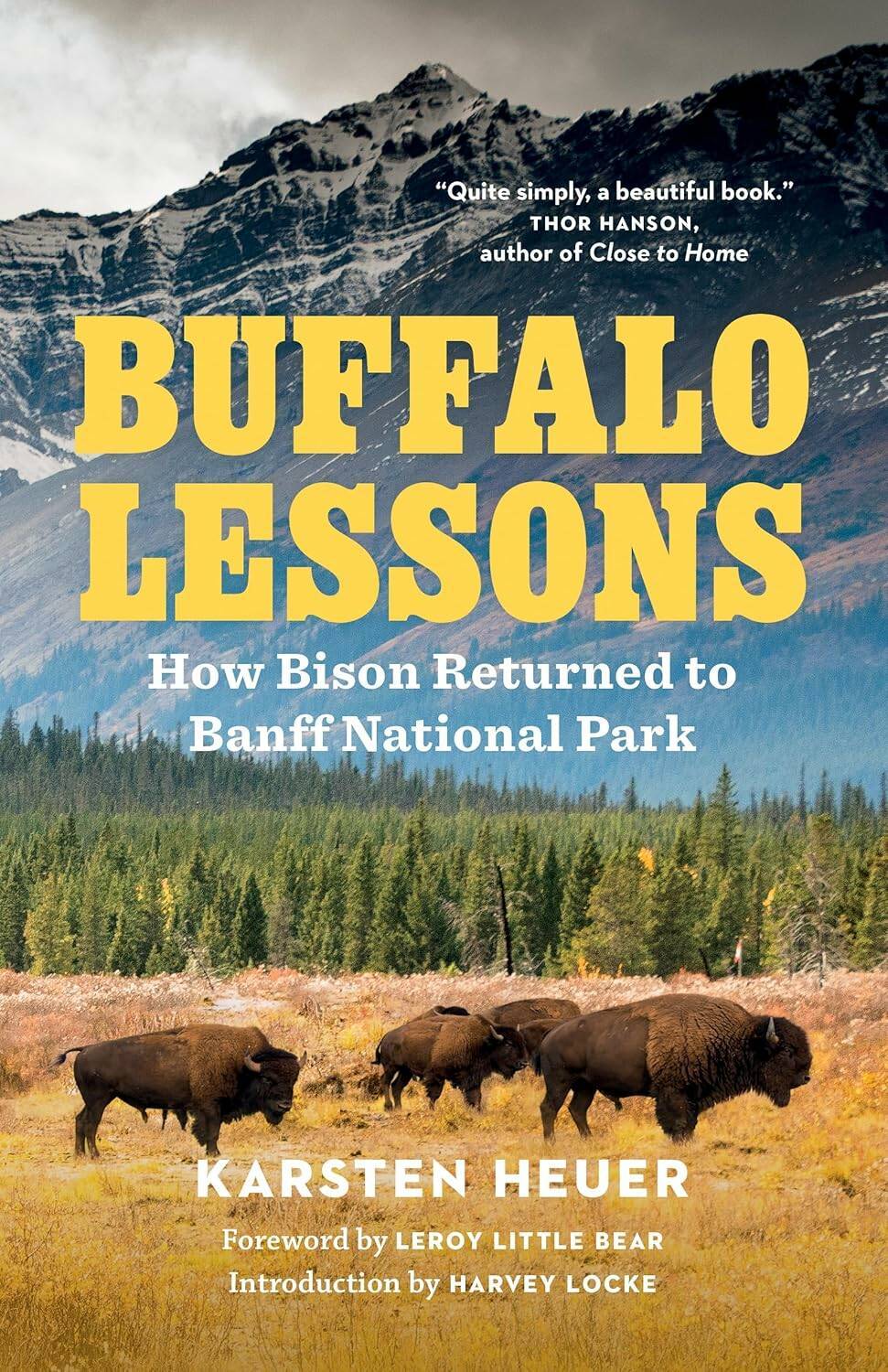
Buffalo Lessons

Buffalo Lessons

Buffalo Lessons is the story of the relocation of plains bison to Banff National Park starting in 2017. Heuer, a conservationist, biologist, author and filmmaker, was head of the project. He died at age 56, shortly after finishing the manuscript.

Bison are remarkable animals. Bulls can weigh up to 1,000 kilograms and run 55 kilometres an hour, faster than a horse (so don’t try to outrun one). They can leap nearly two metres, and bulls can be two metres tall and nearly twice as long. They are the largest land animal in North America.

Enormous herds of buffalo, millions of them, roamed half of North America before European settlers nearly exterminated them in the 1800s. By the late 1880s, fewer than 100 buffalo remained. There are chilling photos out there of huge mounds of buffalo bones and proud marksmen skinning animals of their fur, leaving their carcasses to rot in the sun. It was an ecological nightmare.

What all this did to the Indigenous population who relied on the buffalo for sustenance and clothing is hardly imaginable.

“There is something about buffalo that makes them special,” says conservationist and writer Harvey Locke, in his introduction to Buffalo Lessons. “To the First Peoples of North America… these animals are central to their culture as teacher, provider, and main actor in their stories. ”

Heuer was the biologist picked to reintroduce bison in Banff, in one of the most ambitious conservation efforts in modern history. It began in 2017 and was completed in 2024.

The bison were trucked about 400 kilometres north from Elk Island National Park to Banff National Park. They were herded on horseback to attach tracking collars and airlifted to rugged backcountry in a remote part of the park.

There were exciting times during the transfer of the buffalo to Banff, including a chase on horseback, a helicopter-assisted translocation into the rugged terrain and the risky tracking of wayward bulls that scale steep, treacherous terrain.

In 2024, the year Heuer died, his herd had grown to over 100 bison, and late that year the first ceremonial Indigenous hunt in 150 years took place in the park.

Barry Craig is a retired journalist.

Report Error Submit a Tip

More Stories

Dynamic Winnipeg husband-and-wife duo lead Salvation Army 'troops'

Doug Speirs 6 minute read Preview

Dynamic Winnipeg husband-and-wife duo lead Salvation Army 'troops'

Doug Speirs 6 minute read Friday, Dec. 20, 2019

And so this is Christmas for the Salvation Army in Winnipeg.

Throughout the city, bells jingle as volunteers staff the iconic kettles to collect funds for critical year-round programming.

At police stations, fire halls and Scotiabank locations, growing piles of toys are gathered through the annual Toy Mountain campaign, ensuring thousands of Winnipeg children will have a special gift come Christmas morning.

On Winnipeg’s coldest and cruelest nights there is always room at the inn as the Centre of Hope provides a warm bed for those experiencing homelessness.

Read
Friday, Dec. 20, 2019

A dose of good news

Melissa Martin 7 minute read Preview

A dose of good news

Melissa Martin 7 minute read Saturday, Jan. 29, 2022

Among the most common refrain journalists hear from their audience, is that we need to tell more good news stories. That we spend too much time on the bad. That it’s too depressing to turn on the TV or open the paper and read about everything wrong with the world, without enough of a counterweight in what’s going right.

That longing, for more stories that bring joy, seems especially acute now, after nearly two years of the grinding public health entropy that has defined the pandemic. I get it: the crushing repetition of COVID-19 headlines exhausts me too. It’s a critical task to get it all documented, but there’s a sameness to it all that makes it progressively heavier to get through.

It’s not that journalists like bad news, exactly. It’s that the work of media is to document the events that shape our times, and news is, by nature, usually rooted in either conflict or tragedy. We can’t avoid it, nor should we: if you can’t point to the place that hurts, you won’t know where to start diagnosing the illness. You have to name what’s broken, to fix it.

Still, there’s no doubt that the sheer volume of bad news can be overwhelming and that, since much of it offers little obvious avenue for individual action, it can produce a sort of despair. How are we to cope when so much seems broken, but the fixes seem so far over our heads? Nobody likes feeling helpless, but that is an effect too much bad news can produce.

Read
Saturday, Jan. 29, 2022

A property listing from Niverville is worth a close look. It covers 25,000 square feet, has a 40-foot clear-span ceiling rated at 36 tons, 2,400 amps of power, radiant heat in the concrete, pre-cast walls, and four acres situated at the intersection of Wallace Road and Provincial Road 311. The advertisement states that it’s brand new and asks $9.5 million.

This is Jette Studios, and it has never hosted a single production.

Three years ago Julijette and Volume Global announced a private investment of $30 million aimed at setting up a studio village in phases, which was to create as many as 300 jobs. The local member of the legislative assembly referred to Niverville as the Hollywood of the north. The province had already committed $40.6 million to infrastructure in and around the town and then, in April, pledged an additional $10 million for road work on the grounds that it would lead to a smoother drive to the studio. The building opened in the spring and was put up for sale on August 16.

It has not been made public why the property is for sale, and it would be unfair to speculate about the finances of a private company from outside. However, there is a reasonable question underlying this situation, and it goes beyond just one building: given all the public money that has been spent, what does Manitoba actually own?

Letters, Sept. 25

7 minute read 2:00 AM CDT

More of the basics

Re: “Sage advice,” Letters, Robert Moskal, Sept. 21

I, too, can recall the ‘look both ways’ before crossing lessons but I often wonder whether that is part of our problem. And no — I am not suggesting that the onus is on pedestrians to watch for e-scooters, rather it is a question of common sense having gone by the wayside.

Whether it is basic life lessons, general etiquette or respect for others, much seems to have been lost along the way.

Thinking outside the boxwood

Colleen Zacharias 7 minute read Preview

Thinking outside the boxwood

Colleen Zacharias 7 minute read Saturday, Sep. 12, 2020

With fall barrelling towards us at record wind speeds and winter not far behind, now is the time to decide how you will protect your tender plants. Boxwood is a good example. My experience with growing boxwood in my Zone 3b garden has gone something like this: buy in spring, plant, dig up the following spring, repeat. It’s like one of those videos that plays on a continuous loop.

Digging a trench and burying my boxwood for the winter months beneath a layer of soil and shredded leaves has proven (mostly) successful. When the boxwood is lifted in spring, every speck of debris needs to be cleared from the centre of the plants to prevent fungal disease. I relocate the overwintered boxwood temporarily to a deep shade location to protect the foliage from burning which can occur in the cold temperatures of early spring. Once the root ball has fully thawed, boxwood can be safely replanted into containers and window boxes where it can live on happily for another summer.

But what makes boxwood worth all this trouble and aren’t the boxwood varieties sold at local garden centres supposed to be hardy (or relatively hardy) to our area?

Boxwood is one of the world’s most popular shrubs. It has the distinction of being one of those few plants so widely recognized and beloved for its inimitable structure and style that it can be found growing in landscapes around the world from Europe to Africa, Asia, the Mediterranean, and North America. In addition to the appeal of its small, glossy green, elliptically shaped evergreen foliage, boxwood can be shaped into almost anything. Boxwood is equally beautiful in the landscape or in container arrangements. Its architectural shape and glossy emerald green texture dresses up window boxes and adds pizazz to planters. Boxwood can be purchased in quart size containers, which are less costly, and used as a stand-alone plant or in a linear arrangement of three or more or as the thriller in a container arrangement.

Read
Saturday, Sep. 12, 2020

Police chief, union clash as officer morale takes hit

Erik Pindera  6 minute read Preview

Police chief, union clash as officer morale takes hit

Erik Pindera  6 minute read Thursday, Mar. 4, 2021

Tensions have erupted between Winnipeg’s police chief and rank-and-file officers over reaction from the top brass to the sudden deaths of two veteran cops, including one said to be distraught over anti-police sentiment.

The rift has been exacerbated by Chief Danny Smyth’s decision, on Monday, to launch an internal investigation into fake “member updates” — bulletins issued by the chief — that are riddled with sarcasm and target fellow officers.

A memo issued by Winnipeg Police Association president Moe Sabourin to union members refers to “morale concerns,” which “have become more acute in the wake of the sudden and tragic deaths of two WPS members and the chief’s lack of any outreach to the families of these individuals — or to the broader service.”

Sabourin condemned the phony memos, and blasted Smyth for the tone he used when he informed officers the professional standards unit would investigate the forgeries.

Read
Thursday, Mar. 4, 2021