Body’s signals to brain worth heeding for health

Advertisement

Advertise with us

The erosion of the relationship between science communication and the general public became increasingly evident during the COVID-19 pandemic. Part of this is no doubt due to a numbness caused by the popular media barrage of new cancer and disease cures, if not the end of aging itself.

Read this article for free:


By clicking the button above, an account will be created and you will begin to receive some of our recommended newsletters. You may opt out of any newsletter by visiting your Email and Communication Preferences page or by clicking "unsubscribe" at the bottom of any email.

or

Already have an account? Log in here »

To continue reading, please subscribe:

Digital Subscription

One year of digital access for only $1.44 a week*

  • Enjoy unlimited reading on winnipegfreepress.com
  • Read the E-Edition, our digital replica newspaper
  • Access News Break, our award-winning app
  • Play interactive puzzles

*Billed as $5.77 plus GST every four weeks. After 52 weeks, price increases to the regular rate of $19.95 plus GST every four weeks. Offer available to new and qualified returning subscribers only. Cancel any time.

To continue reading, please subscribe:

Add Free Press access to your Brandon Sun subscription for only an additional

$1 for the first 4 weeks*

  • Enjoy unlimited reading on winnipegfreepress.com
  • Read the E-Edition, our digital replica newspaper
  • Access News Break, our award-winning app
  • Play interactive puzzles
Start now

*Your next Brandon Sun subscription payment will increase by $1.00 and you will be charged $17.95 plus GST for four weeks. After four weeks, your payment will increase to $24.95 plus GST every four weeks.

Hey there, time traveller!
This article was published 29/11/2025 (320 days ago), so information in it may no longer be current.

The erosion of the relationship between science communication and the general public became increasingly evident during the COVID-19 pandemic. Part of this is no doubt due to a numbness caused by the popular media barrage of new cancer and disease cures, if not the end of aging itself.

Caroline Williams is a seasoned translator of neuroscience into accessible language. In Inner Sense, her study of interoception traces the history of a niche scientific field as well as potential future vistas.

Interoception refers to signals arising from the body and communicated to the brain — perceptions of fullness, feelings of worry and respiration rates are familiar examples. When heeded and correctly interpreted, interoception keys us to shifts away from homeostasis towards incipient illness and dangers. Williams heralds research into interoception as one of the most significant areas of study to emerge in science and medicine in many years.
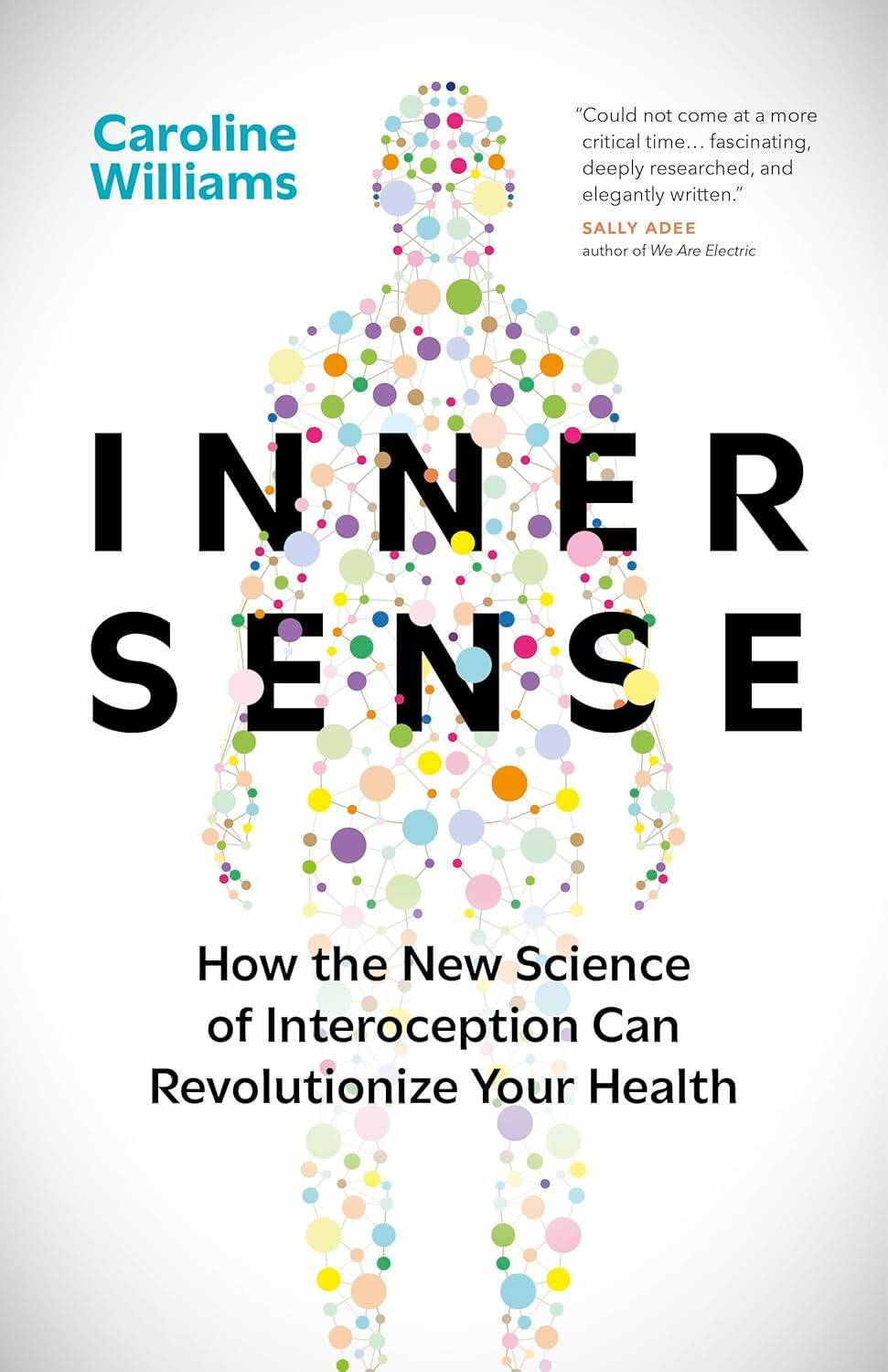
Inner Sense

Inner Sense

Interoceptive ability varies by individuals, but is trainable. Improvements can influence our behaviour to foster greater health resiliency and energy and to reduce stress. Research may offer insights into treatments for arthritis, fatigue, depression and many other maladies; these interventions range from developing heart-rate awareness to more invasive surgical procedures.

An accessible writer, Williams articulates the complicated nuance of signaling pathways and digestive physiology into compelling narrative. AI (artificial intelligence) research, she notes, begins with the brain and often ends absent any sense of body, demonstrating an ongoing obliviousness to the body’s interdependent nature.

Whatever its strengths, Inner Sense feels like it was written too early and too narrowly. Despite promises of an accessible health revolution, concrete advice oscillates between easy fixes and a strange, privileged valorization of technology. We’re encouraged to take a bath, laugh, eat whole foods, try yoga, to spend more (or less) time with others.

Further afoot from banally familiar health advice, Williams suggests we consider wearable technology to track biometrics. She seems largely unaware of both the cost and imprecision of smart devices when tracking data as basic as heart-rate variability, a marker of stress. Anything truly new is left to an uncertain scientific future.

That the brain and body are interconnected is a keystone of Williams’ pitch. For all the energy expended supporting this thesis, it’s novel in neither the world of science or philosophy. Her lack of awareness of context and even culture bleeds into other areas. Many meditative practices are intimately linked to interoceptive awareness, but they get shorter shrift than, say, costly sensory deprivation tanks.

Buddhism, which has rich cultural histories exploring many of the same key concepts, is never mentioned.

Inner Sense frequently reads like a breathless announcement to a Canadian that recreation may be possible on ice surfaces.

Williams is confident that the nature of the self has been resolved through neuroscience — certainly not a unanimous opinion. Addiction is treated with some delicacy, but the focus on the role of interoception is so strong that history, cultural or personal, is largely effaced.

Inner Sense becomes increasingly scattershot in its final section, identifying the possibility of interoception as critical to avoiding online scammers and navigating conflict. At best Williams is being darkly humorous when she notes its role in surviving climate change so that we’re aware of the need for shade and water in a rapidly warming world.

While interoception is an important area of research, so is understanding complex phenomena within cultural and historical contexts. Science is crucial to meeting present-day challenges, but public communication of its findings, tentative as they be, is imperative.

The near-frantic sales pitch of Inner Sense promises too much and delivers too little. It’s almost enough to quicken the pulse.

Jarett Myskiw is a teacher.
Report Error Submit a Tip

More Stories

Liberal MLA’s autism strategy bill gains all-party backing

Carol Sanders 3 minute read 2:00 AM CDT

Manitoba could soon have an autism strategy for the first time, thanks to a private member’s bill that’s garnered rare all-party support in the legislature.

Liberal MLA Cindy Lamoureux’s Bill 232, the Autism Strategy Act introduced in March, would require the government to establish a policy designed to improve the screening and diagnosis of autism spectrum disorder and support research.

It would identify ongoing supports and services needed by people with autism and their families and caregivers. It calls for annual reports tracking the implementation of the measures identified in the strategy, with a mandatory review and updates of the legislation every five years.

The bill goes before the legislature’s standing committee on social and economic development committee Friday. As of Wednesday, 87 private citizens and organizations registered to weigh in on the proposed legislation.

Law will curb e-scooter enthusiasts

Editorial 4 minute read Preview

Law will curb e-scooter enthusiasts

Editorial 4 minute read 2:00 AM CDT

For people concerned about safety on Manitoba’s sidewalks and roadways, the province’s announcement that new rules will be introduced next year regarding the use of e-scooters and other personal electric vehicles (PEVs) was no doubt met with an enthusiastic “It’s about time.”

As their popularity and their presence among pedestrians on sidewalks and/or motor vehicles on the road has increased steadily, so have reports of close calls or, even worse, collisions involving e-scooters or other PEVs — including electric skateboards, hoverboards and unicycles — being operated imprudently and at unsafe speeds.

Traffic laws urgently need to be updated to govern the use of these conveyances, which up until now have remained in a regulatory grey area that has allowed PEVs to operate largely without guidelines and outside conventional avenues of traffic-safety enforcement. Accordingly, updates regarding PEV use will be included in the Highway Traffic Act in 2027.

The new legislation will govern such areas as mandatory helmet use, age restrictions, where PEVs can lawfully operate and the maximum speed at which they can travel (25 km/h). The aim of the new law, according to the province’s website, is “to help keep Manitobans safe when sharing roads, paths, and other public spaces.”

Read
2:00 AM CDT

short head Ottawa expands student loan

Kevin Rollason 4 minute read Preview

short head Ottawa expands student loan

Kevin Rollason 4 minute read Thursday, Mar. 30, 2023

The federal government is hoping forgiving part of their student loans will encourage more doctors and nurses to work and practice in rural communities.

Read
Thursday, Mar. 30, 2023

It’s time for honesty over moribund marriage

Maureen Scurfield 6 minute read Friday, Apr. 14, 2023

DEAR MISS LONELYHEARTS: I married the wrong man. I was 18, and two brothers were interested in me at the same time, and chose to go out with the handsomer of the two. I married him three years later, and we looked like Barbie and Ken dolls.

Man pleads guilty to manslaughter for chasing, stabbing man downtown

Erik Pindera 4 minute read Preview

Man pleads guilty to manslaughter for chasing, stabbing man downtown

Erik Pindera 4 minute read 2:00 AM CDT

An intellectually disabled man who drunkenly chased down a man he had been arguing with and fatally stabbed him in broad daylight admitted to manslaughter on Wednesday.

Matthew Gerald Tomack Pelletier, now 38, chased Ricky Dwayne Mancheese, 49, down Kennedy Street before stabbing him six times in front of his wife on the sidewalk between Sargent and Cumberland avenues, at about 11:50 a.m. on June 11, 2024.

Pelletier, who police arrested the next day, was charged with second-degree murder, but instead pleaded guilty to the lesser offence of manslaughter in front of Court of King’s Bench Justice Joan McKelvey on Wednesday.

“This type of incident on Winnipeg streets is all too common and must be strongly deterred,” said McKelvey.

Read
2:00 AM CDT

Family ‘togetherness’ must have some limits

Maureen Scurfield 5 minute read Monday, Apr. 24, 2023

DEAR MISS LONELYHEARTS: My grown-up family has no problem moving back home when they’re between jobs or going through broken relationships. My two “boys” are in their mid-20s, and both moved “home” after their live-in situations, but have found jobs since. COVID has eased up, so they’re going out drinking and partying again.

One asked permission to stay with us before Christmas, and got it, and then his brother showed up, after a break-up with his girlfriend on Valentine’s Day, and just moved right back into his old bedroom when I was away for work. I just didn’t know how to throw out my sad and upset son.

My husband’s younger sister, who’s been living in the basement room since her marriage broke up many months ago, is in her late 20s. So, these are not kids, but I’m cooking and cleaning for everybody, and also working full-time. My husband is not happy as we have no privacy, and he and I are paying the bills for everyone.

Prior to these “adults” moving in, I made these rules: They must buy their own groceries; do their own laundry; make their own meals; and everybody must clean up after themselves. No one listened, I guess. They just heard, “Yadda, yadda, yadda.”