Humanity will survive, even as things ‘get weird’

Advertisement

Advertise with us

When U.S. science journalist Annalee Newitz, founding editor of the science website io9.com, set out to write a book about the future of humanity, she expected to find the end was nigh.

Read this article for free:


or

Already have an account? Log in here »

To continue reading, please subscribe:

Subscribe and receive a limited-edition Free Press branded hat or tote.

Digital Subscription

One year of digital access for only $205*

  • Enjoy unlimited reading on winnipegfreepress.com
  • Read the E-Edition, our digital replica newspaper
  • Access News Break, our award-winning app
  • Play interactive puzzles

*First annual payment billed as $205.00 + GST for one year. This annual subscription will automatically renew at $233.00 + GST every 52 weeks (10% off the regular annual price of $259.35). Offer available to new and qualified returning subscribers only. Cancel any time.

To continue reading, please subscribe:

Add Free Press access to your Brandon Sun subscription for only an additional

$1 for the first 4 weeks*

  • Enjoy unlimited reading on winnipegfreepress.com
  • Read the E-Edition, our digital replica newspaper
  • Access News Break, our award-winning app
  • Play interactive puzzles
Start now

*Your next Brandon Sun subscription payment will increase by $1.00 and you will be charged $17.95 plus GST for four weeks. After four weeks, your payment will increase to $24.95 plus GST every four weeks.

Opinion

Hey there, time traveller!
This article was published 25/05/2013 (4882 days ago), so information in it may no longer be current.

When U.S. science journalist Annalee Newitz, founding editor of the science website io9.com, set out to write a book about the future of humanity, she expected to find the end was nigh.

Instead, her research led her to believe the opposite: that “humanity has a lot more than a fighting chance at making it for another million years.”

The optimistic result is Scatter, Adapt, and Remember, a refreshing pop-science book that examines ways humans could prevail at Armageddon.
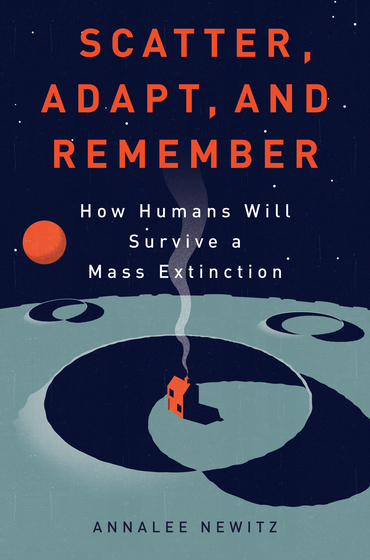
What does humanity’s future look like? You might be surprised: Newitz, who is based in California, thinks it looks like Saskatoon.

The Saskatchewan city “has survived despite its hard climate, and people there have found ways to incorporate the latest scientific advances into their agriculture and urban design without overspending,” she writes in the introduction to the book’s Canadian edition.

Scatter, Adapt and Remember is not a manual; it will not help you duck and cover or stock your survival shelter.

Rather, Newitz takes a page from Alan Weisman’s 2010 book, The World Without Us — which conjured the changes coming to a depopulated world — and imagines instead how Homo sapiens can survive whatever attempts to depopulate us, be it nuclear war, plague, asteroid, or some other curse we have not imagined or invented.

Newitz begins with a review of the history of mass extinctions on Earth — from the Proterozoic microbes of 2.5 billion years ago through dinosaurs and whales and Neanderthals. The book is at its driest here, a sort of super-condensed Brief History of Everything, with a special focus on dying.

By the middle of the book we’re considering the lessons previous mass extinctions — and their survivors — have taught, the lessons of the book’s title: scatter, to escape adversity as best you can; adapt as the world around you changes, and remember: pass on the knowledge of how to survive.

It’s worth enduring the rather arid history lesson at the beginning to get to Parts 4 and 5, where Newitz is at her most speculative. Here she really leave Weisman far in the dust, imagining how humanity will survive a million years into the future, perhaps as part-robot, or perhaps living on the Moon, on Mars, or beyond.

“Our kids are the last generation who will see no city lights on the Moon,” predicts a NASA scientist, one of a hundred fascinating experts Newitz interviews.

Did you know the United Nations has an “action team” on the “Committee on the Peaceful Uses of Outer Space” that would co-ordinate Earth’s defences if an asteroid appears to be headed our direction? Scatter, Adapt and Remember will help you rest easy, safe in the knowledge that someone out there is working hard to keep space rocks from killing us all.

“Our kids are the last generation who will see no city lights on the Moon.”

-Scientist interviewed in Scatter, Adapt and Remember

By the time you get to the end of the book, you might find yourself downloading CD3WD, a “backup copy of everything history has taught us about creating an early industrial society.”

Stored on a few DVDs or (perhaps more practically) printed and secured in your post-apocalypse survival kit, it’ll help you rebuild human civilization from scratch — just in case the future goes a bit sideways.

“Things are going to get weird,” Newitz concludes. “But don’t worry. As long as we keep exploring, humanity is going to survive.”


Wendy Sawatzky is associate editor digital news at winnipegfreepress.com and commander in chief at wendysawatzky.com.

Wendy Sawatzky

Wendy Sawatzky
Associate Editor Digital News

Wendy Sawatzky brought her twin passions for writing and technology to the Winnipeg Free Press in 2008. She's currently the paper's associate editor for digital news.

Our newsroom depends on a growing audience of readers to power our journalism. If you are not a paid reader, please consider becoming a subscriber.

Our newsroom depends on its audience of readers to power our journalism. Thank you for your support.

Report Error Submit a Tip

More Stories

Banning controversial songs is a tone-deaf solution

Jen Zoratti  10 minute read Preview

Banning controversial songs is a tone-deaf solution

Jen Zoratti  10 minute read Friday, Dec. 7, 2018

Along with sipping egg nog and trimming trees, Canadians engaged in another reliable holiday tradition this week: debating whether or not Baby, It’s Cold Outside promotes date rape.

On Tuesday, three of the country’s major broadcasters — CBC, Rogers and Bell Media — announced they’d be putting the chill on the contentious duet, written by American songwriter Frank Loesser in 1944, and would not be playing it on their radio stations this year.

Several American radio stations have also put the song on their naughty lists, arguing it has no place in the #MeToo era. 

Through a modern lens, it’s not hard to see how some people might view this song as a woman being pressured into sex by a guy who won’t take no for an answer. 

Read
Friday, Dec. 7, 2018

Real journalists matter in an AI world

Paul Deegan 4 minute read Preview

Real journalists matter in an AI world

Paul Deegan 4 minute read 2:00 AM CDT

An algorithm can decide what you see, but it doesn’t report the news. Nunatsiaq News, an award-winning newspaper in Nunavut, recently reported that a so-called “news” website was posting AI-generated articles about the north by stealing real news stories produced by real journalists.

The articles were supposedly written by Nunavut correspondent Leah Qammaniq — a fake journalist, with a fake photo and a fake bio.

Governor General Louise Arbour warned us of fake news in her installation speech in June. She said, “We must continue to protect the public space in which our national debates take place: from schools and universities to the media, political parties, unions and civil society organizations …With instant access to vast amounts of information, it is very tempting to pay little attention to the reliability of sources. The lines between knowledge and belief, between truth and falsehood, between facts and assumptions, are increasingly blurred. AI could be threatening not only the way we live and work, but also the control we exercise over our own destiny.”

The Government of Canada has recognized the problem as well. Its recent discussion paper, Enhancing trust in artificial intelligence through increased transparency, stated, “Canadians encounter news reporting, product reviews, and audio-visual content across the internet, often without any indication of whether it was written by a person, generated by an AI system, or produced through some combination of both … A particular concern within this broader landscape is that generative AI greatly enables the creation and dissemination of deceptive or misleading content.”

Read
2:00 AM CDT

Biographer delves deep into the comedy and the tragedy of Robin Williams' troubled life

Reviewed by GC Cabana-Coldwell 6 minute read Preview

Biographer delves deep into the comedy and the tragedy of Robin Williams' troubled life

Reviewed by GC Cabana-Coldwell 6 minute read Saturday, Jun. 16, 2018

Whenever I’m asked with whom I’d love to dine, entertainer Robin Williams always tops my short list of three. Still.

It’s immaterial that we didn’t move in the same social circles. Or that our career paths never crossed, even though one of his many movies, The Big White, was partially shot in Winnipeg in 2005. Something about him — that hairy persona, those kind blue eyes, the “aw shucks” grin — had intrigued me since watching the debut of his Mork & Mindy TV sitcom in 1978. His off-the-wall goofiness simply sealed the deal.

Comedian Williams became movie-star Williams, and I bought every flick — the good, the not-so-good and the real stinkers. His raunchy standup recordings, often released between his movies, were just an added, adult-only bonus.

So I, like many, was gutted when, at age 63, Williams took his own life in 2014. I didn’t “get” it: how could an award-winning, funny guy, admired by so many for so long, get so beaten up inside that he’d off himself?

Read
Saturday, Jun. 16, 2018

Festival riffs off Main Street’s storied past

Melissa Martin 7 minute read Preview

Festival riffs off Main Street’s storied past

Melissa Martin 7 minute read Friday, Jun. 10, 2022

Fifty years later, Billy Joe Green can still remember one of the biggest breaks of his career. It was 1971, and his band was asked to become the house band at the Brunswick, an old Main Street hotel and bar.

People would line up around the block to see them, and for a while Green, who was barely out of his teens, could really feel as if he’d made it.

“That was like the high-end place to play for our people,” he says, with a nostalgic smile.

Oh, if the walls of the Main Street strip could talk, they would tell a million stories, and Green would be in a bunch of them. An Ojibwa man and member of Shoal Lake 40 First Nation, Green is one of Winnipeg’s most iconic blues guitarists; back then, he was jamming on the Main Street circuit, slinging out country and rock hits.

Read
Friday, Jun. 10, 2022

Dozen of Manitoba highways remain closed weeks after storms

Nicole Buffie 5 minute read Preview

Dozen of Manitoba highways remain closed weeks after storms

Nicole Buffie 5 minute read Thursday, Jul. 16, 2026

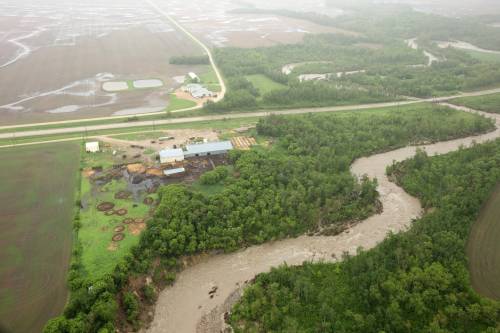
Thirty five highways remain closed weeks after torrential rain caused destructive flooding in several Manitoba communities.

Crews continue to assess flood damage and repair roads and highways as conditions allow, after historic precipitation washed away many routes.

Some areas in the Parkland region of the province received more than 200 millimetres of rain between June 6 and July 1.

The majority of road closures are in the Roblin area. A storm at the end of June undid a lot of repair work in the Municipality of Minitonas-Bowsman after an early June deluge, officials said.

Read
Thursday, Jul. 16, 2026

The alternative is in the ground

Stuart Williams 5 minute read Wednesday, Jul. 29, 2026

The cheapest 750 megawatts isn’t a methane plant. It’s our own furnaces.

Manitoba Hydro wants to build up to $3 billion worth of additional methane turbines near Brandon — 750 megawatts of fossil-fuelled power, to get us through the coldest winter evenings and the driest years.

As the Public Utilities Board weighs the plan this summer, Manitobans should ask a simple question — is burning methane really the cheapest way to keep the lights on and the furnaces running?

The evidence says no.