Whales Tails to be awarded Glass Banjo

Advertisement

Advertise with us

BIRDS HILL PROVINCIAL PARK — Fried dough, butter, cinnamon and sugar.

Read this article for free:


By clicking the button above, an account will be created and you will begin to receive some of our recommended newsletters. You may opt out of any newsletter by visiting your Email and Communication Preferences page or by clicking "unsubscribe" at the bottom of any email.

or

Already have an account? Log in here »

To continue reading, please subscribe:

Digital Subscription

One year of digital access for only $1.44 a week*

  • Enjoy unlimited reading on winnipegfreepress.com
  • Read the E-Edition, our digital replica newspaper
  • Access News Break, our award-winning app
  • Play interactive puzzles

*Billed as $5.77 plus GST every four weeks. After 52 weeks, price increases to the regular rate of $19.95 plus GST every four weeks. Offer available to new and qualified returning subscribers only. Cancel any time.

To continue reading, please subscribe:

Add Free Press access to your Brandon Sun subscription for only an additional

$1 for the first 4 weeks*

  • Enjoy unlimited reading on winnipegfreepress.com
  • Read the E-Edition, our digital replica newspaper
  • Access News Break, our award-winning app
  • Play interactive puzzles
Start now

*Your next Brandon Sun subscription payment will increase by $1.00 and you will be charged $17.95 plus GST for four weeks. After four weeks, your payment will increase to $24.95 plus GST every four weeks.

Hey there, time traveller!
This article was published 13/07/2019 (2672 days ago), so information in it may no longer be current.

BIRDS HILL PROVINCIAL PARK — Fried dough, butter, cinnamon and sugar.

It’s a simple recipe and a quintessential Winnipeg Folk Festival treat, but the humble Whales Tail wouldn’t exist if not for a last-minute menu change 40 years ago.

Gene Freott and Jenny Morris accidentally created the deep-fried delicacy during their first gig at the festival in 1979.

The creators of Whales Tails, Gene Freott and Jenny Morris, started bringing their food stand to the Winnipeg Folk Festival from British Columbia in a Volkswagen bus, pictured here in 1980. (Supplied photo)

After an invitation from folk fest founder Mitch Podolak, the couple packed their Vancouver-based business, Caravan Foods, into a red Volkswagen bus and headed east. The plan was to serve falafel and baklava to the hungry folkies, but Freott and Morris couldn’t find the necessary ingredients when they arrived in Winnipeg.

“They went and got bread dough and just started frying it up. It went crazy and they pulled people from the lineup to help them,” said Sharon Doornbosch, who purchased Caravan Foods with her husband, Gary, 11 years ago.

“The birthplace of the Whales Tail, technically, would be the Winnipeg Folk Festival,” Gary said.

That first year, the kitchen was little more than a cast-iron skillet and a single burner in a homemade tent, but the stand quickly became a staple in the food village.

Haanita Seval has been eating Whales Tails at the festival since 1980.

“It’s been my first breakfast out here every single year,” she said with a hot cinnamon and sugar treat in her hand on Friday afternoon. “I actually think there would be something missing if I couldn’t have a Whales Tail.”

Freott and Morris dropped the original name, Elephant Ears, in 1998 after a trademark issue was brought forward by a company of the same name in the United States. They’ve been selling Whales Tails ever since and hold the trademark on that name.

With 40 years of continuous service, the business is the longest running food vendor at the Winnipeg Folk Festival. This year, Whales Tails is being recognized for their longevity with a Glass Banjo Award, which is given annually to recognize volunteers, supporters, partners and organizations who have made an impact at the festival.

“There is that sense of tradition, people really feel connected to it,” said Lynne Skromeda, folk fest executive director. “Back in the day, because they were so identifiable and everyone knew where they were, they were often a meeting place for people.”

Sharon and Gary — along with representatives from The Manitoba Federation of Labour, which is also receiving an award this year — will be presented with the Glass Banjo on mainstage Saturday night.

“I’m really honoured… I just think it’s nice to be acknowledged for the company coming all this way for all these years,” Sharon said.

“We’re getting a reward for bringing people happiness for the last 40 years,” Gary added.
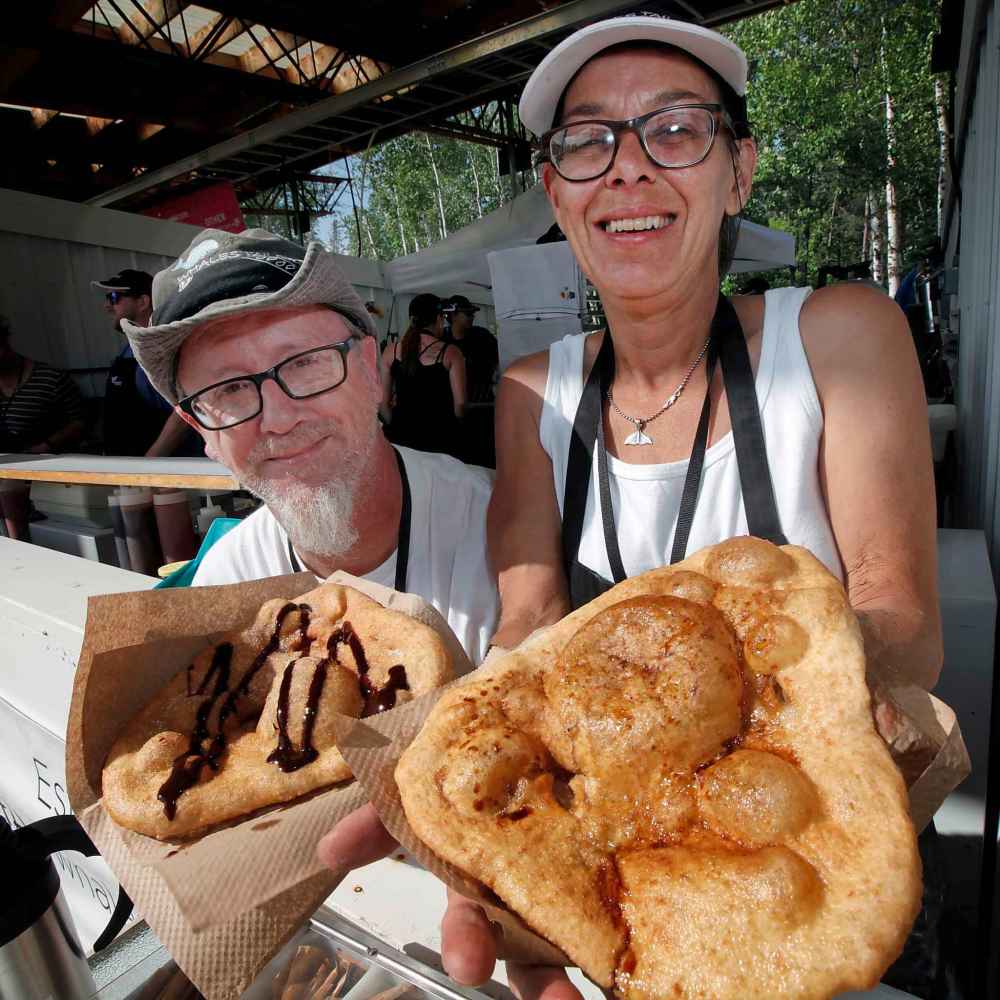
Sharon and Gary Doornsbosch show off the sweet and the savoury Whales Tails. (Phil Hossack / Winnipeg Free Press)

Aside from a few modern updates, the core of the Whales Tails business has remained the same four decades on. Sharon and Gary still make the two-day drive from British Columbia every July, albeit with a truck and trailer, and the classic cinnamon and sugar remains the top seller, although jam has become unusually popular in Manitoba and the current owners have added a slate of new sweet and savory toppings.

They sell an estimated 5,000 Whales Tails each time they come to the folk fest and go through roughly 16 kilograms of jam, 40 kilograms of sugar and two kilograms of cinnamon.

Whales Tails is a seasonal operation for the Doornboschs, who both have “real jobs” in shipping and receiving. What keeps them coming back to Manitoba is the people. The couple hires locally and have one staff member who has worked at the stand for more than 20 years.

“We’ve made a lot of friends and it kind of feels like our second home because everyone is so welcoming,” Sharon said.

The couple does about five festivals across the prairies and west coast each summer and hope to pass the business on to their adult children one day.

“It will just keep going, and that was an attraction for Gene and Jenny because they built this and they didn’t want it to disappear. So we’ll keep carrying on the torch,” Sharon said.


eva.wasney@freepress.mb.ca

Twitter: @evawasney

Eva Wasney

Eva Wasney
Arts Reporter

Eva Wasney is a reporter for the Winnipeg Free Press.

Our newsroom depends on a growing audience of readers to power our journalism. If you are not a paid reader, please consider becoming a subscriber.

Our newsroom depends on its audience of readers to power our journalism. Thank you for your support.

Report Error Submit a Tip

More Stories

How do you decolonize Canada’s museums? It’s a transformation that’s finally getting underway

Jeremy Nuttall - Vancouver Bureau, Toronto Star 7 minute read Preview

How do you decolonize Canada’s museums? It’s a transformation that’s finally getting underway

Jeremy Nuttall - Vancouver Bureau, Toronto Star 7 minute read Friday, Nov. 12, 2021

The Canadian Museum of Human Rights is one of a number of museums across the country working to better their representation of traditionally marginalized groups.

Read
Friday, Nov. 12, 2021

WP Router Placeholder Page

0 minute read Thursday, Dec. 22, 2022

Tory plan to defund CBC ignores associated costs, impact on Canadian life

Tom Brodbeck 5 minute read Preview

Tory plan to defund CBC ignores associated costs, impact on Canadian life

Tom Brodbeck 5 minute read Thursday, Apr. 24, 2025

This week, the Conservative Party of Canada unveiled a costed platform that includes a bold and controversial proposal: to defund the CBC.

The plan aims to save taxpayers $1 billion annually by reducing spending on Crown corporations, with the CBC being the primary target. However, the proposal raises significant questions about its feasibility, implications for Canadian journalism and the future of public broadcasting in the country.

Under the Conservative plan, the CBC’s English-language services would be expected to become financially self-sufficient, relying on revenue from viewers, listeners and donations. In contrast, French-language services provided by Radio-Canada would continue to receive public funding.

Conservative Leader Pierre Poilievre has argued that the private market can adequately support English-language media, making public funding unnecessary, while maintaining support for French-language services to serve linguistic minorities.

Read
Thursday, Apr. 24, 2025

Digital media an illusion of democracy

Rod Lastra 5 minute read Preview

Digital media an illusion of democracy

Rod Lastra 5 minute read 2:01 AM EST

I recently finished reading The Obsolescence of the Human (Die Antiquiertheit des Menschen) by Günther Anders, a German philosopher and critical theorist known for his critique of technology and modern society.

First published in German in 1956, the book appeared in English for the first time only in 2025. It is an unsettling work. Writing in the age of television, industrial automation and the atomic bomb, Anders worried that humanity was becoming more technologically capable without becoming better able to understand, much less control, what it had created.

Seven decades later, his observations seem remarkably prescient. Quoting a tale set in his fictional land of Molussia, Anders writes: “The less people have a voice, the more they are given to look at and see.”

Anders was describing a world in which images brought distant events into people’s living rooms while decisions shaping those events remained beyond their influence. The world appeared increasingly accessible, but accessibility was not agency. He warned that images could become “stultification-devices”: representations that reveal fragments of reality while obscuring the relationships needed to understand and judge them. One could watch history unfold without having much say in its direction.

Read
2:01 AM EST

Blue wave in U.S. gives Democrats a choice

Editorial 4 minute read Preview

Blue wave in U.S. gives Democrats a choice

Editorial 4 minute read 2:00 AM EST

The win might not have been completely unexpected, but the size of it certainly was.

U.S. President Donald Trump’s Republican party was handily dismantled by the Democrats in Tuesday’s midterm elections, with the Democrats taking control of both the U.S. House of Representatives and the Senate.

States including Texas, South Carolina and Kansas elected Democrats, something that hasn’t happened in Kansas, for example, for 94 years. The Democrat who won a senate seat in Kansas, Adam Hamilton, notably campaigned on a moderate platform, promising to listen to all sides. There might be a lesson in that.

An unrepentant Trump said on social media that the loss was because he was not personally on the ballot, “I wasn’t on the Ballot and if I was, we would have won IN A LANDSLIDE.” He also said that he didn’t view the vote as a rejection of his policies: “We’ve had the greatest two years in the history of the presidency.”

Read
2:00 AM EST

Dark mornings fuel school safety fears

Maggie Macintosh 5 minute read Preview

Dark mornings fuel school safety fears

Maggie Macintosh 5 minute read Updated: 9:07 AM EST

School officials are fielding complaints about Manitoba’s decision to abandon biannual clock changes as they urge children to wear bright clothing and take other safety precautions to commute to class in the dark.

The St. James-Assiniboia School Division board office has received two formal complaints related to the province’s new year-round time zone — Manitoba Standard Time (MBT).

“Both were concerned about student safety in the dark and one questioned if we would be changing the start times of all our schools,” said Tara Smith, chairperson of the board of trustees.

Smith said in an email that the division, encompassing Deer Lodge, Westwood and surrounding areas, has no plans to adjust schedules at any of its kindergarten-to-Grade 12 buildings.

Read
Updated: 9:07 AM EST