Laser’s blue light gives green light to enter world of pure imagination

Advertisement

Advertise with us

Before the humans take the stage at the beginning of Glitch, the audience’s senses are already activated.

Read this article for free:


By clicking the button above, an account will be created and you will begin to receive some of our recommended newsletters. You may opt out of any newsletter by visiting your Email and Communication Preferences page or by clicking "unsubscribe" at the bottom of any email.

or

Already have an account? Log in here »

To continue reading, please subscribe:

Digital Subscription

One year of digital access for only $1.44 a week*

  • Enjoy unlimited reading on winnipegfreepress.com
  • Read the E-Edition, our digital replica newspaper
  • Access News Break, our award-winning app
  • Play interactive puzzles

*Billed as $5.77 plus GST every four weeks. After 52 weeks, price increases to the regular rate of $19.95 plus GST every four weeks. Offer available to new and qualified returning subscribers only. Cancel any time.

To continue reading, please subscribe:

Add Free Press access to your Brandon Sun subscription for only an additional

$1 for the first 4 weeks*

  • Enjoy unlimited reading on winnipegfreepress.com
  • Read the E-Edition, our digital replica newspaper
  • Access News Break, our award-winning app
  • Play interactive puzzles
Start now

*Your next Brandon Sun subscription payment will increase by $1.00 and you will be charged $17.95 plus GST for four weeks. After four weeks, your payment will increase to $24.95 plus GST every four weeks.

Hey there, time traveller!
This article was published 12/04/2026 (202 days ago), so information in it may no longer be current.

Before the humans take the stage at the beginning of Glitch, the audience’s senses are already activated.

Throughout the Manitoba Theatre for Young People, it’s cloudy. Over the sound system, pipes drip. Through squinted eyes, one can almost make out a staircase and the downward swoop of a curtain. “I have a question,” a young girl asks her grandmother before the matinee production begins. “Why is it so foggy?”

The fog is a stand-in for the plumes of dust that one might find in the basement of an abandoned theatre, where four friends — Carlos Mendoza, Léa Noblet Di Ziranaldi, Chloé Ouelle-Payeur & Marie-Ève Dion — stumble onto a world of balletic make-believe.

As they head down the staircase, the friends cross flashlight beams. When the quartet takes its first collective steps, each member is reluctant: what transpires is a testament to the transformative power of a performative green light — a signal to go where you’ve never gone before.

In the case of Glitch, the green light is often blue, but it descends from the ceiling of the MTYP mainstage as a dazzling channel of laser light. This beam seems to have a mind and a spirit of its own. At times, it directs the friends to open stage boxes and remove the worlds contained inside, at others, it forms walls and conical structures that seem intent on keeping its friends downstairs for a little while longer.

Directed by Hélène Langevin, who choreographed with Audrey Bergeron, Glitch — a production from Montreal’s Bouge de là — is an ode to unadulterated, infectious creativity, with its performers imbuing found material with narrative, energy and life.

This is perhaps best exemplified by a sequence in which one performer dons cardboard sleeves that seem to have a mind of their own, magnetized, as it were, by the beam of light. At first, the other three are reluctant to play this game. But as each successive performer straps their arms into pieces of discarded boxes, they each buy in.

In no time, the four performers unite at centre stage to perform a robotic dance, a well-oiled machine working together to tell a story.

The group numbers are strong, but each performer gets the opportunity to shine in the light.

As Au Clair de la Lune plays, Mendoza, wearing a silky dress, manipulates the lasers with his hands as if he were controlling the pitch of each instrument in music director Bernard Falaise’s interpretation of the classic French folk song.

A trained gymnast, Ouelle-Payeur stuns with a backwards, back-bridged walk and other feats of flexibility. Noblet Di Ziranaldi excels at playing both rigid — a technically stunning, futuristic light tunnel dance is a standout — and loose, playing as a flaccid green monster with remarkable control.

Dion, whose variety of facial expressions hint at a rich education in mime, struts her stuff in a green morphsuit to close out the show with a jazzy ensemble piece that bursts forth from a long-sealed wardrobe.

Falaise’s music and Guy Fortin’s sound design enliven the production in tandem with Lucie Bazzo’s and Martin Lepage’s dynamic lighting and Jimmy Lakatos’s laser show. Costume designer Marilène Bastien’s work here is modernist and refuses to play by any rules, once again highlighting the value, in theatre and in life, of chosen appearance.
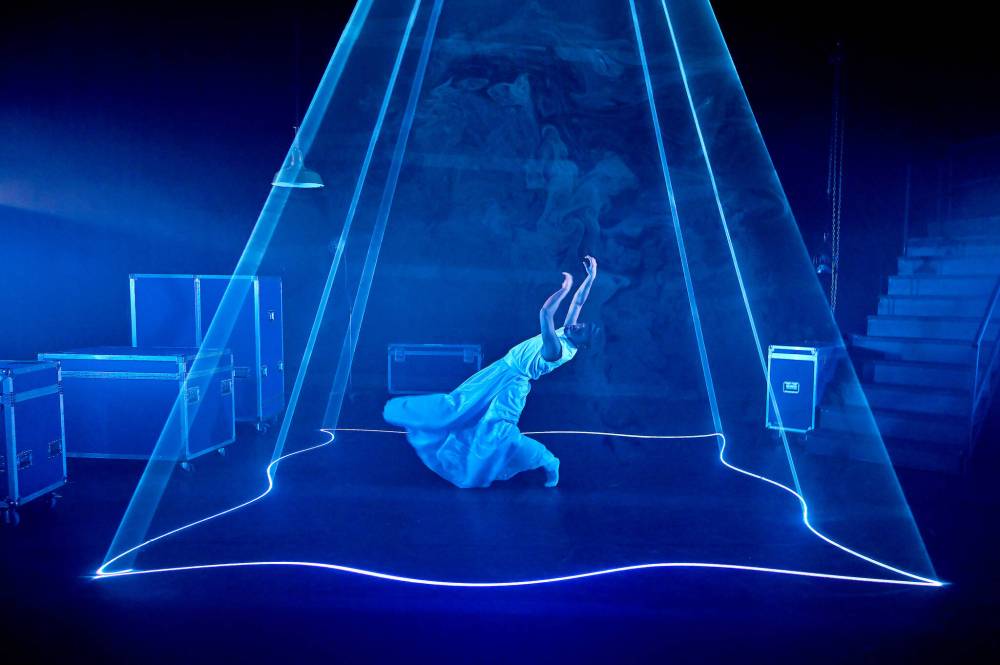
Langevin shows this most clearly when the characters are presented with four options for masks to wear. The characters make initial choices but then shift. When Mendoza emerges a minute or so later wearing a dress, the audience takes it as a natural decision, as do his friends, who watch the performer from the wings.

A surreal treat, Glitch ends after just under an hour-long run, when the lights and the lasers cut to black. Until next time.

winnipegfreepress.com/benwaldman

David Wong photo
                                Glitch is an ode to unadulterated, infectious creativity.
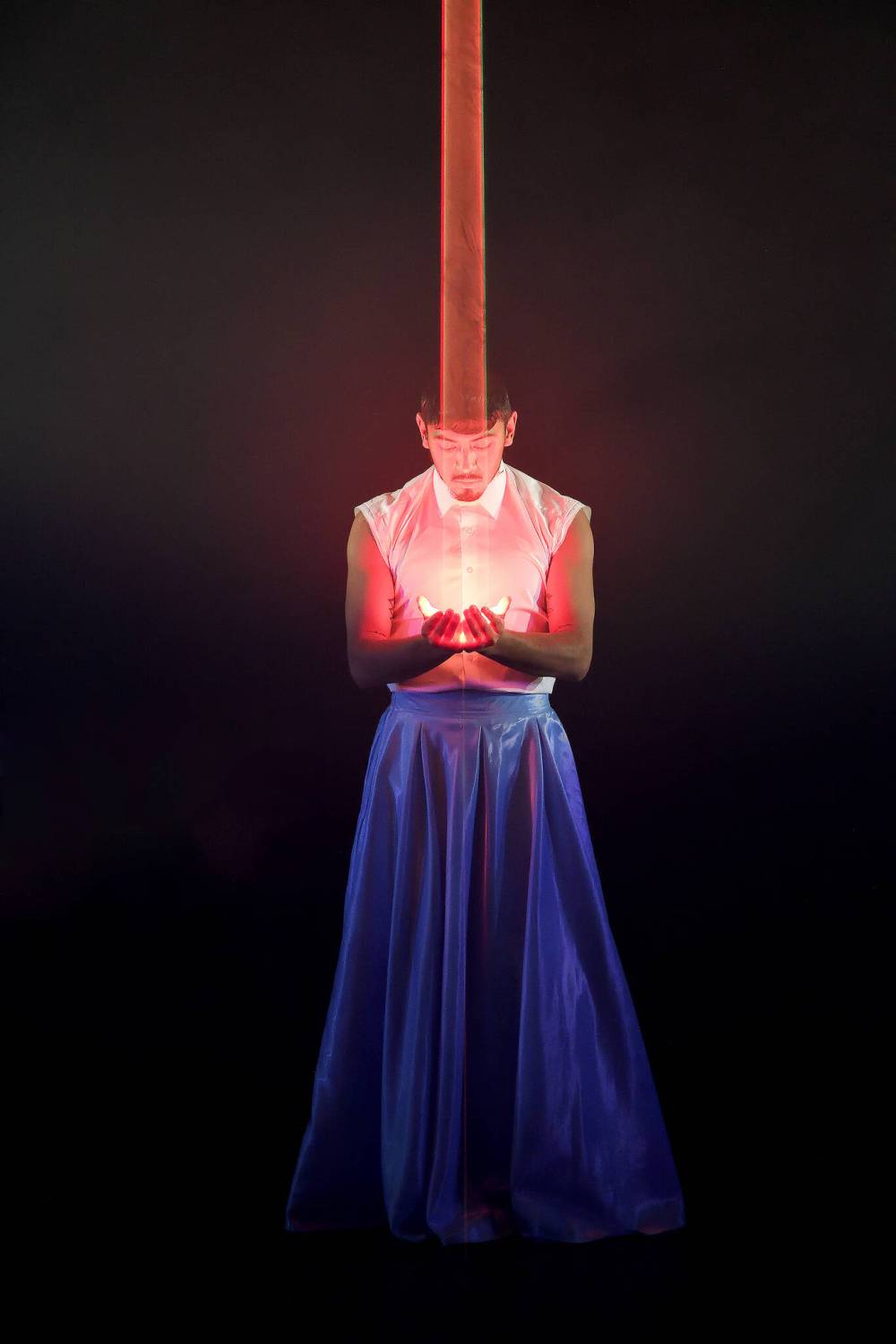
David Wong photo

Glitch is an ode to unadulterated, infectious creativity.

Suzane O’Neill photo
                                In Glitch, a laser light beam seems to have a mind and a spirit of its own.
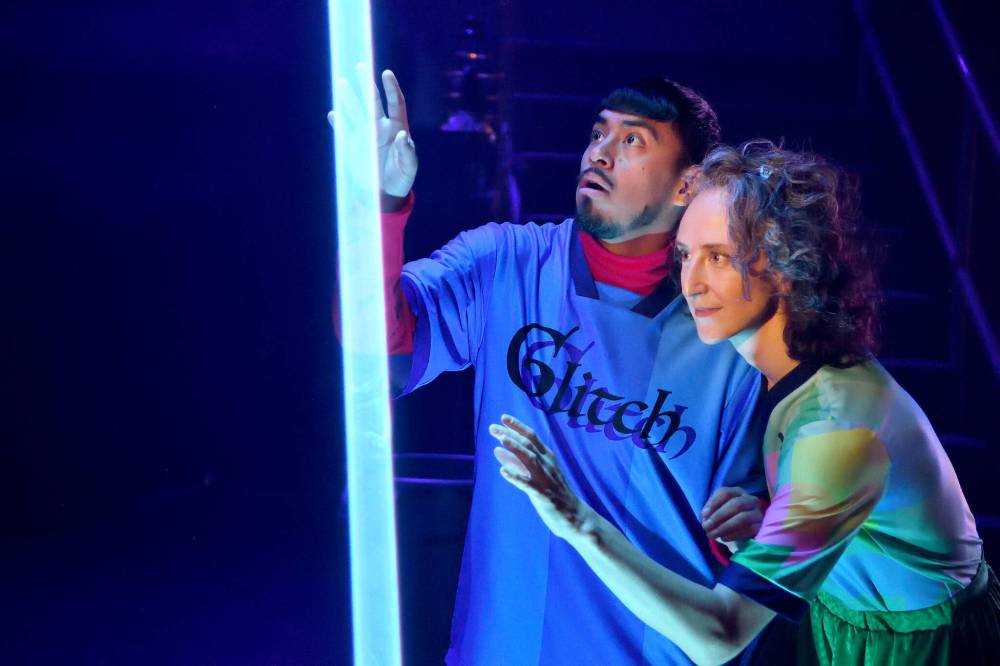
Suzane O’Neill photo

In Glitch, a laser light beam seems to have a mind and a spirit of its own.

Suzane O’Neill photo
                                The cast of Glitch is a well-oiled machine, but individual members also shine.

Suzane O’Neill photo

The cast of Glitch is a well-oiled machine, but individual members also shine.

Ben Waldman

Ben Waldman
Reporter

Ben Waldman covers a little bit of everything for the Free Press.

Our newsroom depends on a growing audience of readers to power our journalism. If you are not a paid reader, please consider becoming a subscriber.

Our newsroom depends on its audience of readers to power our journalism. Thank you for your support.

History

Updated on Sunday, April 12, 2026 3:18 PM CDT: Adds photos

Report Error Submit a Tip

More Stories

Just say no (to deficits during good economic times)

Tom Brodbeck 5 minute read Preview

Just say no (to deficits during good economic times)

Tom Brodbeck 5 minute read Wednesday, Oct. 2, 2019

When a political party pledges to run small, “manageable” deficits if elected, it almost always means it will go deeper into the red if it wins government.

It’s human nature.

After all, as a government, if you get the blessing of the public to spend beyond your means, what’s a few billion more a year in overspending?

The problem is, it doesn’t usually end there. When those same politicians seek re-election, they often want permission to post even larger deficits. In some cases, they’ve abandoned the idea of balancing the books altogether, arguing perpetual deficit financing is acceptable, as long as the debt doesn’t exceed a certain percentage of the economy.

Read
Wednesday, Oct. 2, 2019

Opera singer David Daniels no longer in singers’ union following sexual assault guilty plea

The Associated Press 2 minute read Preview

Opera singer David Daniels no longer in singers’ union following sexual assault guilty plea

The Associated Press 2 minute read Thursday, Dec. 21, 2023

NEW YORK (AP) — Countertenor David Daniels is no longer a member of the union for singers following his guilty plea to a charge of sexual assault.

The 57-year-old and his husband, Scott Walters, pleaded guilty to sexual assault of an adult, a second-degree felony, in Houston's Harris County District Court on Aug. 4. Their accuser was aspiring opera singer Sam Schultz.

They both were sentenced to eight years’ probation and required to register as sex offenders.

American Guild of Musical Artists spokesperson Alicia Cook said Wednesday that Daniels is no longer a member of the union.

Read
Thursday, Dec. 21, 2023

Westman to lose sole medical oncologist

Rylee Gerrard 5 minute read Preview

Westman to lose sole medical oncologist

Rylee Gerrard 5 minute read Updated: 9:26 AM CDT

BRANDON — Western Manitoba is about to lose its only medical oncologist, leaving just 22 in the province — all of whom are in Winnipeg.

Brandon West MLA Wayne Balcaen raised the issue during question period Thursday, saying the departure of Dr. Brady Anderson will be a “major loss” for the region.

After four years working out of the Western Manitoba Cancer Centre in Brandon, Anderson’s last day will be Nov. 13.

“He literally sees hundreds of patients within the Westman area, and now those individuals will have to travel to Winnipeg to get that personal service,” Balcaen said, calling Anderson’s impending departure “catastrophic.”

Read
Updated: 9:26 AM CDT

Actor-director Cooper takes new approach to familiar tale

Randall King 4 minute read Preview

Actor-director Cooper takes new approach to familiar tale

Randall King 4 minute read Thursday, Oct. 4, 2018

TORONTO — In his self-directed version of A Star Is Born, Bradley Cooper plays a rock star named Jackson Maine.

Note the name: it marks the character as a member of a cinematic lineage that descends all the way to 1937.

That year, the first A Star Is Born was made, with Frederick March in the role of alcoholic actor Norman Maine. The name stayed in 1954, when James Mason took over the role of an actor who first nurtures the career of Judy Garland’s up-and-coming star Vicki Lester before his drunken shenanigans threaten to derail it. By 1976, Kris Kristofferson played the role of musician John Norman Howard, a rock singer with a musical stake in the ascent of Barbra Streisand’s Esther Hoffman.

Cooper, 43, remembered the Maine name, but also brought his own vision as a first-time feature filmmaker to the new version, which opens Thursday, Oct. 4, opposite Lady Gaga after the originally designated director, Clint Eastwood, dropped out. While actors might not want to see different interpretations of a role, Cooper embraced the opportunity to see all the past iterations.

Read
Thursday, Oct. 4, 2018

Waiting for Cormier verdict the ‘calm before the storm’

Katie May 6 minute read Preview

Waiting for Cormier verdict the ‘calm before the storm’

Katie May 6 minute read Thursday, Feb. 22, 2018

As the jury room door closed behind the seven women and four men who are now deliberating on the evidence against Tina Fontaine’s accused killer, Thelma Favel rose from the chair she’s occupied for most of Raymond Cormier’s second-degree murder trial.

Almost every day over the past three weeks, Favel, the woman who raised 15-year-old Tina, has sat right up front, directly across from the jury box, listening, sobbing and soaking in disturbing details of the teen’s last days that have come to light over the course of Cormier’s second-degree murder trial.

On Wednesday afternoon, after Court of Queen’s Bench Chief Justice Glenn Joyal instructed the jury and sent them off to be sequestered until they decide whether 56-year-old Raymond Cormier is guilty of killing Tina, Favel got up and hugged Crown prosecutor Breta Passler. It was one of many moments, this one shielded from jurors, that have long since proven the emotional impact of the case and the lasting power of Tina’s legacy.

Tina’s death sparked a public outcry that renewed calls for a national inquiry into disproportionately high rates of missing and murdered Indigenous women and girls across Canada, and the criminal trial for the man accused of killing her hasn’t happened in a vacuum.

Read
Thursday, Feb. 22, 2018

City rec facilities crumbling

Ryan Thorpe 7 minute read Preview

City rec facilities crumbling

Ryan Thorpe 7 minute read Monday, Oct. 22, 2018

Throughout Winnipeg, decades-old community assets — pools, arenas and recreation and leisure centres — are deteriorating so quickly that service disruptions are inevitable.

Meanwhile, the city’s community services department, which is responsible for managing those assets, operates with an annual deficit of roughly $80 million, meaning there are scant resources to do little more than bail water on a sinking ship.

Soon, Winnipeggers will have a choice: fewer community services or higher costs.

“It poses a huge challenge because we have very limited dollars that we have to invest in our existing facilities. We also have growing demands for new amenities in new areas. We have to be very strategic,” said Ken McKim, manager of asset management for the department.

Read
Monday, Oct. 22, 2018