Donated tuques for homeless are warm-hearted, handmade therapy for woman who makes them

Advertisement

Advertise with us

A recent donation to the Main Street Project not only leaves a warm and fuzzy feeling in the heart, but also a warm and fuzzy feeling on the heads of the homeless.

Read this article for free:


By clicking the button above, an account will be created and you will begin to receive some of our recommended newsletters. You may opt out of any newsletter by visiting your Email and Communication Preferences page or by clicking "unsubscribe" at the bottom of any email.

or

Already have an account? Log in here »

To continue reading, please subscribe:

Digital Subscription

One year of digital access for only $1.44 a week*

  • Enjoy unlimited reading on winnipegfreepress.com
  • Read the E-Edition, our digital replica newspaper
  • Access News Break, our award-winning app
  • Play interactive puzzles

*Billed as $5.77 plus GST every four weeks. After 52 weeks, price increases to the regular rate of $19.95 plus GST every four weeks. Offer available to new and qualified returning subscribers only. Cancel any time.

To continue reading, please subscribe:

Add Free Press access to your Brandon Sun subscription for only an additional

$1 for the first 4 weeks*

  • Enjoy unlimited reading on winnipegfreepress.com
  • Read the E-Edition, our digital replica newspaper
  • Access News Break, our award-winning app
  • Play interactive puzzles
Start now

*Your next Brandon Sun subscription payment will increase by $1.00 and you will be charged $17.95 plus GST for four weeks. After four weeks, your payment will increase to $24.95 plus GST every four weeks.

Hey there, time traveller!
This article was published 19/01/2022 (1745 days ago), so information in it may no longer be current.

A recent donation to the Main Street Project not only leaves a warm and fuzzy feeling in the heart, but also a warm and fuzzy feeling on the heads of the homeless.

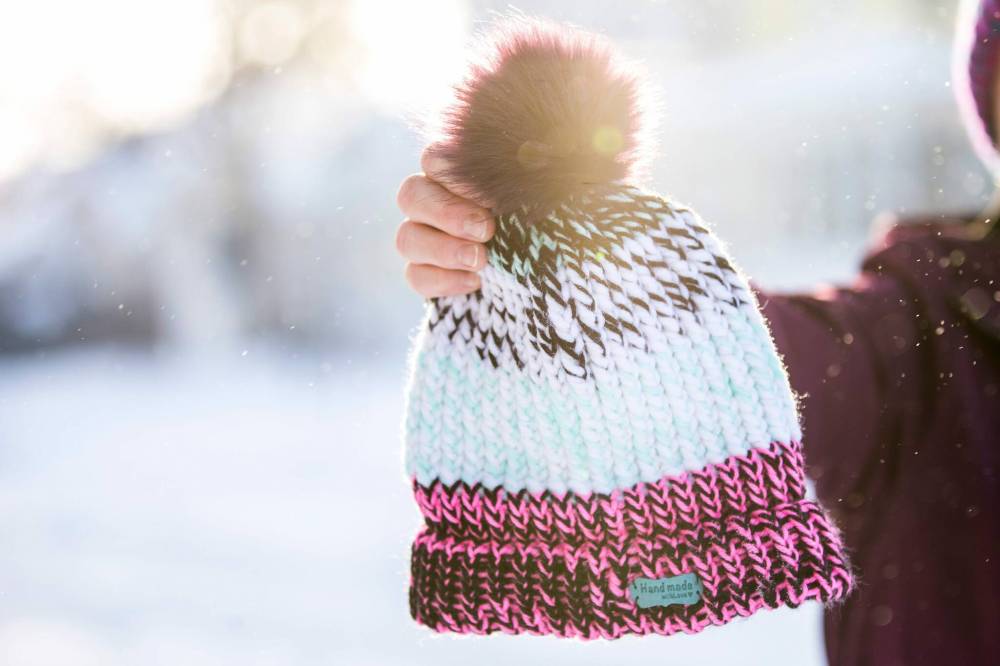
That’s because Kyla Simms, a former member of the Canadian Armed Forces, made 50 tuques and delivered them to the Martha Street support agency.

And Simms said they will soon be getting more.
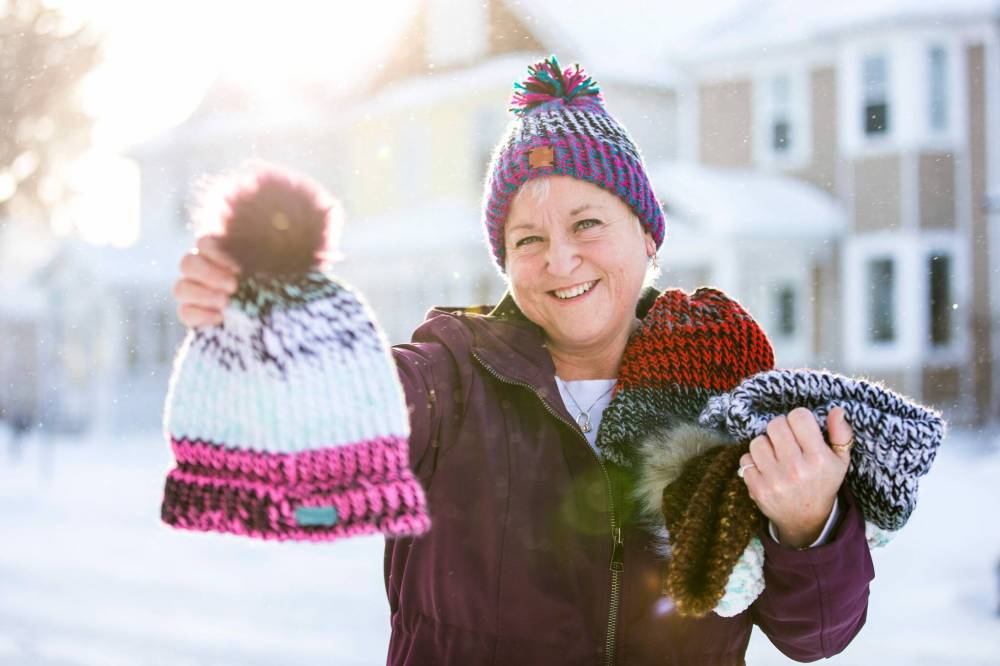
MIKAELA MACKENZIE / WINNIPEG FREE PRESS
Kyla Simms poses for a portrait with her toques in Winnipeg. She is an armed forces veteran who has made so many toques that she was able to give some to fellow patients and nurses at the health care facility in Ontario she was at and has recently donated 50 of them to Main Street Project.
MIKAELA MACKENZIE / WINNIPEG FREE PRESS Kyla Simms poses for a portrait with her toques in Winnipeg. She is an armed forces veteran who has made so many toques that she was able to give some to fellow patients and nurses at the health care facility in Ontario she was at and has recently donated 50 of them to Main Street Project.

“As I make more, I’ll still be taking them there,” she said. “I’m still making them. I pay for all the wool, but I don’t mind doing it. I like to know people will get them and will use them.”

“It’s so freaking cold here, so there are people who will want these.”

Making the tuques is good for Simms, too. She first began creating them as therapy to deal with her post-traumatic stress disorder.

She served in the air force side of the Canadian Forces until her 23-year career ended with a medical discharge in 2014. At one point, in 2003 and 2004, she was a member of the peacekeeping force separating Israeli and Syrian armies in the Golan Heights.

Last year, Simms was undergoing therapy at the Homewood Health Centre in Guelph, Ont., and was taught how to use a loom to knit tuques. She said she donated 18 knit caps to other patients and nurses there, before filling up her suitcases with more headwear and flying back here.

“It started as a therapy,” she said. “My goal was 50, but I made 68 and I’m still making them. At first it took me two days to make them. Now I can finish one in two hours.”

Her friend Sandra Edmondson also learned how to use a loom but “was not as good.”

“What she has done is just incredible,” Edmondson said. “She is able to help people. She said, ‘I’m going to make a difference,’ and she is. She is out there for the homeless.”
MIKAELA MACKENZIE / WINNIPEG FREE PRESS
Simms first began creating togues as therapy to deal with her post-traumatic stress disorder.
MIKAELA MACKENZIE / WINNIPEG FREE PRESS Simms first began creating togues as therapy to deal with her post-traumatic stress disorder.

Anastasia Ziprick, the Main Street Project’s director of development, said some agency clients have received tuques.

“We so appreciate these beautiful handmade winter hats and the heart-warming story that came along with them,” said Ziprick.

“Hundreds of people come through our doors every day and night, most in need of warm winter wear, and these are extra-special.”

Ziprick said Main Street Projects and other agencies that help homeless Winnipeggers appreciate donations of winter hats, mitts and gloves. She said anyone who wants to help can go to www.mainstreetproject.ca for donation guidance.

kevin.rollason@freepress.mb.ca

Kevin Rollason

Kevin Rollason
Reporter

Kevin Rollason is one of the more versatile reporters at the Winnipeg Free Press. Whether it is covering city hall, the law courts, or general reporting, Rollason can be counted on to not only answer the 5 Ws — Who, What, When, Where and Why — but to do it in an interesting and accessible way for readers.

Our newsroom depends on a growing audience of readers to power our journalism. If you are not a paid reader, please consider becoming a subscriber.

Our newsroom depends on its audience of readers to power our journalism. Thank you for your support.

History

Updated on Wednesday, January 19, 2022 6:52 PM CST: Corrects spelling of tuque.

Updated on Thursday, January 20, 2022 7:29 PM CST: Corrects photo caption.
Report Error Submit a Tip

More Stories

Westman to lose sole medical oncologist

Rylee Gerrard 5 minute read Preview

Westman to lose sole medical oncologist

Rylee Gerrard 5 minute read Updated: 9:26 AM CDT

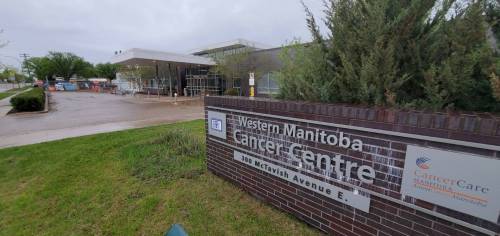
BRANDON — Western Manitoba is about to lose its only medical oncologist, leaving just 22 in the province — all of whom are in Winnipeg.

Brandon West MLA Wayne Balcaen raised the issue during question period Thursday, saying the departure of Dr. Brady Anderson will be a “major loss” for the region.

After four years working out of the Western Manitoba Cancer Centre in Brandon, Anderson’s last day will be Nov. 13.

“He literally sees hundreds of patients within the Westman area, and now those individuals will have to travel to Winnipeg to get that personal service,” Balcaen said, calling Anderson’s impending departure “catastrophic.”

Read
Updated: 9:26 AM CDT

Fact Check

1 minute read Thursday, Nov. 30, 2023

Fact Check

Having problems with the form?Contact Us Directly |

Science-art collaboration injects dose of emotion into cold, hard truths

Sarah Lawrynuik 5 minute read Preview

Science-art collaboration injects dose of emotion into cold, hard truths

Sarah Lawrynuik 5 minute read Wednesday, Apr. 28, 2021

Looking at spreadsheets and map plots of trees is far beyond Rhian Brynjolson’s typical day as a visual artist, but she became entranced and inspired by data collected by Canadian scientists for a new art project.

Her hope is to try and bring the numbers, map dots and statistics to life in a new way to help the public better connect to climate science.

Falcon Lake’s Brynjolson is one of 12 Canadian artists who participated in an art-science collaboration exhibit, co-ordinated by the Global Water Futures program out of the University of Saskatchewan. The project saw the artists paired with researchers and scientists across the country who then engaged in conversations to try to inspire a new angle to their art.

“The whole idea behind it is: water is life,” says Louise Arnal, the project lead, and a post-doctoral fellow at the Centre for Hydrology and Coldwater Laboratory.

Read
Wednesday, Apr. 28, 2021

Is Canada headed for time chaos this weekend?

Michelle Bastian 5 minute read 2:00 AM CDT

When Manitoba Premier Wab Kinew declared Sept. 17 that the province would remain on permanent daylight time, he suggested it was a historical moment people would share with their “great-great-grandkids.” But, while Sunday, Nov. 1 has been heralded as the date many Canadians will stop changing their clocks, there are rumblings behind the scenes suggesting this will actually cause more trouble than ever before.

There are, of course, the warnings from chrono-biologists and sleep scientists about the damage permanent daylight time will do. The lighter evenings will mean many more dark mornings. But there is another set of problems in the offing in the critical infrastructure that underpins our digital lives.

While it used to be common to spend the Sunday morning after a time change going around our homes updating the clocks, we now wake up to devices that have already adjusted to the new time. These automatic updates occur regularly for daylight time, as well as when we travel to new time zones.

Our clocks are able to change by themselves owing to the hard work of a group of volunteers who were recently named in a list of the people who hold up the internet. This group, led by Paul Eggert, a computer scientist at UCLA, maintains a little-known tool called the Time Zone Database. Since the 1980s, it has kept track of regional, national and international debates about clock time and provided an up-to-date table of what time it should be on our walls.

Must-see Folk Fest workshops

16 minute read Preview

Must-see Folk Fest workshops

16 minute read Thursday, Jul. 5, 2018

Workshops have always been an integral part of the Winnipeg Folk Festival.

They are magic-moment makers; a curated group of musicians — sometimes friends, sometimes strangers — on one stage playing together, supporting each other, creating something that will only exist for an hour or two. No one knows what will come out of the collaboration, but usually it’s something special.

When the Free Press spoke to Winnipeg Folk Festival artistic director Chris Frayer ahead of the lineup release in early March, he noted he would be paying some extra attention to workshops this year, as some of the special projects occurring during the past couple of festivals had pulled some of his attention away.

And with 37 workshops on the books, it would seem he followed through on his promise.

Read
Thursday, Jul. 5, 2018

A fond farewell to the Hercules

Editorial 4 minute read Preview

A fond farewell to the Hercules

Editorial 4 minute read 2:00 AM CDT

Fans at the NHL’s outdoor Heritage Classic game last weekend were no doubt thrilled by the sight and sound of two CF-18 Hornet fighter jets conducting a flyover at Princess Auto Stadium shortly before the puck was dropped for the much-anticipated Winnipeg Jets/Montreal Canadiens matchup.

Flyovers such as these always create a spectacular scene, as the speed and power of the jets are on full display for the brief moments they’re in view above the stadium bowl. But fans who maintained their skyward gaze for a few seconds after the Hornets’ blink-and-you’ll-miss-it appearance were treated to a much more poignant aeronautical exhibition, as a CC-130H Hercules aircraft passed over the stadium in the fighter jets’ wake.

Compared to the supersonic CF-18s, the massive, propeller-driven transport plane probably seemed to be doing more of a “crawl-over”; what most folks at the outdoor game probably didn’t realize, however, was that this was almost certainly the last time they’ll see one of these ubiquitous Canadian Forces aircraft in the sky.

The CC-130H is being retired after more than half a century as the RCAF’s combat, rescue and transport workhorse. The “Herc” will be replaced by more modern aircraft, including the smaller and more nimble CC-295 Kingfisher, which will be used for search-and-rescue missions out of 17 Wing Winnipeg, beginning next month.

Read
2:00 AM CDT