Blanket a witness to history

Advertisement
Read this article for free:
or
Already have an account? Log in here »
To continue reading, please subscribe:

Digital Subscription
One year of digital access for only $205*
- Enjoy unlimited reading on winnipegfreepress.com
- Read the E-Edition, our digital replica newspaper
- Access News Break, our award-winning app
- Play interactive puzzles
*First annual payment billed as $205.00 + GST for one year. This annual subscription will automatically renew at $233.00 + GST every 52 weeks (10% off the regular annual price of $259.35). Offer available to new and qualified returning subscribers only. Cancel any time.
To continue reading, please subscribe:
Add Free Press access to your Brandon Sun subscription for only an additional
$1 for the first 4 weeks*
- Enjoy unlimited reading on winnipegfreepress.com
- Read the E-Edition, our digital replica newspaper
- Access News Break, our award-winning app
- Play interactive puzzles
*Your next Brandon Sun subscription payment will increase by $1.00 and you will be charged $17.95 plus GST for four weeks. After four weeks, your payment will increase to $24.95 plus GST every four weeks.
Read unlimited articles for free today:
or
Already have an account? Log in here »
Hey there, time traveller!
This article was published 23/04/2021 (1987 days ago), so information in it may no longer be current.
In many cultures, blankets are a symbol of comfort and protection. We wrap our babies in blankets; we wrap our dead in blankets, too. In Indigenous cultures, blankets hold powerful significance, used in ceremony and storytelling.
When Indigenous artist and master carver Carey Newman set about creating a large-scale work that honoured the children forced into Canada’s residential school system, a blanket came to mind. Called The Witness Blanket, it’s a striking, 12-metre cedar “blanket” that contains more than 800 pieces of residential school history from across the country.
Now, after years of travel and exhibition since its completion in 2014, The Witness Blanket is back at the Canadian Museum for Human Rights for some care and conservation under an unique agreement between Newman and the CMHR: the blanket has the rights of a living entity, with guardians who look after it as opposed to owning it.
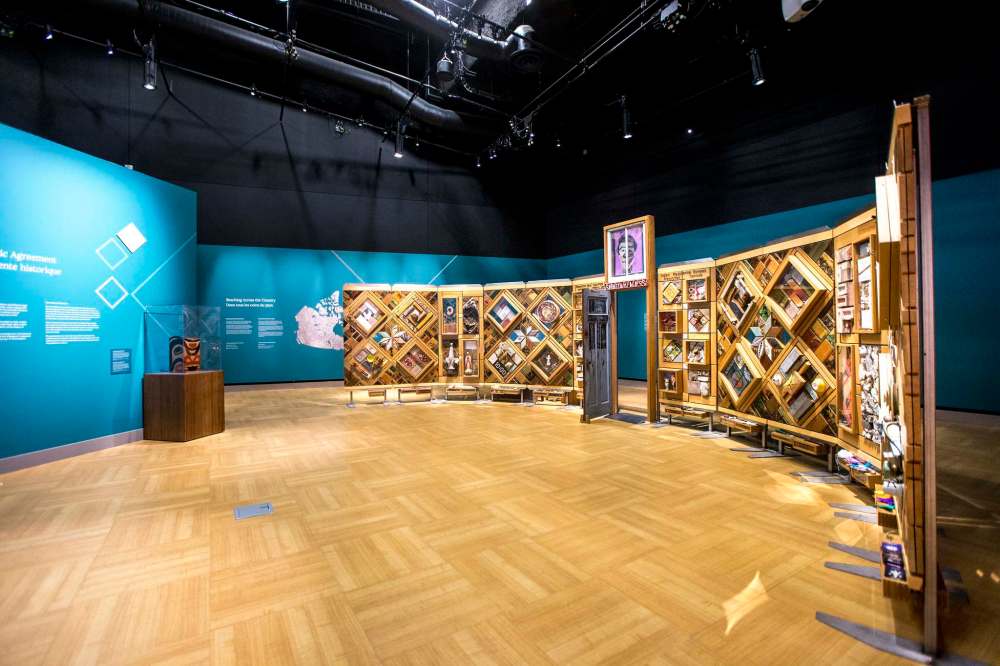
Witness Blanket: Preserving a Legacy is being presented at the CMHR alongside Artivism, an exhibit featuring six artists/art collectives from around the world whose art is an activist response to identity-based mass atrocities. Both are on view from April 30 until Jan. 16 in the Level 1 Gallery.
“We have this stewardship agreement that puts rights with the blanket and the stories that it carries,” Newman explains via Zoom from his home in Victoria, B.C. “And that idea connects to our Kwakwak’awakw ways, where we think of objects, like our masks and our big houses, as having a spirit or having agency. That we think of them as our ancestor, or ancestors. When you think about preserving all of these different objects that have been gathered from across this country, then it raises the question of how should they be looked after in the ways of the place that they come from.”
Several years ago, Newman went to see an ancestral family mask at a museum in Berlin. It was ensconced in a glass, and lit in a way that wouldn’t harm it.
“It was really beautiful and emotional — but it felt like visiting somebody in prison because you couldn’t touch it,” he says.
“For our ceremonial masks, when they’re not in ceremony, we wrap them in blankets and put them in what we call box of treasures, but it’s bentwood boxes,” he says. “And there’s a process to that — you sing them to sleep and you wrap them in blankets and put them away, and when it’s time for ceremony, we sing to wake them up again.
“And it just kind of felt to me like it was this mask was experiencing insomnia and needed some some cultural care.”
Newman asked the institution if he could arrange for a loan, in order to take the mask home so it could dance again. The response was gutting: even if a loan could be arranged, one could never touch or wear the mask again because of the poison used to preserve it. The mask, Newman says, can’t live its purpose anymore.
That got Newman thinking about how best to maintain The Witness Blanket.
“Making sure things like medicine that are on (the work) are not poisoned for preservation, that we’ve set a plan about to use and replace them,” he says. “Medicines, depending on where you’re from, can absorb things and then when you burn them, then that sets them free.”
Witness Blanket: Preserving a Legacy will offer visitors another chance to see the blanket, but it will also offer a behind-the-scenes glimpse at what folks such as Stephanie Chipilski do.
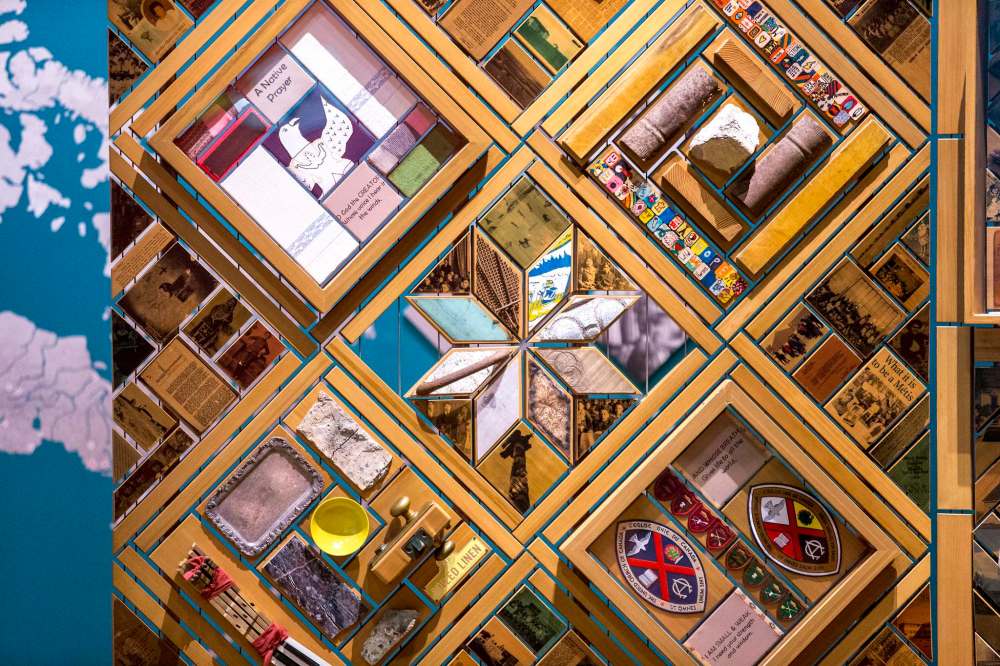
Chipilski is a conservator at the CMHR, which means she cares for artifacts, art, documents and objects, preventing damage and repairing if necessary so they can last a long time. Climate, light, how frequently something is touched — these all have an impact on artifacts themselves, and visitors will be able to learn more about this intersection between art and science.
Caring for The Witness Blanket requires looking after many different parts. Some ceremonial pieces can’t be touched, so preventative conservation may look like a piece of acrylic in front of an object, so it helps but doesn’t hurt.

“(Carey’s) guided us in saying, this is a piece that is meant to have a lifespan, a life cycle, and so it’s OK for things to change their condition over time — but it’s also OK to support it so that doesn’t happen rapidly,” she says.
It’s a blanket — and a legacy — that has many stewards.
“With most art projects, there’s a beginning and an end where you finish it: you put it up and, largely, your responsibility to it is complete, because your responsibility is in the process, not the legacy,” Newman says. “And with the blanket, there’s this whole ongoing legacy that kind of comes out of feeling responsible to the individual pieces in the blanket itself. That idea is reflected again, in that agreement, where rather than transferring responsibility to the museum, we share it. And we also share it with community.”
jen.zoratti@freepress.mb.ca
Twitter: @JenZoratti
Jen Zoratti is a Winnipeg Free Press columnist and author of the newsletter, NEXT, a weekly look towards a post-pandemic future.
Our newsroom depends on a growing audience of readers to power our journalism. If you are not a paid reader, please consider becoming a subscriber.
Our newsroom depends on its audience of readers to power our journalism. Thank you for your support.
Jen Zoratti is a Winnipeg Free Press columnist and author of the newsletter, NEXT, a weekly look towards a post-pandemic future.
Our newsroom depends on a growing audience of readers to power our journalism. If you are not a paid reader, please consider becoming a subscriber.
Our newsroom depends on its audience of readers to power our journalism. Thank you for your support.
Advertisement Advertise With Us
Advertisement Advertise With Us