‘OK Boomer’ rally cry about status, not ageism

Advertisement

Advertise with us

Few two-word sentences stop an argument in its tracks quite like “OK, Boomer.”

Read this article for free:


or

Already have an account? Log in here »

To continue reading, please subscribe:

Subscribe and receive a limited-edition Free Press branded hat or tote.

Digital Subscription

One year of digital access for only $205*

  • Enjoy unlimited reading on winnipegfreepress.com
  • Read the E-Edition, our digital replica newspaper
  • Access News Break, our award-winning app
  • Play interactive puzzles

*First annual payment billed as $205.00 + GST for one year. This annual subscription will automatically renew at $233.00 + GST every 52 weeks (10% off the regular annual price of $259.35). Offer available to new and qualified returning subscribers only. Cancel any time.

To continue reading, please subscribe:

Add Free Press access to your Brandon Sun subscription for only an additional

$1 for the first 4 weeks*

  • Enjoy unlimited reading on winnipegfreepress.com
  • Read the E-Edition, our digital replica newspaper
  • Access News Break, our award-winning app
  • Play interactive puzzles
Start now

*Your next Brandon Sun subscription payment will increase by $1.00 and you will be charged $17.95 plus GST for four weeks. After four weeks, your payment will increase to $24.95 plus GST every four weeks.

Opinion

Hey there, time traveller!
This article was published 18/11/2019 (2503 days ago), so information in it may no longer be current.

Few two-word sentences stop an argument in its tracks quite like “OK, Boomer.”

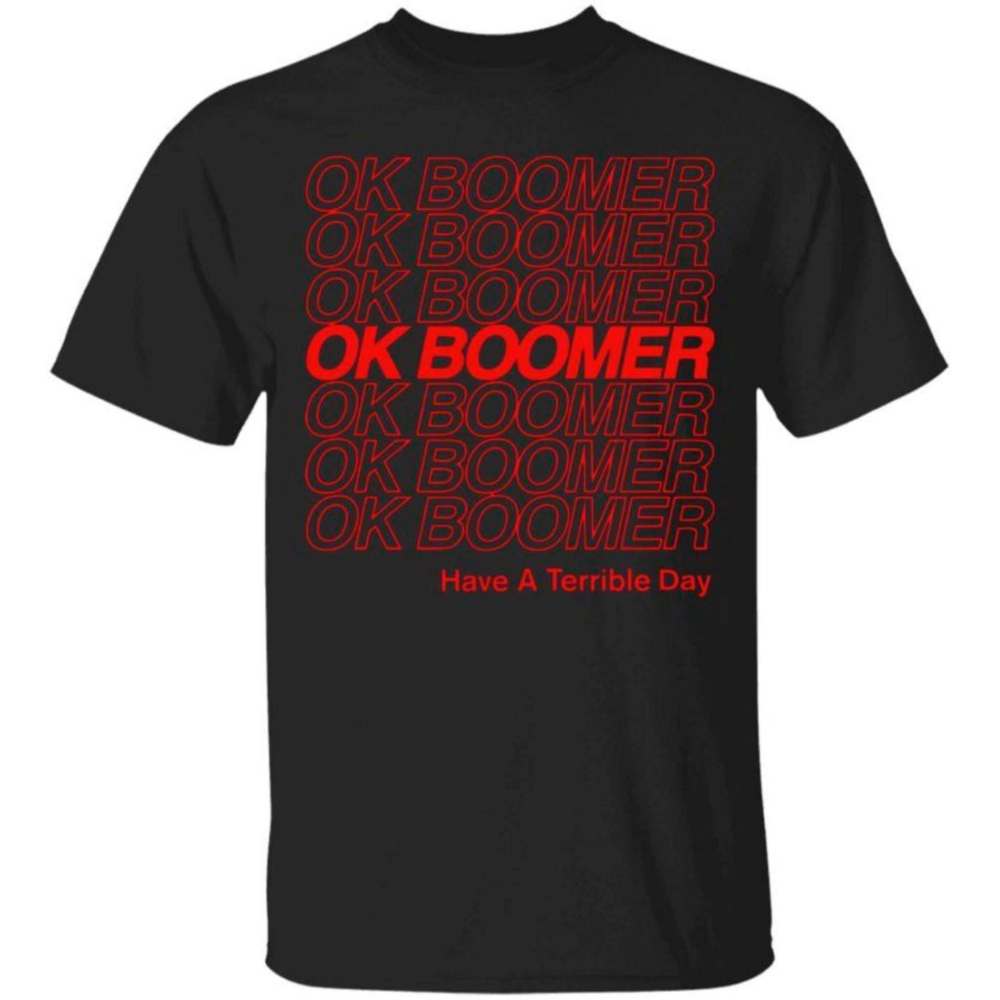
The phrase has become a rallying cry of Generation Z (roughly, people born in the mid-to-late 1990s and later), spawning memes and merch. And it’s not hard to understand the resonance. “OK, Boomer” is genius in its simplicity. It’s cuttingly dismissive, and plays directly on fears of irrelevance.

Predictably, the trend has made some boomers bristle. An American radio host even referred to it as the “n-word of ageism.” Allow me to quote comedian John Mulaney: “If you’re comparing the badness of two words, and you won’t even say one of them? That’s the worse word.”

The ‘OK, Boomer’ phrase has spawned popular merchandise.

Of course, #notallboomers are resistant to change, progress and empathy for young people — though the thin-skinnedness of people who sure like to throw around the term “snowflake” is rather striking. It’s almost as if being dismissed with a condescending head pat feels bad!

This trend is also not about “disrespecting your elders.” The invisibility and neglect of older people is a real societal problem, but it’s not this problem.

“OK, Boomer,” to me, is more about dismissing outdated, harmful opinions — usually spouted by the very rich and very conservative — than it is about dismissing an entire segment of the population because of its birth year. Opinions like, “climate change is a scam” or “kids today” are entitled and spoiled because they want, I don’t know, universal mental-health coverage.

A lot of generational ire is directed at my generation, the millennials, which still seems to be used as shorthand for “young person,” even though the oldest cohort is closing in on 40. Many op-eds have actually credited millennials with “OK, Boomer.”

I can say as an elder millennial that we couldn’t have been the generation behind “OK, Boomer.” We can admire the pluck of it and try to co-opt it for ourselves, but it is a distinctly Generation Z invention. We millennials spent too much time trying to defend ourselves, offering proof to people who didn’t care that we weren’t snowflakes and getting stuck on an endless and unproductive ‘which generation had it worse?’ merry-go-round.

We fed the trolls. We wrestled the pigs. We engaged. The avocado toast was a trap and we fell for it.

By dropping “OK, Boomer,” Gen Z is refusing to engage, because there’s too much work to do to have yet another circular Facebook argument. “OK, Boomer” is often framed up as a “generational war,” but there’s no battle here. The world is on fire. The kids literally don’t have time to fight with you about their humanity, because they need to figure out their future, and whether or not that future will include oxygen. What they are saying, when they say “OK, Boomer,” is you can evolve, or you can die. You can join us, or you can be left behind in an inferno of your own making. Ignorance is a choice. So, too, is irrelevance.

The thing is, boomers know this. This is the generation that came of age during a time of anti-war activism and sexual liberation and feminist organizing and rock music.

It’s human to want your struggles acknowledged, your choices validated, your wisdom consulted. Admitting that some of your most closely held beliefs might be wrong and harmful to other people can be hard. Living in a world you no longer recognize can be scary. I get it, I do, because now I have to Google things young people talk about. (“What is TikTok?”) We were all young once. If we’re lucky, we’ll grow old. We’re all products of our own time.

Whether we chose to stay there, ensconced and immutable like a fly in amber, is up to us.

jen.zoratti@freepress.mb.ca

Twitter: @JenZoratti

Jen Zoratti

Jen Zoratti
Columnist

Jen Zoratti is a Winnipeg Free Press columnist and author of the newsletter, NEXT, a weekly look towards a post-pandemic future.

Our newsroom depends on a growing audience of readers to power our journalism. If you are not a paid reader, please consider becoming a subscriber.

Our newsroom depends on its audience of readers to power our journalism. Thank you for your support.

Report Error Submit a Tip

More Stories

More than 60,000 Manitobans rely on food bank each month, Harvest Manitoba report says

Scott Billeck 4 minute read Preview

More than 60,000 Manitobans rely on food bank each month, Harvest Manitoba report says

Scott Billeck 4 minute read 4:28 PM CDT

Linda Smith first turned to Harvest Manitoba in the early 1990s when her husband became permanently disabled. Now, on a fixed income, she continues to access the food bank to make ends meet.

Smith is one of more than 60,000 Manitobans now relying on food banks each month as demand continues to grow, a new report by Harvest Manitoba reveals.

The organization said in its 2025-26 impact report, released Thursday, that 61,188 people accessed a food bank in the province in March. Nearly half of them were children. The number of people accessing food banks in the province since 2020 has ballooned by more than 150 per cent, including more seniors, like Smith, than ever before.

Smith, a mother of five now in her 70s, first went to Harvest Manitoba in 1991 when he husband was disabled, and then again in the mid 2000s following a major car accident that led to a brain stem injury that forced her out of the workforce.

Read
4:28 PM CDT

Jets focus on power play and penalty kill as shortened pre-season winds down

Mike McIntyre 6 minute read Preview

Jets focus on power play and penalty kill as shortened pre-season winds down

Mike McIntyre 6 minute read 6:13 PM CDT

You can point the finger of blame in a number of directions when it comes to finding fault with last season’s Winnipeg Jets.

A lineup that was too old and too slow. Injuries to key players. Regression from other core members. Inconsistent goaltending. The list goes on.

Well, here’s another culprit that doesn’t get talked about nearly enough: spotty special teams. More specifically, a power play that was anything but potent and a penalty kill that was far too porous.

That has to change — and fast — if this team is going anywhere.

Read
6:13 PM CDT

‘OK Boomer’ rally cry about status, not ageism

Jen Zoratti 4 minute read Preview

‘OK Boomer’ rally cry about status, not ageism

Jen Zoratti 4 minute read Monday, Nov. 18, 2019

Few two-word sentences stop an argument in its tracks quite like “OK, Boomer.”

The phrase has become a rallying cry of Generation Z (roughly, people born in the mid-to-late 1990s and later), spawning memes and merch. And it’s not hard to understand the resonance. "OK, Boomer" is genius in its simplicity. It’s cuttingly dismissive, and plays directly on fears of irrelevance.

Predictably, the trend has made some boomers bristle. An American radio host even referred to it as the “n-word of ageism.” Allow me to quote comedian John Mulaney: “If you’re comparing the badness of two words, and you won’t even say one of them? That’s the worse word.”
Of course, #notallboomers are resistant to change, progress and empathy for young people — though the thin-skinnedness of people who sure like to throw around the term “snowflake” is rather striking. It’s almost as if being dismissed with a condescending head pat feels bad!

Read
Monday, Nov. 18, 2019

Students and rising tuition

Jonathan Szo and Joy Chikezie 4 minute read Yesterday at 2:01 AM CDT

Students in Manitoba are facing additional costs at a time when many are already struggling with the rising cost of living, despite repeated promises from the provincial government to make life more affordable.

In the March 2026 Manitoba Budget, the provincial government permitted post-secondary institutions to increase domestic tuition by up to the legislated maximum of four per cent for the 2026-2027 academic year, despite students already facing rising housing costs, food insecurity, growing debt and an increasingly difficult labour market.

However, all hope was not lost — the decision on how much to raise tuition still rested with the institutions themselves. Much like a speed limit, the four per cent increase was the maximum, not necessarily the target.

Like with speed limits, however, the maximum became the target, as boards of the University of Winnipeg, Brandon University and the University of Manitoba decided to raise tuition by the maximum allowable four per cent. Meanwhile, provincial operating funding to post-secondary institutions increased by only two per cent.

Manitoba budget reveals province underspent on crucial departments related to justice, public safety

Carol Sanders 5 minute read Preview

Manitoba budget reveals province underspent on crucial departments related to justice, public safety

Carol Sanders 5 minute read Yesterday at 2:01 AM CDT

While concerns about homelessness and public safety continue to make headlines in Manitoba, the two government departments mainly responsible for addressing them came in under budget last year.

The 2025-26 public accounts, released Monday, show Housing, Addictions and Homelessness underspent its budget of $869 million by $18 million. Manitoba Justice underspent its budget of $994 million by $34 million.

The 247-page public accounts report attributes the underspending in justice mainly to “reduced impacts of contingency liabilities,” such as a court ruling or legal settlement.

The report did not explain how and why Housing, Addictions and Homelessness underspent its budget last year as the province addresses those critical issues.

Read
Yesterday at 2:01 AM CDT

Changing Transit Plus drivers’ status a ‘ridiculous anti-worker provision,’ councillor says

Joyanne Pursaga 5 minute read Preview

Changing Transit Plus drivers’ status a ‘ridiculous anti-worker provision,’ councillor says

Joyanne Pursaga 5 minute read Tuesday, Sep. 22, 2026

Some fear a change of status for Winnipeg Transit Plus drivers could allow them to be paid less and receive fewer benefits.

However, council’s public works chairwoman said pay protections are now embedded in contracts and the change is needed to attract enough workers.

Three years ago, city council passed a motion that required Winnipeg Transit Plus drivers to be employees of companies the city hires to provide accessible transit service.

Coun. Brian Mayes said that clause prevents “sub-minimum wages” from being permitted for subcontracted drivers and ensures drivers can access multiple benefits.

Read
Tuesday, Sep. 22, 2026